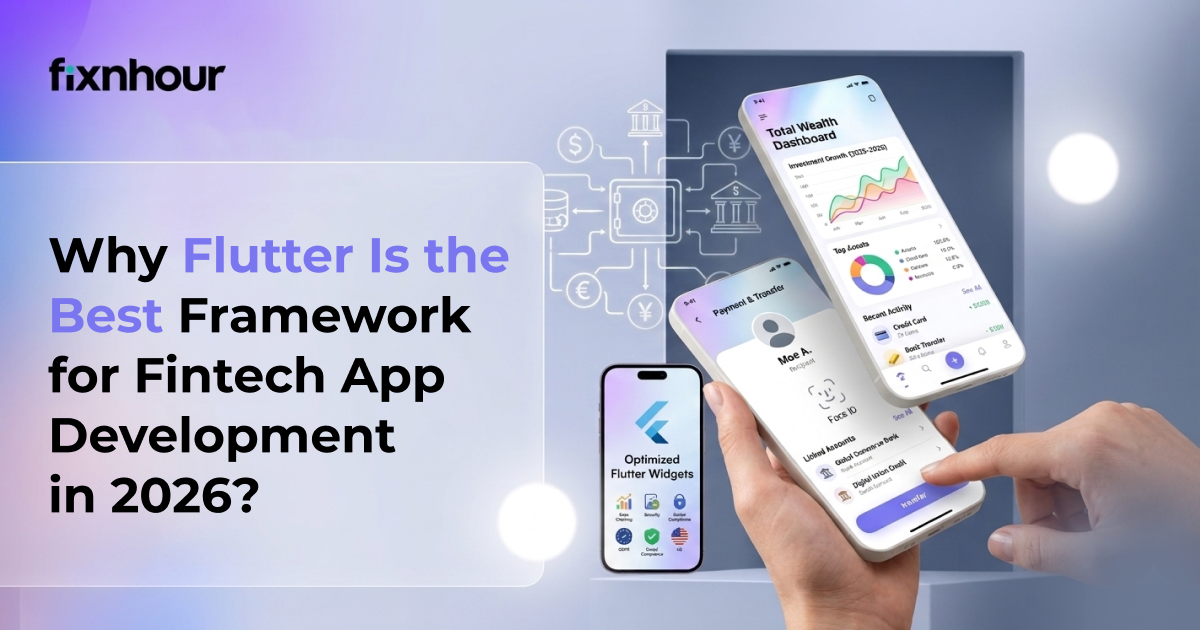
The fintech industry is evolving faster than ever in 2026, with businesses racing to deliver secure, scalable, and user-friendly digital solutions. From mobile banking to digital wallets, users expect seamless performance and strong security in every transaction. This growing demand has pushed companies to choose technologies that not only reduce development time but also ensure high performance. That’s where Flutter fintech app development is making a powerful impact, offering a modern solution for building feature-rich financial applications.
Flutter, backed by Google, has become a go-to framework for startups and enterprises aiming to build high-performing cross-platform apps. With a single codebase, faster development cycles, and stunning UI capabilities, Flutter helps fintech companies launch apps quickly without compromising quality. As the competition in fintech app development 2026 intensifies, choosing the right framework can define success—and Flutter is clearly leading the way.
Key Takeaways
-
Flutter enables cross-platform fintech app development with a single codebase
-
Faster development helps fintech startups launch apps quickly
-
Strong UI/UX improves user trust and engagement
-
Built-in features support secure fintech app development
-
Cost-effective compared to native app development
-
Easy integration with APIs, payment gateways, and banking systems
-
Ideal for scalable and future-ready fintech applications
Why Flutter Is Dominating Fintech App Development
Flutter is dominating Android App Development thanks to its speed, flexibility, and cross-platform capabilities. Businesses can build high-performance apps for both iOS and Android using a single codebase, reducing costs and time-to-market. With rich UI components and strong security features, Flutter ensures seamless user experiences. For companies focusing on fintech innovation, Flutter has become a top choice in modern app development strategies.
1. Single Codebase, Multiple Platforms
One of the biggest advantages of Flutter is its ability to create apps for Android, iOS, and the web using a single codebase. For fintech companies, this means reduced development costs and faster deployment. Instead of managing multiple teams, businesses can streamline their process and focus on innovation.
-
Build once and deploy across iOS, Android, and web, reducing development time and cost
-
Maintain a single codebase, making updates, bug fixes, and feature rollouts faster and easier
-
Ensure consistent UI/UX across platforms, improving user experience and brand consistency
2. High-Level Security for Financial Apps
Security is a top priority in fintech. Flutter supports secure APIs, encryption protocols, and robust authentication systems. This makes it easier to build apps that protect sensitive financial data, ensuring user trust and regulatory compliance.
-
Advanced data encryption and secure APIs help protect sensitive financial transactions
-
Built-in authentication features like biometrics and multi-factor authentication enhance user safety
-
Regular security updates and compliance support reduce risks and ensure data protection standards
3. Stunning UI/UX for Better Engagement
User experience plays a huge role in fintech success. Flutter offers customizable widgets and smooth animations that help create visually appealing dashboards and transaction flows. A well-designed app increases user retention and builds credibility.
-
Smooth, responsive interfaces deliver a seamless and enjoyable user experience
-
Customizable widgets and modern design tools help create visually appealing fintech apps
-
Consistent and intuitive navigation improves user engagement and retention
4. Faster Development with Hot Reload
Flutter’s hot reload feature allows developers to see changes instantly without restarting the app. This speeds up development, testing, and debugging, making it perfect for fintech startups looking to launch MVPs quickly.
-
Instantly view code changes in real time without restarting the app
-
Speeds up development, testing, and debugging for quicker delivery
-
Helps developers experiment with UI and features more efficiently
Flutter vs Other Frameworks in Fintech
Flutter stands out in fintech app development due to its fast performance, single codebase, and highly customizable UI. Compared to other frameworks like React Native, Flutter offers better consistency across platforms and smoother user experiences. Its strong security features make it ideal for financial apps, while faster development and lower costs give businesses a competitive edge in building scalable fintech solutions.
| Feature | Flutter | React Native / Others |
|---|---|---|
| Performance | Near-native, fast rendering | Moderate, depends on bridge |
| Development Speed | Faster with hot reload | Good but slightly slower |
| UI Consistency | Highly customizable, uniform | Varies across platforms |
| Security | Strong, suitable for fintech | Depends on third-party plugins |
| Cost Efficiency | Single codebase reduces cost | May need platform-specific fixes |
Flutter vs React Native
Flutter provides better performance due to its native compilation and consistent UI across devices. This makes it more reliable for complex fintech applications.
-
Performance & Speed: Flutter offers near-native performance with its own rendering engine, while React Native relies on a bridge, which can sometimes slow down complex apps.
-
UI & Design Flexibility: Flutter provides highly customizable widgets for consistent UI across platforms, whereas React Native uses native components, making design dependent on platform behavior.
-
Development Experience: Flutter supports faster development with hot reload and a single codebase in Dart, while React Native uses JavaScript, making it easier for web developers to adapt quickly.
Flutter vs Native Development
While native apps offer strong performance, they are expensive and time-consuming. Flutter delivers near-native performance at a lower cost, making it a smarter choice for most fintech businesses.
-
Performance: Native development (Swift for iOS, Kotlin for Android) delivers the highest performance, while Flutter offers near-native speed with smooth UI rendering.
-
Development Time & Cost: Flutter uses a single codebase for both platforms, reducing time and cost, whereas native development requires separate apps for iOS and Android.
-
Maintenance & Updates: Flutter makes updates easier with one codebase, while native apps need separate maintenance, increasing effort and long-term costs.
Benefits of Flutter for Fintech Startups
Flutter offers fintech startups a powerful way to build fast, secure, and scalable apps. With a single codebase, a Mobile App Developer can create apps for both Android and iOS, reducing time and cost. Its rich UI components ensure smooth user experiences, while strong community support speeds up development. Flutter also enables easy integration of APIs, making it ideal for modern fintech solutions and rapid innovation.
| Benefit | Description | Impact on Fintech Startups |
|---|---|---|
| Single Codebase | Build one app for both iOS and Android using a unified codebase | Reduces development time and cost |
| Faster Development | Hot reload feature allows quick updates and testing | Speeds up time-to-market |
| High Security | Supports secure coding practices and integrates with strong backend systems | Ensures safe financial transactions |
| Stunning UI/UX | Rich widgets create smooth and engaging interfaces | Improves user retention and trust |
| Cost-Effective | Lower development and maintenance costs compared to native apps | Ideal for startups with limited budgets |
| Scalability | Easily scales as user base and features grow | Supports long-term business growth |
| Strong Performance | Near-native performance with smooth animations | Enhances user experience in financial apps |
| Cross-Platform Consistency | Same design and performance across devices | Maintains brand consistency |
Challenges of Using Flutter in Fintech
Using Flutter in fintech comes with challenges around Trust & Verification, especially when dealing with sensitive financial data. Ensuring compliance with strict regulations, integrating secure APIs, and meeting banking-grade security standards can be complex. Additionally, building Best Portfolios for IT Vendors becomes essential to showcase credibility and expertise. Performance limitations in highly complex transactions and dependency on third-party libraries may also impact reliability and long-term scalability.
| Challenge | Description | Impact on Fintech Apps |
|---|---|---|
| Security Concerns | Flutter relies on third-party plugins which may not always meet strict financial security standards | Risk of data breaches and compliance issues |
| Limited Native Features | Some advanced native banking features require platform-specific code | Increases development complexity |
| Regulatory Compliance | Fintech apps must follow strict regulations (KYC, GDPR, etc.) | Extra effort needed to ensure compliance |
| Performance Issues | Heavy animations or complex financial data processing may affect performance | Can impact user experience in real-time transactions |
| Plugin Dependency | Over-reliance on plugins for payments, biometrics, etc. | Stability and long-term support risks |
| Integration Challenges | Difficulty integrating with legacy banking systems | Slower deployment and higher costs |
| Limited Talent Pool | Fewer experienced Flutter developers in fintech domain | Hiring and development delays |
Future of Flutter in Fintech (2026 & Beyond)
Flutter is set to revolutionize fintech app development with faster deployment, enhanced security, and seamless cross-platform experiences. Its adaptability and robust ecosystem make it ideal for the next generation of financial apps. Key trends include:
- Cross-platform – Develop apps once and run seamlessly on all devices.
- Speed – Faster development cycles reduce time-to-market for fintech solutions.
- Security – Advanced features ensure secure transactions and protect sensitive data.
- Scalability – Easily scale apps to handle growing user bases efficiently.
- Real-time – Support instant data updates for dynamic financial operations smoothly.
- Design – Create stunning, intuitive interfaces to enhance user engagement significantly.
- Ecosystem – Growing Flutter community provides robust tools, plugins, and support.
Conclusion
Flutter has emerged as a powerful framework for fintech app development in 2026. Its ability to deliver secure, scalable, and visually engaging applications makes it the ideal choice for modern financial businesses. Whether you are a startup or an enterprise, investing in Flutter fintech app development can help you stay ahead in a competitive market.
Ready to transform your fintech app with Flutter? Don’t wait, partner with experts who deliver secure, scalable, and stunning solutions. Contact us today to bring your innovative financial app ideas to life and stay ahead in 2026.
Frequently Asked Questions
Q1. What makes Flutter ideal for fintech app development?
Flutter allows developers to build secure, high-performance, and visually appealing apps with a single codebase for Android, iOS, and web. Its hot reload, customizable widgets, and strong community support make Flutter fintech app development faster and more cost-effective.
Q2. Can Flutter apps handle sensitive financial data securely?
Yes. Flutter supports encryption protocols, secure APIs, and authentication systems, making it suitable for secure fintech app development like banking apps, wallets, and investment platforms.
Q3. How does Flutter reduce development costs for fintech startups?
Flutter uses a single codebase for multiple platforms, reducing the need for separate Android and iOS teams. Faster development cycles and lower maintenance costs make it ideal for budget-conscious fintech startups.
Q4. Is Flutter better than React Native for fintech apps?
Flutter offers better performance due to native compilation, consistent UI across devices, and smoother animations. For fintech apps requiring complex dashboards and real-time updates, Flutter is often the preferred choice.
Q5. What fintech apps can be built with Flutter?
Flutter is perfect for mobile banking apps, digital wallets, trading and investment platforms, lending and loan apps, and payment gateways. Its scalability supports fintech app development 2026 trends.
Q6. Are Flutter apps scalable for growing user bases?
Absolutely. Flutter apps are designed to scale efficiently. Integration with cloud services, APIs, and backend systems ensures smooth performance even as your fintech app user base grows.
Q7. How fast can a fintech MVP be developed using Flutter?
With Flutter’s hot reload and cross-platform support, developers can launch an MVP in weeks instead of months, making it ideal for startups looking to test ideas quickly in the market.
Q8. What is the future of Flutter in fintech app development?
Flutter adoption in fintech is rising, with continuous updates from Google and integrations with AI, blockchain, and Web3 technologies. It’s poised to dominate fintech app development 2026 and beyond.