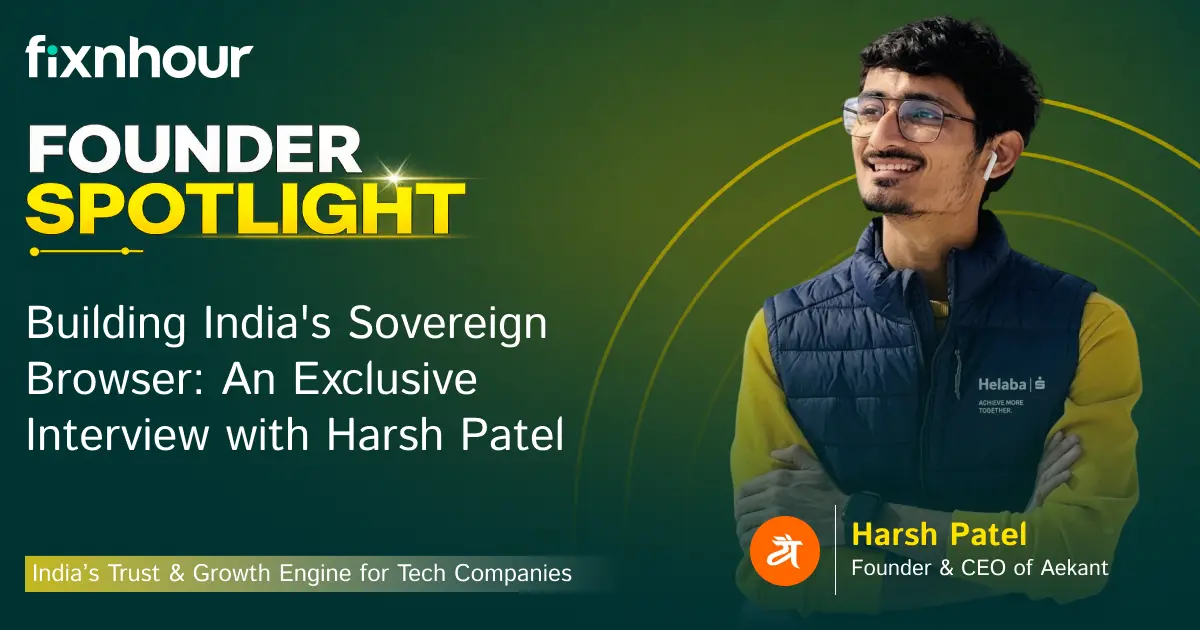
As digital sovereignty and data privacy become increasingly important, India is witnessing a new wave of innovation focused on building secure, homegrown digital solutions. Leading this movement is Harsh Patel, Founder & CEO of Aekant, who is on a mission to develop India's sovereign browser designed to prioritize user privacy, strengthen national digital infrastructure, and reduce dependence on foreign technologies. In this exclusive interview, Harsh Patel shares the inspiration behind Aekant, the challenges of creating a browser from the ground up, the role of indigenous technology in shaping India's digital future, and his vision for empowering millions of users with a safer, more transparent online experience.
Who is Harsh Patel?
Technology is the silent force that influences our digital experiences every time we use a browser to browse the Internet. Browsers are the vehicle that millions of people use to gain access to their work, communication, education, banking and business. However the majority of web browsers have been based on just a few browser engines, and these are owned by a small number of technology firms worldwide.
For Harsh Patel, there's a question to ponder:
How can a country be digitally autonomous if its main access to the Internet is through foreign technology?
That was the genesis of Aekant. Aekant is an ambitious project to create India's first truly sovereign, privacy-first, non-Chromium browser that is built, governed, maintained and owned in India. Harsh brings a wealth of experience in systems programming, browser engineering, full-stack development, low-level infrastructure, Rust, C++, TypeScript, React, Node.js, Electron, networking, DevOps, and browser architecture, which enables him to create technology that values privacy, transparency, and digital sovereignty for the nation. Aekant aims to remove all telemetry, augment user privacy, add native container-based VPN support and create an independent browser ecosystem for India's digital future, while others rely on centralized ecosystems.
In this exclusive Founder Spotlight with Fixnhour, Harsh Patel shares with us his entrepreneurial journey, his vision for digital sovereignty, and why browsers may be one of the most important strategic technologies of the coming decade.
Q1. So, before we talk about Aekant, tell us about yourself, Harsh. What got you started on your way to becoming an entrepreneur?
I'm always been fascinated by systems that work under the hood. Most people interact with applications, but I have always wondered how the applications run, all the layers of infrastructure the operating systems, the networking layers, browser engines, core technologies how they all work.
During my time as a software engineer, I have developed experience in creating scalable applications utilizing modern technologies such as Rust, C++, TypeScript, React and Node.js. Later, I developed an interest in browser engineering since browsers are no longer just software but are critical digital infrastructure. This curiosity morphed into Aekant.
Q2. Why did you start developing India's first sovereign browser?
The inspiration was simple – watching. Today nearly all the major browsers are based on technology that is controlled outside of India. With the growing dependence on digital devices, I believe it is time for countries to invest in digital independence too. The web browser is not a program, per se. It is the main conduit through which citizens connect to information and government services, banking services, education, communication and business. Without such an external dependency, digital sovereignty is challenging. Aekant was established with the goal of offering a neutral alternative that is rooted in the principles of privacy, transparency and national ownership.
Q3. What is Aekant's uniqueness over the existing browsers?
Our philosophy is all different. Ecosystems are the most important priority for most browsers. We prioritize users. Built with privacy-first engineering, minimal telemetry, transparent architecture and independent browser infrastructure, Aekant is designed to be privacy-first. We're working on a browser that strips away the unwanted tracking and empowers users to regain control of their online experience. We're also spending on independent update infrastructure and innovation in the browser level, which we don't want to just be another Chromium based browser. We don't want to compete in looks. It is played on trust.
Q4. So why is digital sovereignty gaining in importance?
Technological development is a part of the national infrastructure. Transportation, energy, health care and telecommunications are important sectors that governments invest heavily because of their strategic importance. The same should apply to digital infrastructure. Browsers, cloud platforms, operating systems, cyber security, and AI will be among the more factors that will shape the national competitiveness in the coming years. Digital sovereignty isn't about isolation. It's about the ability to develop, manage and protect pivotal technologies on their own and work worldwide. Self-reliant technology is essential to a resilient digital future.
Q5. Privacy is a worldwide issue. What do you think will happen with online privacy in the future?
Privacy is never a high price option. A basic requirement. Users have the right to have transparency over the collection, processing and sharing of their data. With the advent of increasingly intelligent technology, safeguarding personal information is crucial. Openness over the collection of too much data is the key to platforms' ability to earn trust in the future, I believe. Innovation and privacy can definitely go hand in hand. All they need is a little bit of careful design.
Q6. The job of a browser engineer is very specialized. What are your favorite aspects of this job?
Browsers are at the crossroads of nearly all of the technology disciplines. Networking. Security. Rendering engines. Memory management. Operating systems. JavaScript execution. Performance optimization. Developing browser infrastructure implies addressing issues that impact millions of interactions on a daily basis. It's incredibly complex technically, and yet it could have a huge impact. That's why browser engineering is exciting.
Q7. How does AI enhance the capabilities of browsers?
How people will interact with browsers will be significantly transformed by AI. The future Web browsers are not just going to display websites. They will be the intelligent assistants who will understand the context, automate workflows, summarize information, enhance accessibility and assist users to complete their tasks more efficiently. But in the realm of responsible use, privacy is paramount when integrating AI. Never sacrifice user trust to gain from innovation. The problem is that it's a balance between intelligence and transparency.
Q8. From your own experience, what is your advice for young engineers who want to work in systems programming?
It's ok to try new technologies that are challenging. While systems programming is intimidating at first glance, it's lower level concepts, such as memory management, networking, operating systems, performance optimization, can be daunting. Those are good ones to have, though, and they make for a much stronger engineer. Stay curious. Read source code. Build projects. Experiment continuously. The top engineers are lifelong learners. Technology rewards curiosity.
Q9. What are some of the lessons about leadership that you have learned on your entrepreneurial journey?
You must have conviction before you are a leader. It's very difficult to build something as ambitious as an independent browser unless it's something you believe in well before others do. I have also discovered that perseverance is very important. Patient is the key word for deep tech products. Things can change slowly. The trick is to stick to the meaningful problem and not the quick-money. Effective teams, ongoing learning, and a long-term approach ensure enduring innovation.
Q10. What role does founder branding play in the current tech world?
Founder brands make things clear. The public is looking for insights into the humans who create the technologies they rely on.There is a greater demand for information on the people who make the technologies that people use. Telling people who you are and why you do what you do and your plans for the future builds trust and draws in customers, collaborators, and great engineers. Without platforms such as Fixnhour, founders would have far fewer ways to promote their vision beyond marketing. You will have to know the vision behind the technology for it to mean more to people.
Q11. What do you see your vision for Aekant in the long-term?
I don't want to just make a browser. I want Aekant to be a symbol of the Indian ability to build world class digital infrastructure by itself. With the constant evolution of Artificial Intelligence, cybersecurity, cloud computing, and digital identity, sovereign technologies will be growing in significance. I hope that Aekant will help shape the future of India where we build applications and also the underpinnings of the internet. If we can get more engineers so inspired to develop indigenous technology, we will have accomplished much more than software.
About Harsh Patel
Harsh Patel is the Founder and CEO of Aekant, India's first private and sovereign browser which will not be based on Google's chromium browser. He is a systems programmer who also has expertise with Rust, C++, TypeScript, React, Node.js, Electron, networking, and browser architecture, and is committed to constructing and building a secure, privacy-focused, and decentralized digital infrastructure to bolster technological autonomy and digital sovereignty in India.
Conclusion
Do not underestimate the need to build basic technology. Some of the greatest innovations in the world can go largely unnoticed. Stay curious. Build difficult things. Challenge assumptions. When you have the opportunity to invent new systems, do not confine yourself to enhancing and optimizing your current ones. The first step to innovation is to ask better questions. The first step in progress is to have the courage to construct the answers.
Contact us today to share your entrepreneurial journey, feature your business story, or explore collaboration opportunities through our exclusive interview series.