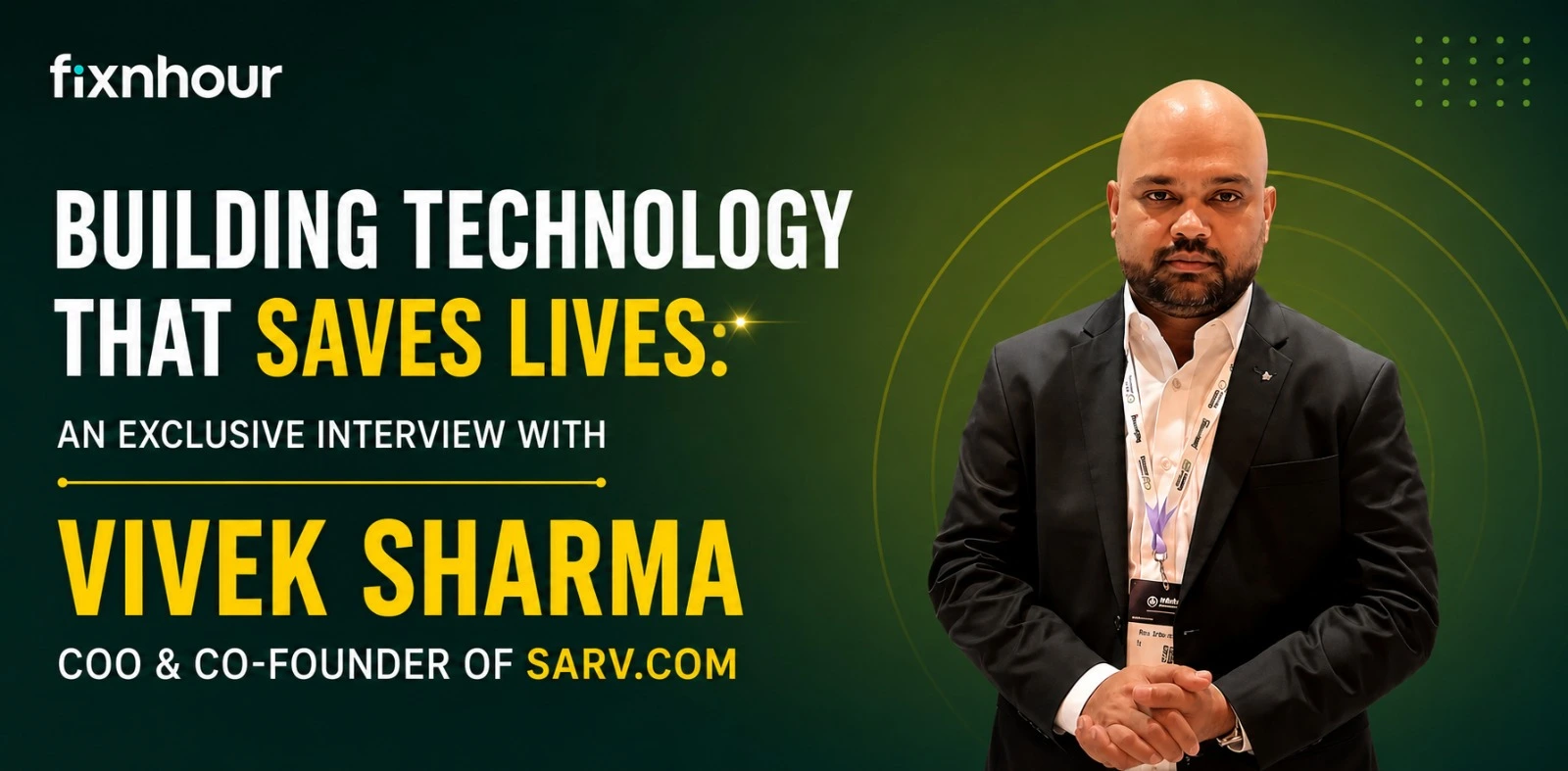
Few innovations in a world where technology is transforming industries have a bigger impact than those that save lives. Vivek Sharma, COO & Co-Founder of Sarv.com, is spearheading this endeavor, a company that is spearheading the revolution in emergency response and healthcare accessibility by leveraging cutting edge technology. Innovation and purpose merge as Sarv.com constructs solutions to enable individuals and organizations to respond more quickly in critical scenarios.
In this exclusive interview, Vivek Sharma talks about the inspiration behind Sarv.com, the challenges of developing technology that can save lives, the importance of AI and digitalization for emergency service providers, and his vision of a safer, smarter future. As a journey of an entrepreneur, a tech leader, and one who loves to create solutions that make a difference, it has something for everyone.
Who is the person Vivek Sharma?
For most tech companies, their business is to make people's lives easier. Others enhance enterprises. Few build techs where every second matters and the reliability of the system means life and death. Vivek Sharma is one such rare type of technology leaders. Vivek is Co-Owner & Co-Founder of Sarv.com, having worked on the development of mission critical communication platforms, emergency response systems and secure digital infrastructure for both governments and entities as well as public safety organisations.
His work extends from guaranteeing secure networking solutions and digital public infrastructure, to creating AI-driven communication systems and supporting services such as Dial 112 for emergency services and Dial 100 for disaster relief, ensuring millions of citizens have timely and reliable access to disaster response.His work is behind the scenes, working on the power for emergency services, such as Dial 112 and Dial 100, or building secure networking solutions, AI-based communication platforms and building digital public infrastructure which allow millions of citizens to get emergency support faster and more reliably.
He also believes in the concept of Make in India and works towards developing indigenous technologies which will help India become self-reliant and enhance its digital skills. In this exclusive conversation with Fixnhour, Vivek Sharma shares his journey, his vision for the future of technology in India, and the increasing significance of trust, reliability and innovation in the modern-day digital infrastructure.
Q1. Vivek, your job is related to mission critical technology. What was it that got you started?
My fascination with technology has always been there, but I wanted to work on things that had a direct effect on the society. Building systems for emergency response, public safety, and critical communication is more than software, it's infrastructure that people rely on during their most challenging times. That's a shift in thinking about technology. It challenges you to come up with solutions that are reliable, secure, scalable, and available 24/7. We know that our work is helping to save lives.
Q2. Sarv.com operates on emergency response systems, such as Dial 112 or Dial 100. Why is it these are so significant?
The emergency response infrastructure is one of the most essential components of public infrastructure. In an emergency situation, people don't have the time to wait for technology to react. Every second matters. Every call matters. Every response matters. These services require a high-reliability technology to process and process large amounts of communication in real-time. It is our duty to keep these platforms safe, secure and functioning in order for emergency services to be able to respond as quickly as possible. When technology works seamlessly in these situations, it has the potential to save lives.
Q3. What are the largest hurdles to overcome when developing mission-critical technology?
Unlike many commercial applications, mission critical platforms can't afford downtime. Security risks are ever changing. The amount of data is still growing. Citizens expect immediate responses. Concurrently, such systems need to be extremely scalable, resilient and user friendly to emergency operators. Innovation and reliability are possibly the biggest challenges. New technologies are great but never compromise stability. When it comes to mission critical, reliability is always the number one priority.
Q4. Artificial Intelligence has been revolutionizing all industries. What do you think are the potential applications of AI in emergency response?
There is vast potential Artificial Intelligence can augment public safety. AI can aid in prioritizing emergency requests, processing massive amounts of data, uncovering patterns, supporting decision-making, and enhancing response times. It can also be used to improve predictive analytics and uncover trends that aid agencies in their resources allocation. But AI must be used to augment a human decision, not replace it. The best technology is when it enables trained individuals to make faster and better decisions. Where I think AI will be most useful is there.
Q5. You strongly believe in Make in India. Why is it necessary to develop indigenous technology?
Technology is a national resource. The build of a secure digital infrastructure is not just an economic boost, it is also a technological one for countries building a digital infrastructure themselves. India has a great talent pool of engineers. We are able to develop world-class communication platforms, AI solutions, cyber security systems and public digital infrastructure completely on national grounds. Fostering indigenous innovation generates jobs, boosts our ecosystem and ensures critical technologies stay on track with national priorities. Make in India is more than manufacturing. It's about the confidence in the innovation of India.
Q6. What are some leadership principles that have guided your career?
Accountability is the first step to leadership. In times of emergency, the technology must allow for emergency response systems, and there's no room for the short cuts. All decisions are responsible. I am a believer in team empowerment, as well. Great ideas come from great people who are willing to think outside the box and share ideas. Innovation is never the result of one person. Strong teams are always the result of common goal.
Q7. Cyber security key has grown in significance. What should be done to prepare the organisation?
Security by itself should never be an afterthought. Security needs to be part and parcel of technology development for organisations. These are secure architecture, ongoing monitoring, frequent testing, employee awareness and proactive threat management. With the rapid pace of digital transformation, cyber resilience is just as vital as business resilience. Data protection is about trust protection.
Q8. If you were to give some tips to new companies developing technology products, what would they be?
Begin by working on real problems. Technology should always be based on the principle of innovation. It should be there because it generates measurable value. Prioritise the development of reliable, scalable and customer-focused products. Practice good investment from the start. Be not too hasty in giving trust. Sustainable business is not a quick fix, but consistency.
Q9. What is the impact of trust in delivering technology to governments and enterprises?
Trust is everything. Businesses that are required to use mission-critical platforms have to be certain that the technology will do what they need it to do. That trust comes from transparency, quality, security and regularity of supply. The technology provider is not just a vendor. They become strategic partners for the long term. This trust is one of our top priorities in building and maintaining that trust.
Q10. What are your thoughts on the importance of trust for the delivery of technology to governments and enterprises?
Trust is everything. When enterprise applications rely on mission-critical platforms, there's a need for assurance of technology performance. That confidence is built on transparency, quality, security and reliability. Technology is not just a product for sale. They turn into long-term strategic partners. One of our greatest priorities is to build and maintain that trust.
Q11. In what ways has Fixnhour helped businesses gain credibility?
Trust is a crucial factor in the technology ecosystem, which platforms can help build. Investors want to know more about the companies and leaders behind the solutions they purchase. Validated company profiles Fixnhour , real customer experiences, and genuine business intelligence bolster the credibility of an organisation, going beyond marketing claims. Building trust involves transparency and openness about the business's journey, knowledge, and dedication to excellence.
Q12. What changes do you hope to see in Sarv.com over the next decade?
Our goal is to become one of the top mission critical digital infrastructure and communication service providers in India. We will remain invested in technologies that enable governments and enterprises, such as Artificial Intelligence, secure communication systems, and public safety technologies, as well as digital public infrastructure. This is why we are committed to helping India's digital transformation journey through creating technologies that are secure, scalable and made in India. It's very simple what we want to do. Develop technology that users can rely on, when it counts.
Final Words to Entrepreneurs and Technology Leaders
Innovation is not the only thing in technology.
It's a matter of responsibility. All the products we produce have an impact on people's lives. Practice solving practical problems. Build with integrity. Focus on quality and not shortcuts. Develop systems that they can rely on. Because not all of the greatest technologies are seen. They are the ones who people will look to when they need them the most.
About Vivek Sharma
Vivek Sharma serves as the COO & Co-Founder of Sarv.com, a leading provider of mission-critical communication systems, emergency response technologies, AI-powered platforms, cybersecurity, and digital public infrastructure solutions. He brings a wealth of experience in secure communications networks and large-scale technology initiatives within Government sectors with a dedication to developing indigenous, scalable and secure technology solutions to support India's vision of Make in India, and to strengthen the public safety ecosystem. Contact us today to feature your founder story, showcase your business journey, and connect with a wider audience through our exclusive Founder Spotlight interviews.