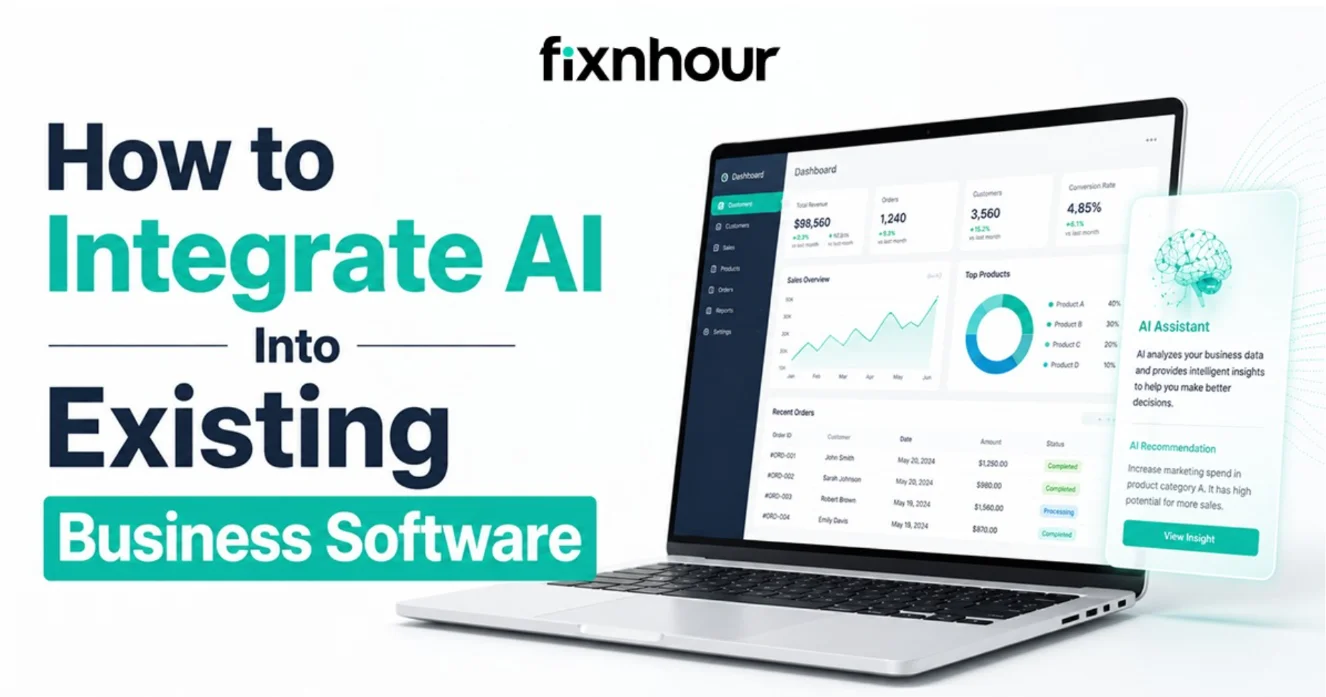
Artificial Intelligence (AI) has emerged as a powerful force in the realm of digital transformation, enabling businesses to optimize their operations, streamline repetitive tasks, and make informed decisions. Rather than opting for a complete overhaul, many companies are turning to AI tools for their already established business software to enhance and augment existing technology investments. AI integration can significantly optimize business processes, improve customer experiences, and offer data-driven insights in any custom enterprise application or accounting, HRM, ERP, or CRM solution. From predictive analytics and intelligent chatbots to workflow automation and personalized recommendations, AI is reshaping modern business operations. This thorough guide explores how to leverage AI within existing business software, the technologies at play, implementation process, cost considerations, challenges, security concerns, and best practices to ensure your organization can create scalable, future-proof AI solutions in 2026.
What Is AI Integration in Existing Business Software?
Fixnhour AI integration refers to the inclusion of AI functionality within current business software systems, but not the complete replacement of the software itself. Integrating AI models, APIs, and automation with existing platforms enables businesses to make more informed decisions, automate repetitive tasks, enhance customer engagement, and gain deeper insights into data, while maximizing the return on their current technology investments.
Understanding AI Integration
- Integrates Artificial Intelligence services into current software solutions.
- Uses APIs to enable intelligent features.
- Saves human effort by automation.
- Improves software performance and business efficiency.
How AI Works with Existing Systems
- Collects and processes business data.
- Draws lessons from past and past history.
- Generates intelligent recommendations.
- Works well with existing processes.
Why Businesses Are Integrating AI Into Existing Software
Every industry now is shifting towards AI-powered systems due to their ability to boost productivity, cut down on operational expenses, and boost customer satisfaction. By leveraging AI in existing systems, businesses can automate processes, make predictions, and provide tailored user experiences without overhauling their software and ensure a better ROI and reduced disruption.
Business Advantages
- Executes repetitive business process.
- Enhances employee productivity.
- Improves customer engagement.
- Accelerates business decision-making.
Competitive Benefits
- Delivers up-to-the-minute business information.
- Reduces operational expenses.
- Allows growth of a business.
- Provides market opportunities to gain or overcome.
Key Benefits of AI Integration
By leveraging existing software with the power of automation, analytics, and machine learning, AI integration can bring tangible benefits to business operations. By adopting AI, organizations can streamline their processes, reduce manual errors, improve forecasting, and provide better customer experiences, all of which contribute to greater efficiency and profitability, ultimately boosting long-term business value.
Operational Benefits
- Automates repetitive workflows.
- Reduces human errors.
- Saves employee time.
- Increases operational efficiency.
Strategic Benefits
- Supports data-driven decisions.
- Improves customer satisfaction.
- Enables predictive analytics.
- Boosts long-term ROI.
Types of AI Technologies Used in Business Software
Today, AI solutions encompass a variety of technologies that address various business problems. The selection of the appropriate AI technology relies on the goals, mobile app development, data at your fingertips, software architecture, and outcomes you aim to achieve. Several AI technologies can be used together to deliver the best and scalable business solutions.
Core AI Technologies
- Machine Learning (ML)
- Natural Language Processing (NLP)
- Computer Vision
- Deep Learning
Advanced AI Solutions
- Generative AI
- Predictive Analytics
- Recommendation Engines
- Intelligent Automation (RPA + AI)
Business Software That Can Be Enhanced With AI
Nearly every business application can benefit from AI integration. From customer relationship management to financial systems, AI improves efficiency, automates routine processes, and provides valuable insights that help businesses make faster and smarter decisions while enhancing user experiences.
Enterprise Applications
- CRM software
- ERP systems
- HR management software
- Accounting software
Industry-Specific Software
- Healthcare management systems
- Retail and eCommerce platforms
- Manufacturing software
- Logistics and supply chain systems
Step-by-Step AI Integration Process
Successfully integrating AI into existing business software requires careful planning, quality data, and a scalable implementation strategy. Businesses should begin by identifying high-value use cases, preparing their infrastructure, and selecting the right AI models. A phased deployment approach minimizes risks, ensures smooth adoption, and allows continuous optimization for long-term performance and return on investment.
Planning Your AI Integration
- Assess your existing software architecture.
- Identify business problems AI can solve.
- Define measurable project goals and KPIs.
- Choose the right AI technology and deployment model.
Implementation & Deployment
- Clean and organize business data.
- Integrate AI using APIs or custom models.
- Test AI functionality in real-world scenarios.
- Monitor performance and optimize continuously.
AI Integration Architecture Explained
A well-designed AI integration architecture ensures that AI components work seamlessly with existing business software. It connects data sources, AI models, cloud services, APIs, and user applications while maintaining security, scalability, and high performance. A robust architecture enables organizations to expand AI capabilities as business requirements evolve.
Core Architecture Components
- Data collection and storage layer.
- AI model and processing layer.
- API and integration layer.
- Business application interface.
Best Architecture Practices
- Use scalable cloud infrastructure.
- Build modular system components.
- Ensure secure API communication.
- Monitor system performance regularly.
Best AI Integration Tools & Frameworks
Selecting the right AI tools and frameworks simplifies development, improves scalability, and accelerates deployment. Modern AI platforms provide pre-trained models, APIs, automation features, and machine learning capabilities that help businesses integrate intelligent functionality into their existing software with minimal complexity.
Popular AI Development Tools
- TensorFlow for machine learning.
- PyTorch for deep learning models.
- LangChain for AI workflows.
- OpenAI APIs for generative AI.
Cloud AI Platforms
- Microsoft Azure AI Services.
- Google Cloud Vertex AI.
- Amazon Web Services (AWS) AI.
- IBM Watson AI Platform.
AI Integration Use Cases Across Industries
AI integration is transforming industries by automating repetitive processes, improving customer experiences, and enabling predictive decision-making. Every sector can leverage AI differently, from personalized healthcare solutions to intelligent financial systems and automated manufacturing operations, creating measurable improvements in productivity and business growth.
Industry Applications
- Healthcare diagnosis and patient support.
- Banking fraud detection.
- Retail product recommendations.
- Manufacturing quality control.
Business Process Automation
- AI-powered customer support chatbots.
- Intelligent document processing.
- Sales and marketing automation.
- Predictive inventory management.
Challenges of AI Integration and Solutions
Although AI offers significant business benefits, successful implementation comes with technical, operational, and organizational challenges. Businesses must address data quality, legacy system compatibility, employee adoption, and security concerns through proper planning, skilled development teams, and continuous monitoring to achieve successful AI integration.
Common AI Integration Challenges
- Poor or inconsistent business data.
- Legacy software compatibility issues.
- High implementation complexity.
- Employee resistance to AI adoption.
Practical Solutions
- Build a strong data governance strategy.
- Modernize outdated software gradually.
- Train employees on AI technologies.
- Monitor and improve AI models regularly.
AI Security, Privacy & Compliance
Protecting business data is one of the most important aspects of AI integration. Organizations must implement strong cybersecurity measures, comply with industry regulations, and ensure responsible AI practices. A secure AI environment builds customer trust, minimizes legal risks, and protects sensitive information while maintaining reliable system performance.
Security Best Practices
- Encrypt sensitive business data.
- Implement role-based access control (RBAC).
- Secure APIs with authentication and authorization.
- Perform regular security audits and penetration testing.
Compliance & Governance
- Follow GDPR, CCPA, or applicable local regulations.
- Maintain transparent AI decision-making.
- Establish AI governance policies.
- Continuously monitor compliance requirements.
AI Integration Cost Breakdown
The cost of integrating AI into existing business software depends on project complexity, AI features, software infrastructure, data preparation, and development resources. Businesses should evaluate both initial implementation expenses and ongoing maintenance costs to calculate long-term return on investment and ensure sustainable AI adoption.
Factors That Influence Cost
- Software complexity and architecture.
- AI model development or customization.
- Third-party API licensing fees.
- Cloud infrastructure and hosting costs.
Ongoing Expenses
- AI model monitoring and optimization.
- Software updates and maintenance.
- Cloud computing and storage charges.
- Employee training and technical support.
AI Integration Timeline
The timeline for AI integration varies based on software complexity, project scope, and customization requirements. Small AI projects can be completed within weeks, while enterprise-level implementations may require several months. A phased deployment approach helps reduce risks and ensures successful adoption.
Project Planning Phase
- Business requirement analysis.
- Data assessment and preparation.
- AI strategy development.
- Technical architecture planning.
Development & Deployment Phase
- AI model integration.
- Software testing and quality assurance.
- User acceptance testing (UAT).
- Production deployment and monitoring.
Best Practices for Successful AI Integration
Following proven implementation strategies increases project success and maximizes ROI. Businesses should prioritize high-impact use cases, use quality data, adopt scalable architectures, and continuously evaluate AI performance to ensure long-term business value and operational efficiency.
Technical Best Practices
- Start with clearly defined business goals.
- Use clean, structured, and accurate data.
- Build scalable and modular AI architecture.
- Continuously monitor AI performance.
Business Best Practices
- Train employees on AI adoption.
- Involve stakeholders throughout the project.
- Measure KPIs and business outcomes.
- Improve AI models using user feedback.
Common Mistakes to Avoid
Many AI projects fail because organizations overlook planning, data quality, and change management. Avoiding common implementation mistakes helps reduce costs, improve system performance, and increase the likelihood of successful AI integration across business operations.
Technical Mistakes
- Using poor-quality training data.
- Selecting the wrong AI model.
- Ignoring cybersecurity measures.
- Failing to test before deployment.
Business Mistakes
- Expecting immediate results.
- Underestimating implementation costs.
- Ignoring employee training.
- Failing to monitor AI performance after launch.
AI Integration Timeline & Cost Comparison
|
|
|
|
|
|
|
|
|
|
|
|
|
|
|
|
|
|
|
|
|
|
|
|
|
Why Choose a Professional AI Development Company
Integrating AI into existing business software requires technical expertise, strategic planning, and continuous optimization. A professional AI app development company helps businesses implement secure, scalable, and customized AI solutions that align with operational goals. From AI strategy and data preparation to deployment and post-launch support, experienced developers ensure smooth integration while minimizing risks, reducing implementation time, and maximizing return on investment.
Benefits of Hiring AI Experts
- Develop customized AI solutions for your business.
- Integrate AI without disrupting existing software.
- Ensure secure and scalable AI architecture.
- Reduce development time and implementation risks.
Services You Can Expect
- AI consulting and digital transformation strategy.
- Custom AI model development and integration.
- API integration and cloud deployment.
- Ongoing maintenance, monitoring, and optimization.
Conclusion
For businesses aiming to optimize workflows, boost efficiency, and gain a competitive edge, the strategic integration of AI within business software is an excellent investment. Businesses can achieve this by improving their existing systems, rather than replacing them completely, with the proper strategy, quality data and scalable architecture. From startups to large corporations, AI integration proves beneficial for streamlining operations, enhancing customer experiences, and facilitating data-driven decision-making. Contact us today By working with an AI development company with experience, you can ensure that the implementation is secure, efficient, and future-proof, leading to sustainable digital transformation and business growth in 2026 and beyond.
Frequently Asked Questions
Q1. What does AI integration into existing business software mean?
Ans. Integration of AI with business software: Introduction of AI features into existing software without starting from scratch. AI can be employed to streamline repetitive tasks, process vast amounts of data, enhance customer support, make predictions, and optimise business operations. This method adds to the capabilities of the software, safeguards existing investments in technology and overcomes the expense of implementing a new system.
Q2. What are the main benefits of integrating AI into business software?
Ans. AI integration offers numerous advantages, including improved productivity, automated business processes, better decision-making, enhanced customer experiences, predictive analytics, and lower operational costs. It also aids companies in minimizing handbook mistakes, enhancing data precision, and scaling operations efficiently. AI empowers organizations to be more competitive, and to get the most from their current software investments and business data.
Q3. Which business applications can be integrated with AI?
Ans. AI can be applied across various business processes such as customer management (CRM), enterprise resource planning (ERP), human resource management (HRM), accounting, inventory and supply chain management, health and wellness, customer support, eCommerce, and more. Custom enterprise software can also be enhanced with AI features such as chatbots, recommendation engines, predictive analytics, intelligent search, and workflow automation.
Q4. How long does AI integration usually take?
Ans. The timeline for AI integration will vary based on the complexity of the project, software architecture, availability of data, and the specific AI features desired. The time required for the small projects is from two to six weeks, and for the medium-sized projects, it takes one month to three months. A successful project with a custom-made machine learning model, numerous integrations and extensive testing may take six months or more.
Q5. How much does AI integration cost?
Ans. The price of integrating AI into business is subject to the needs of the business, the scope of the project, AI technologies, cloud infrastructure, and development complexity. The price of the project for small businesses could be anywhere from $5,000 to $20,000, and for medium-sized projects, it can vary from $20,000 to $150,000. Implementations that require a custom AI model, sophisticated analytics, and continuous support in large enterprises can cost over $150,000 depending on individual business requirements.
Q6. Is AI integration secure for sensitive business data?
Ans. Yes, AI integration can be very secure when done correctly, with industry best practices. Data encryption, secure APIs, role-based access control, multi-factor authentication and continuous security monitoring should be used by businesses. Ensuring adherence to regulatory protocols like GDPR and other relevant data privacy regulations further strengthens the protection of sensitive data and promotes responsible AI deployment and utilization throughout the business operations and customer interactions.
Q7. What challenges do businesses face during AI integration?
Ans. Common challenges faced in integrating AI into everyday business involve low data quality, legacy system compatibility, lack of technical skills, employee resistance, cybersecurity risks, and implementation costs. Issues can be mitigated with careful planning, data preparation, incremental deployment, training of staff, and working with an AI development firm that is knowledgeable about the business process and the latest in AI technology.
Q8. Why should businesses hire an AI development company?
Ans. An AI development company has the know-how to develop, integrate, and optimize the AI solutions required for businesses. Professional developers guarantee safety of implementation, scalable structure, integration with existing software and ongoing technical assistance. Their experience decreases development danger, speeds up deployment, enhances ROI, and guarantees ongoing achievement in AI-enabled digital transformation projects.