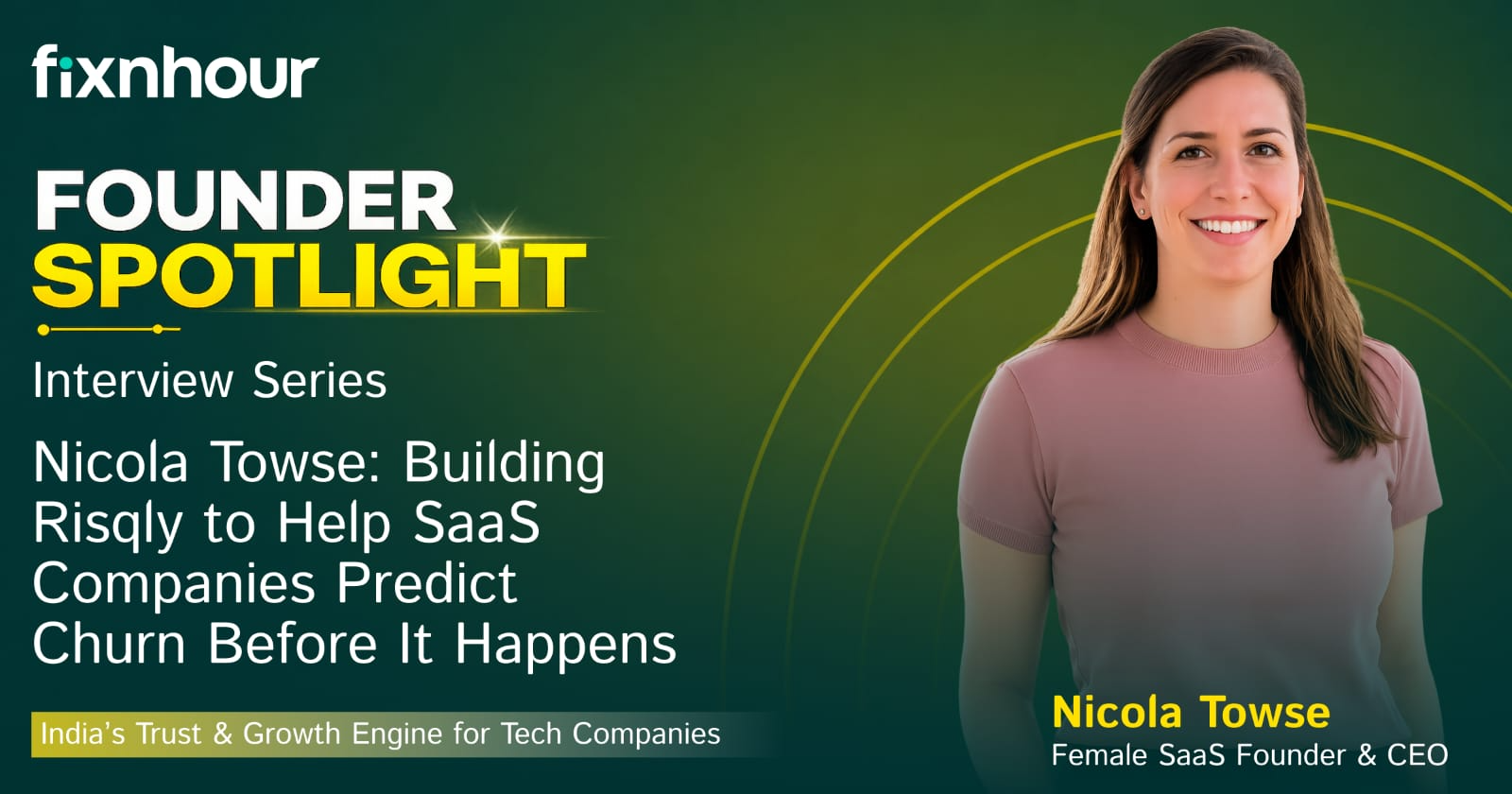
Customer retention has become one of the biggest challenges for SaaS businesses, where even a small increase in churn can significantly impact recurring revenue and long-term growth. In this Founder Spotlight Interview Series, we feature Nicola Towse, the founder of Risqly, a platform designed to help SaaS companies identify customer risk early and predict churn before it happens. By combining data-driven insights with proactive customer success strategies, Risqly enables businesses to take action before valuable customers decide to leave.
In this interview, Nicola Towse shares the inspiration behind building Risqly, the challenges of developing an AI-powered SaaS solution, and the lessons learned throughout the entrepreneurial journey. We also explore how predictive analytics is transforming customer retention, why early risk detection is essential for sustainable SaaS growth, and what the future holds for AI-driven customer success platforms.
Who is Nicola Towse?
In the SaaS world, acquiring customers often receives the majority of attention. Companies invest heavily in marketing, sales, and customer acquisition, yet one of the biggest threats to growth frequently goes unnoticed—customer churn.
For years, Nicola Towse watched organizations lose revenue not because they lacked great products or talented teams, but because they couldn't identify customer risk early enough.
That experience inspired her to build something different.
Nicola Towse is the Founder and CEO of Risqly, a SaaS platform designed to help customer success, renewals, and revenue teams identify at-risk accounts before they churn. Her mission is simple but powerful: help companies stop losing customers they could have retained.
Before launching Risqly, Nicola spent years developing strategy inside large organizations, where she repeatedly observed how revenue quietly slipped away through avoidable customer attrition. Despite the availability of data, many customer success teams lacked the visibility and actionable insights needed to intervene before it was too late.
Rather than accepting the problem, she decided to solve it.
Today, Risqly is helping B2B SaaS businesses improve renewals, strengthen retention, and create more predictable revenue outcomes.
Beyond SaaS, Nicola is also training as an End-of-Life Doula, a journey that reflects her belief that the most important conversations, whether about business risks or life transitions, should happen early, honestly, and intentionally.
In this exclusive Founder Spotlight Interview, Nicola shares her entrepreneurial journey, lessons from building a SaaS startup, thoughts on customer retention, and her vision for the future of revenue intelligence.
Q1. Tell us about your professional journey and what inspired you to start Risqly?
My journey began in corporate strategy roles where I spent years helping organizations make better business decisions.
One thing became increasingly obvious. Companies were investing significant resources into customer acquisition, yet many were losing existing customers without fully understanding why.
Revenue was quietly disappearing through churn, often without warning.
Customer success teams had data, but not necessarily visibility. They could see what had already happened, but they struggled to identify risk early enough to take action.
I became fascinated by that problem.
Eventually, I realized there was an opportunity to build something that could help businesses proactively identify customer risk before it impacted renewals.
That idea became Risqly.
Q2. What problem is Risqly solving for B2B SaaS companies?
Most SaaS companies focus heavily on acquiring customers.
The challenge is that growth doesn't only depend on acquisition. It also depends on retention.
Many businesses don't discover renewal risks until the customer is already preparing to leave.
By then, it's often too late.
Risqly helps customer success, revenue, and renewal teams identify warning signals earlier.
Instead of reacting to churn, organizations can proactively engage customers, address concerns, and improve retention outcomes.
Ultimately, we help businesses protect revenue that might otherwise be lost.
Q3. Why do so many SaaS businesses struggle with customer retention?
Many organizations underestimate the complexity of retention.
Customer churn rarely happens suddenly.
There are usually warning signs.
Engagement drops.
Product usage changes.
Communication patterns shift.
Business priorities evolve.
The challenge is that these signals are often scattered across different systems and teams.
Without visibility, organizations miss opportunities to intervene.
Retention is not simply a customer success responsibility. It should be a company-wide priority.
Q4. What inspired the name Risqly?
The name reflects exactly what we help companies manage risk.
Every business faces uncertainty around renewals and customer retention.
Our goal is to make those risks visible before they become revenue problems.
The idea was to create a platform that helps organizations move from reactive decision-making to proactive action.
The name Risqly represents that mission.
Q5. What has been the most challenging part of building a SaaS startup?
Building a startup requires constant learning.
One of the biggest challenges is balancing product development, customer feedback, fundraising, marketing, and execution simultaneously.
As founders, we wear many hats.
Another challenge is maintaining conviction while remaining flexible.
You need enough confidence to pursue your vision but enough humility to adapt based on customer needs and market realities.
That balance is critical.
Q6. What lessons from your corporate experience have helped you as a founder?
Corporate environments taught me how organizations make decisions, manage risk, and prioritize resources.
I learned the importance of strategy, stakeholder management, and execution.
Perhaps most importantly, I learned how expensive inefficiencies can become at scale.
Those experiences helped shape my understanding of the retention problem and influenced how we designed Risqly.
Founding a startup is very different from working in a large organization, but many foundational business principles remain the same.
Q7. What are some early indicators that a customer may be at risk of churn?
There is no single indicator.
Usually, it's a combination of signals.
These might include:
* Reduced product engagement
* Lower platform usage
* Delayed responses
* Missed meetings
* Support frustrations
* Changes within the customer's organization
The challenge is connecting those signals into a clear picture.
Organizations that can identify patterns early gain a significant advantage in retention efforts.
Q8. How do you see AI changing customer success and retention management?
AI has enormous potential.
Customer success teams often manage large volumes of customer data.
AI can help identify patterns that humans might miss.
It can highlight risks, predict outcomes, prioritize actions, and improve decision-making.
However, I don't believe AI replaces relationships.
Customer retention remains fundamentally human.
AI helps teams focus their attention more effectively, but trust, communication, and customer understanding will always remain essential.
Q9. What advice would you give founders building SaaS businesses today?
Talk to customers constantly.
Many founders become focused on building products without spending enough time understanding customer problems.
The best products solve real pain points.
Customer conversations provide clarity.
They challenge assumptions.
They reveal opportunities.
If you're building a SaaS business, customer insight should be one of your greatest competitive advantages.
Q10. How important is customer success in today's SaaS economy?
Customer success has never been more important.
Acquiring customers is expensive.
Retaining them is often significantly more profitable.
As markets become more competitive, organizations need to focus not only on growth but also on sustainability.
Strong customer success strategies create stronger relationships, better retention, higher lifetime value, and more predictable revenue.
Retention is growth.
Q11. Fixnhour is building a trusted ecosystem of technology companies worldwide. How can platforms like Fixnhour help founders make better technology decisions?
Choosing the right technology partner can significantly impact a company's success.
Founders often face an overwhelming number of options when selecting agencies, development partners, consultants, or technology providers.
Platforms like Fixnhour create transparency.
By showcasing company expertise, founder stories, verified profiles, client experiences, and service capabilities, founders can make more informed decisions.
Trust is one of the most valuable currencies in business.
Platforms that help establish credibility and reduce decision-making risk create enormous value for founders.
Q12. What should founders look for when choosing a technology partner?
The cheapest option is rarely the best option.
Founders should evaluate partners based on:
* Technical capability
* Communication quality
* Industry expertise
* Strategic thinking
* Long-term support
* Cultural fit
Technology projects are partnerships.
The right partner contributes beyond development and becomes invested in business outcomes.
That relationship can have a significant impact on long-term success.
Q13. You are also training as an End-of-Life Doula. How has that experience influenced your leadership perspective?
At first glance, SaaS and end-of-life care seem completely unrelated.
However, both involve difficult conversations.
One of the lessons I've learned is that avoiding important conversations rarely improves outcomes.
Whether discussing customer risk, organizational challenges, or life transitions, early conversations create better opportunities for understanding and action.
That perspective influences how I lead, communicate, and make decisions.
It has reinforced the importance of empathy, honesty, and proactive engagement.
Q14. What trends do you believe will shape the future of SaaS?
Several trends are already transforming the industry.
AI will continue changing how products are built and how businesses operate.
Customer expectations will increase.
Retention and customer experience will become even more important.
Organizations will place greater emphasis on revenue predictability and customer intelligence.
The companies that thrive will be those that combine innovation with strong customer relationships.
Q15. What is your vision for Risqly over the next five years?
Our vision is to become the operating system for SaaS renewals and retention.
We want to help organizations move beyond reactive customer management and toward proactive revenue protection.
The goal is simple:
Help businesses identify risk earlier, make better decisions, and retain more customers.
If we can help companies protect revenue while improving customer outcomes, we'll create significant value for both businesses and their customers.
Leadership Lessons from Nicola Towse
Retention Is Growth
The customers you keep are often more valuable than the customers you acquire.
Difficult Conversations Should Happen Early
Avoiding challenges rarely improves outcomes.
Build Products Around Real Problems
The strongest businesses solve meaningful customer pain points.
Visibility Creates Better Decisions
You cannot solve problems you cannot see.
Customer Success Is Everyone's Responsibility
Retention should involve the entire organization.
Trust Is a Competitive Advantage
Strong relationships drive long-term business success.
Final Thoughts
Nicola Towse is building more than a software platform.
She is helping SaaS businesses rethink how they approach customer retention, revenue protection, and long-term growth.
Through Risqly, she is addressing one of the most overlooked challenges in SaaS: identifying risk before it becomes churn.
Her journey demonstrates the power of turning professional frustration into innovation and transforming business problems into scalable solutions.
As the SaaS industry continues evolving, founders like Nicola remind us that sustainable growth isn't only about acquiring customers.
It's about understanding them, supporting them, and retaining them.
Because sometimes the most important opportunities are not the customers you're about to win but the customers you're about to lose. Get started Today.