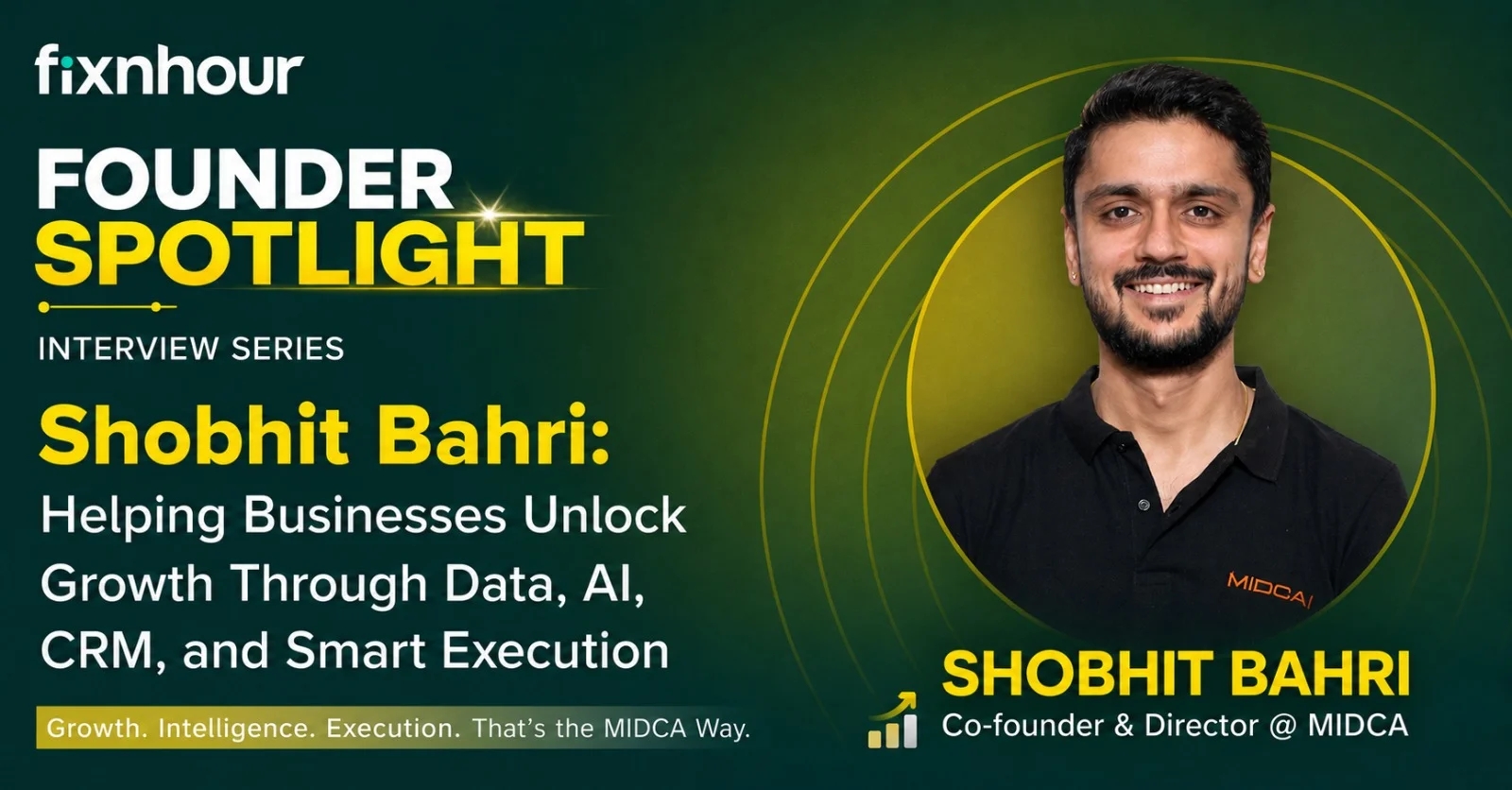
Founder Spotlight Interview Series featuring Shobhit Bahri explores how modern businesses can unlock sustainable growth through the intelligent use of data, artificial intelligence, CRM systems, and smart execution strategies. In today’s competitive digital economy, organizations need more than traditional methods to scale effectively and make informed decisions that drive long-term success.
Shobhit Bahri’s insights highlight the importance of combining technology with practical execution to achieve measurable business outcomes. His approach focuses on leveraging data-driven strategies, AI-powered tools, and CRM integration to improve efficiency, customer experience, and revenue growth. This interview provides valuable perspectives for founders and leaders aiming to build scalable and future-ready organizations in the modern business landscape today.
Who is Shobhit Bahri?
In today's business environment, technology alone is no longer enough. Organizations have access to more data, tools, and platforms than ever before, yet many still struggle to convert those resources into meaningful business outcomes.
The challenge isn't technology.
The challenge is execution.
This is where professionals like Shobhit Bahri create extraordinary value.
Shobhit Bahri is the Co-Founder and Director of Strategy & Consulting at MIDCAI, a company focused on helping organizations leverage Data, Artificial Intelligence, CRM, and MarTech solutions to improve business performance and customer engagement.
With more than a decade of consulting experience, Shobhit has worked with organizations across multiple industries, helping them simplify complexity, modernize operations, and implement scalable technology solutions that generate measurable business impact.
His experience spans the entire consulting lifecycle from pre-sales and discovery workshops to solution architecture, delivery management, user acceptance testing, and business transformation.
Having worked closely with clients across the United States, the Middle East, and other global markets, he has gained deep insights into the challenges organizations face when adopting new technologies and scaling operations.
Today, through MIDCAI, Shobhit is combining his expertise in strategy, consulting, technology, and business transformation to help companies unlock the full potential of data-driven decision-making and AI-powered customer engagement.
His belief is simple:
Technology should not just automate processes; it should create measurable business outcomes.
In this exclusive Founder Spotlight Interview, Shobhit shares insights on consulting, entrepreneurship, AI, CRM transformation, business growth, and the future of intelligent customer experiences.
Q1. Tell us about your professional journey and what inspired you to co-found MIDCAI?
My journey has always revolved around solving business problems through technology.
Over the last decade, I have worked with organizations across different industries, helping them modernize systems, improve processes, and implement technology solutions that create measurable outcomes.
Throughout those experiences, I noticed a common challenge.
Many businesses invested heavily in technology but struggled to fully realize its value.
There was often a gap between implementation and actual business impact.
That realization inspired the creation of MIDCAI.
We wanted to build a company focused not only on technology implementation but also on ensuring that businesses achieve meaningful outcomes through Data, AI, CRM, and MarTech solutions.
Q2. What problem is MIDCAI solving for modern businesses?
Organizations today are overwhelmed with data, tools, and platforms.
Many businesses have CRM systems, marketing automation tools, analytics platforms, and customer engagement technologies.
The challenge is that these systems often operate in silos.
MIDCAI helps organizations connect data, technology, and business objectives.
Our goal is to help companies make better decisions, improve customer experiences, increase operational efficiency, and drive growth.
Technology should support strategy, not complicate it.
Q3. You have worked across multiple industries. What common business challenges do you see repeatedly?
Regardless of industry, many challenges remain surprisingly similar.
Organizations often struggle with:
* Disconnected systems
* Data silos
* Poor customer visibility
* Inefficient processes
* Lack of actionable insights
Many businesses collect large amounts of data but fail to transform it into meaningful decisions.
The organizations that succeed are those that create alignment between technology, people, and business goals.
Q4. How has consulting evolved over the last decade?
Consulting has changed significantly.
Earlier, many consulting engagements focused on recommendations and strategy documents.
Today, businesses expect measurable outcomes.
Clients want partners who can help them execute, implement, and deliver results.
The role of consultants has evolved from advisors to transformation partners.
Success is no longer measured by recommendations alone but by business impact.
Q5. Artificial Intelligence is transforming every industry. How do you see AI changing business operations?
AI is fundamentally changing how businesses operate.
Organizations can now automate repetitive processes, improve customer interactions, generate insights faster, and make more informed decisions.
However, I believe the biggest impact of AI will come from augmentation rather than replacement.
AI enables people to focus on higher-value work while reducing operational friction.
The companies that successfully combine human expertise with AI capabilities will gain significant competitive advantages.
Q6. What role does CRM play in business growth today?
CRM is no longer just a customer database.
It has become a strategic business platform.
A well-implemented CRM provides visibility into customer behavior, sales performance, marketing effectiveness, and service quality.
When integrated properly, CRM becomes the foundation for stronger customer relationships and better business decisions.
Organizations that leverage CRM strategically often achieve better retention, higher revenue, and improved customer satisfaction.
Q7. Why do many CRM implementations fail?
Technology is rarely the problem.
The real challenge is adoption.
Many organizations implement CRM systems without clearly defining business processes, user expectations, or success metrics.
If employees do not understand the value of the system, adoption suffers.
Successful CRM projects require alignment between technology, people, and business objectives.
A CRM implementation should always begin with business outcomes, not software features.
Q8. What is the biggest mistake businesses make when adopting AI and automation?
Many companies start with technology instead of business problems.
They invest in tools before identifying specific use cases.
AI should solve real challenges.
Organizations should begin by asking:
* What process needs improvement?
* Where are inefficiencies occurring?
* What decisions require better insights?
Once those questions are answered, technology becomes far more effective.
The goal should never be AI for the sake of AI.
The goal should be business improvement.
Q9. What lessons have you learned from working with global clients in the US and the Middle East?
One important lesson is that every market has unique characteristics.
Customer expectations, business cultures, and operational priorities can vary significantly.
However, one thing remains consistent.
Businesses everywhere want solutions that create measurable value.
Successful consulting requires listening carefully, understanding context, and adapting approaches to specific business environments.
Global exposure teaches flexibility and broadens problem-solving perspectives.
Q10. As a founder, how do you balance strategy, consulting, sales, branding, and company growth?
Entrepreneurship requires versatility.
As founders, we wear multiple hats.
Some days you're focused on business development.
Other days you're solving operational challenges, meeting clients, refining marketing strategies, or helping shape product direction.
The key is maintaining clarity around priorities.
Not everything requires equal attention at the same time.
Successful founders learn how to focus on activities that create the greatest impact.
Q11. How important is data-driven decision-making for businesses today?
Data has become one of the most valuable assets organizations possess.
However, data alone is not enough.
Businesses need actionable insights.
The organizations that succeed are those capable of transforming information into decisions.
Data-driven decision-making reduces uncertainty, improves efficiency, and creates growth opportunities.
It enables leaders to move beyond assumptions and make decisions based on evidence.
12. Fixnhour is building a trusted ecosystem of technology companies worldwide. How do you think platforms like Fixnhour help founders find the right technology partners?
One of the biggest challenges founders face is identifying trustworthy technology partners.
There are thousands of agencies, consultants, software companies, and development firms competing for attention.
From the outside, many appear similar.
Platforms like Fixnhour help create transparency.
By providing company profiles, founder stories, expertise details, verified information, and customer insights, founders can make more informed decisions.
I particularly appreciate the focus on showcasing founders behind the businesses because relationships matter.
Understanding the people, values, and vision behind a company often reveals more than a service brochure ever could.
Q13. What advice would you give founders when selecting a CRM, MarTech, or technology consulting partner?
Founders should evaluate partners beyond technical capabilities.
Important considerations include:
* Industry experience
* Business understanding
* Communication quality
* Strategic thinking
* Long-term support
* Cultural alignment
Technology projects are rarely just technical projects.
They are business transformation initiatives.
The best partners understand both technology and business outcomes.
Choose partners who ask thoughtful questions rather than immediately selling solutions.
Q14. What trends do you believe will define the future of CRM and customer engagement?
The future will be increasingly intelligent and personalized.
AI will enable organizations to better understand customer needs and predict behavior.
Customer experiences will become more proactive.
Automation will eliminate repetitive tasks while allowing teams to focus on building stronger relationships.
Organizations that combine customer data, AI, and human expertise will create more meaningful and effective customer experiences.
Q15. What is your long-term vision for MIDCAI?
Our vision is to become a trusted partner for organizations seeking to leverage data, AI, CRM, and marketing technology for sustainable growth.
We want to help businesses move beyond fragmented systems and disconnected data toward integrated, intelligent, customer-centric operations.
Ultimately, our goal is to help organizations make better decisions, improve customer experiences, and achieve measurable business outcomes.
Technology should create an impact.
That remains our guiding principle.
Final Thoughts
Shobhit Bahri's journey reflects the evolution of modern consulting, where success is measured not by recommendations but by real-world outcomes.
Through MIDCAI, he is helping organizations bridge the gap between technology investment and business impact by combining strategic thinking, AI, CRM expertise, and data-driven decision-making.
His perspective serves as a valuable reminder that technology alone does not transform businesses.
People, processes, strategy, and execution remain equally important.
As organizations continue navigating an increasingly digital future, leaders like Shobhit Bahri are helping businesses unlock the true value of data, AI, and intelligent customer engagement.
Because at the end of the day, technology is most powerful when it helps organizations make better decisions and create better outcomes. Get Started Today.