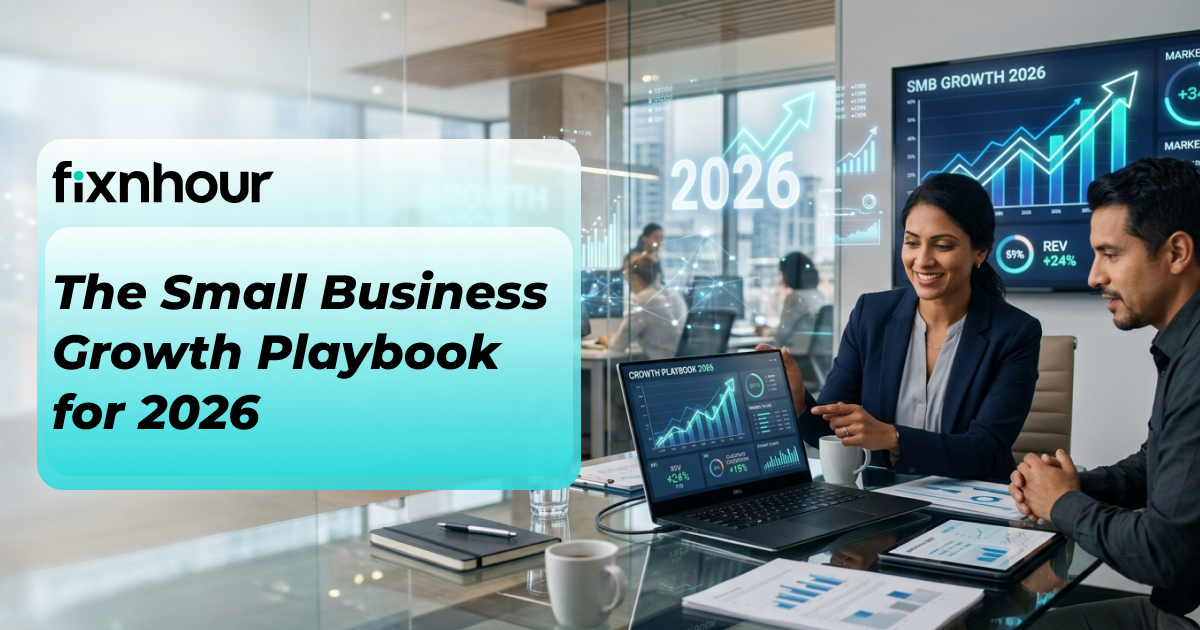
Growing a small business in 2026 demands more than hard work—it requires smart strategy, digital agility, and a customer-first mindset. With evolving technologies, changing consumer behavior, and rising competition, businesses must adapt quickly to stay relevant. This playbook outlines practical, proven approaches to help you attract customers, increase revenue, and build sustainable growth in a fast-moving market.
In today’s fast-changing digital world, small business growth strategies 2026 are more advanced, data-driven, and technology-focused than ever before. Whether you're a startup or an established company, knowing how to grow a small business fast requires the right mix of innovation, marketing, and smart scaling.This playbook will guide you through the best growth tactics for small businesses to help you stay competitive and profitable in 2026.
Why Small Business Growth Matters in 2026
Small business growth matters more than ever in 2026 as markets become increasingly digital, competitive, and customer-driven. Growing your business helps boost revenue, create jobs, and build long-term stability in uncertain economic conditions. With rapid advancements in technology and AI, businesses that scale can adapt faster, reach wider audiences, and stay ahead of competitors. Growth also allows small businesses to invest in innovation, improve customer experience, and strengthen brand authority. In a fast-changing global economy, focusing on sustainable growth is no longer optional—it’s essential for survival, resilience, and long-term success.
-
Increased Revenue Opportunities – Growth helps small businesses generate higher income and improve profitability.
-
Competitive Advantage – Expanding your business allows you to stay ahead in an increasingly crowded and digital marketplace.
-
Adaptation to Technology – Growth enables investment in AI, automation, and digital tools for better efficiency.
-
Stronger Brand Presence – Scaling builds credibility, trust, and visibility among your target audience.
-
Job Creation – Growing businesses contribute to employment and economic development.
-
Improved Customer Experience – Expansion allows better services, faster support, and personalized offerings.
-
Long-Term Sustainability – Continuous growth ensures resilience against market changes and economic uncertainty.
Top Small Business Growth Strategies 2026
The most effective small business growth strategies focus on efficiency, digital expansion, and smart outsourcing. One key approach is to Hire Local Service Experts, which helps businesses access specialized skills, reduce operational costs, and improve service quality. Combining this with AI tools, targeted marketing, and strong customer experience enables faster scaling. By leveraging local expertise and modern technology, small businesses can stay competitive and achieve sustainable growth.
1. Focus on Customer-Centric Growth
Customer-centric growth means putting your customers at the core of every business decision. Understand their needs, personalize experiences, and deliver consistent value. By focusing on customer satisfaction, feedback, and loyalty, small businesses can build stronger relationships, increase retention, and drive sustainable growth through repeat business and positive word-of-mouth referrals.
-
Personalize customer experiences
-
Use feedback to improve products/services
-
Build long-term relationships
2. Use Data-Driven Decision Making
Use data-driven decision making to guide your business strategies with real insights instead of guesswork. Analyze customer behavior, sales trends, and market data to identify opportunities and reduce risks. By leveraging analytics tools, small businesses can make smarter decisions, optimize performance, and achieve consistent, scalable growth in 2026.
-
Track KPIs like conversion rate and CAC
-
Use analytics tools for insights
-
Predict trends with AI tools
3. Invest in AI and Automation
Investing in AI and automation helps small businesses streamline operations, reduce manual work, and improve efficiency. From chatbots and marketing automation to inventory and data analysis, these tools save time and cut costs. By adopting smart technology, businesses can scale faster, enhance customer experience, and stay competitive in 2026.
-
Automate customer support with chatbots
-
Use AI for marketing campaigns
-
Streamline operations with automation tools
Small Business Marketing Trends 2026
Small business marketing trends in 2026 focus on personalization, AI-driven campaigns, and omnichannel strategies. Businesses are prioritizing a Scalable Business Model to reach wider audiences while maintaining efficiency. Short-form video, local SEO, and data-driven marketing are key drivers of growth. By adopting flexible and scalable approaches, small businesses can optimize costs, improve customer engagement, and achieve long-term success in an increasingly competitive digital landscape.
| Marketing Trend | Description | Benefit for Small Businesses |
|---|---|---|
| AI-Powered Marketing | Use of AI tools for automation, personalization, and campaign optimization | Saves time and improves targeting accuracy |
| Scalable Business Model | Flexible marketing strategies that grow with business needs | Supports long-term growth without high costs |
| Short-Form Video Content | Platforms like reels and shorts dominate engagement | Increases reach and audience engagement |
| Local SEO Optimization | Focus on “near me” searches and local listings | Attracts nearby customers and boosts visibility |
| Omnichannel Marketing | Consistent presence across multiple platforms (social, email, web) | Improves customer experience and brand consistency |
| Data-Driven Marketing | Using analytics to guide decisions and campaigns | Enhances ROI and reduces guesswork |
| Influencer & Micro-Creators | Collaborating with niche influencers for promotion | Builds trust and expands audience reach |
AI-Powered Marketing
AI-powered marketing is transforming how small businesses connect with customers in 2026. By using artificial intelligence tools, businesses can automate campaigns, personalize content, and predict customer behavior. From chatbots to email automation and smart ad targeting, AI improves efficiency and accuracy. It helps reduce marketing costs while increasing ROI. Small businesses can deliver the right message at the right time, enhancing engagement and conversions. Adopting AI-driven strategies ensures faster growth, better decision-making, and a competitive edge in the evolving digital marketplace.
- Automate campaigns using AI tools for personalized email marketing, ad targeting, and customer segmentation to boost conversions.
- Leverage predictive analytics to understand customer behavior, optimize content, and improve ROI with data-driven insights.
- Use AI chatbots and virtual assistants to enhance customer engagement, provide instant support, and increase lead generation efficiency.
Scalable Business Model
A scalable business model is essential for sustainable growth in 2026. It allows small businesses to expand operations, reach more customers, and increase revenue without significantly increasing costs. Digital platforms, automation, and cloud-based systems make scaling easier and more efficient. By building flexible processes and systems, businesses can adapt quickly to market changes. A scalable model supports long-term success, improves operational efficiency, and ensures businesses can handle growth without compromising quality or customer experience.
- Design flexible systems that allow your business to grow without a proportional increase in costs, ensuring higher profit margins.
- Implement technology-driven processes and automation to handle increased demand efficiently while maintaining quality and service standards.
- Focus on recurring revenue streams and modular offerings that can be expanded easily to new markets or customer segments.
Short-Form Video Content
Short-form video content is one of the most powerful marketing trends for small businesses in 2026. Platforms like reels, shorts, and TikTok-style videos capture attention quickly and drive high engagement. These videos are easy to create, cost-effective, and highly shareable. Businesses can showcase products, tell stories, and connect with audiences in a more authentic way. With strong storytelling and creative visuals, short-form videos boost brand awareness, increase reach, and drive conversions, making them a key strategy for digital marketing success.
- Create engaging, bite-sized videos optimized for social media platforms like TikTok, Instagram Reels, and YouTube Shorts to boost brand visibility.
- Use storytelling and trending formats to capture attention quickly, increasing audience retention and shares.
- Leverage analytics to track performance, optimize content, and drive conversions through short, impactful video campaigns.
Local SEO Optimization
Local SEO optimization helps small businesses attract nearby customers by improving visibility in local search results. In 2026, “near me” searches and Google Business profiles play a crucial role in driving traffic. Optimizing keywords, managing reviews, and updating local listings can significantly boost online presence. This strategy helps businesses connect with local audiences, increase foot traffic, and build trust. Local SEO is cost-effective and essential for businesses that rely on location-based customers and services.
- Optimize your website and Google Business Profile for location-based keywords to attract nearby customers searching for your services.
- Build local citations, backlinks, and reviews to improve search engine visibility and credibility in your community.
- Create location-specific content and landing pages to engage local audiences and drive foot traffic or local leads effectively.
Omnichannel Marketing
Omnichannel marketing focuses on creating a seamless customer experience across multiple platforms, including social media, websites, email, and mobile apps. In 2026, customers expect consistent messaging and interaction wherever they engage with a brand. This strategy helps businesses build stronger relationships, improve customer retention, and increase conversions. By integrating all marketing channels, small businesses can deliver personalized experiences and maintain brand consistency, resulting in higher engagement and long-term growth.
- Deliver a seamless customer experience across multiple channels—online, offline, social media, email, and mobile—to strengthen brand consistency.
- Use integrated data from all touchpoints to personalize messaging, improve engagement, and drive higher conversions.
- Coordinate campaigns across platforms to ensure customers receive timely, relevant content, boosting loyalty and long-term retention.
Data-Driven Marketing
Data-driven marketing enables small businesses to make informed decisions based on real insights rather than assumptions. By analyzing customer behavior, preferences, and campaign performance, businesses can optimize strategies for better results. Tools like analytics dashboards and CRM systems provide valuable data to improve targeting and personalization. In 2026, using data effectively helps increase ROI, reduce marketing waste, and enhance customer experiences. It empowers businesses to stay competitive and achieve measurable, scalable growth.
- Analyze customer behavior, preferences, and trends using advanced analytics to make informed marketing decisions and improve ROI.
- Segment audiences based on data insights to deliver personalized campaigns that increase engagement and conversions.
- Continuously track and measure campaign performance, using metrics to optimize strategies and refine targeting for better results.
Essential Tools for Small Business Growth
Essential tools for small business growth include Local Service Marketing platforms that help attract and engage nearby customers effectively. By leveraging SEO, customer reviews, and location-based advertising, businesses can boost visibility and drive more leads. Tools for social media management, email campaigns, and analytics also enhance outreach and performance tracking. Integrating Local Service Marketing with CRM systems ensures personalized communication, higher conversions, and sustainable growth for small businesses in competitive local markets.
| Tool Category | Tool Name / Example | Purpose & Benefit | Keywords Focus |
|---|---|---|---|
| Local Service Marketing | Google Business Profile | Boost local visibility, attract nearby customers, manage reviews | Local Service Marketing, local SEO, customer reviews |
| Social Media Management | Hootsuite, Buffer | Schedule posts, track engagement, improve brand presence | Social media marketing, engagement, brand visibility |
| Email Marketing | Mailchimp, Sendinblue | Send personalized campaigns, nurture leads, increase conversions | Email campaigns, lead nurturing, personalized marketing |
| Analytics & Insights | Google Analytics | Track website traffic, understand customer behavior, optimize strategy | Data-driven marketing, analytics, performance tracking |
| CRM Tools | HubSpot, Zoho CRM | Manage customer relationships, automate follow-ups, improve sales | CRM, customer management, automation |
| Advertising Tools | Facebook Ads, Google Ads | Run targeted campaigns to reach local audiences effectively | Paid ads, local advertising, lead generation |
| Review & Reputation Management | Trustpilot, Yelp | Collect and showcase reviews to build trust | Online reputation, reviews, customer trust |
Best Growth Tactics for Small Businesses
The best growth tactics for small businesses include leveraging Sales Influencers to amplify brand reach and credibility. Collaborating with industry influencers helps drive targeted traffic, generate leads, and increase conversions quickly. Combining influencer partnerships with social media marketing, email campaigns, and data-driven strategies ensures maximum ROI. Small businesses can also use Local Service Marketing to attract nearby customers while building strong relationships through personalized communication. By integrating Sales Influencers into a scalable marketing plan, businesses can accelerate growth, enhance brand visibility, and achieve sustainable success in competitive markets.
-
Collaborate with Sales Influencers to expand reach, build trust, and generate high-quality leads.
-
Implement Local Service Marketing strategies to attract nearby customers and increase foot traffic or local sales.
-
Use data-driven marketing to analyze performance, optimize campaigns, and improve ROI consistently.
-
Leverage social media marketing and short-form video content to engage audiences and boost brand visibility.
-
Focus on a scalable business model with automation and recurring revenue streams for sustainable long-term growth.
Key Takeaways
-
Embrace small business digital transformation to stay competitive and efficient.
-
Use AI and automation to streamline operations and boost productivity.
-
Follow small business marketing trends 2026 to attract and retain customers.
-
Focus on customer experience to increase loyalty and repeat sales.
-
Apply best growth tactics for small businesses consistently for sustainable results.
-
Leverage data-driven insights to make smarter business decisions.
-
Build scalable systems and processes to grow without compromising quality.
Final Thoughts
Growing a business in 2026 is all about being smart, fast, and adaptable. By implementing these small business growth strategies in 2026, you can achieve sustainable success and stay ahead of competitors. Embracing digital transformation, leveraging AI and automation, and staying updated with small business marketing trends in 2026 will help you optimize operations, reduce costs, and enhance customer experience. Consistently applying best growth tactics for small businesses ensures long-term profitability, stronger brand presence, and scalable growth in a rapidly evolving market.
Ready to grow your business in 2026? Contact us today for expert strategies, AI solutions, and scalable growth support!
Frequently Asked Questions
Q1: What are the best small business growth strategies for 2026?
Ans. The best small business growth strategies 2026 focus on digital transformation, leveraging AI, and improving customer experience. Businesses should implement automation tools to streamline operations, use data-driven insights for decision-making, and follow small business marketing trends 2026 to attract new customers. Scaling successfully requires building scalable systems, optimizing workflows, and investing in employee training. By consistently applying these best growth tactics for small businesses, companies can increase efficiency, reduce costs, and achieve sustainable growth, staying competitive in an ever-evolving market landscape.
Q2: How can I grow a small business fast in 2026?
Ans. To grow a small business fast, focus on high-demand products, optimized marketing campaigns, and efficient sales funnels. Leverage AI and automation to handle repetitive tasks, freeing your team to focus on growth initiatives. Implement digital transformation strategies like cloud-based tools and data analytics to improve decision-making. Personalize customer experiences using AI-driven marketing and CRM systems. Following small business marketing trends 2026, such as short-form video and social media engagement, can boost visibility quickly. Combining speed with smart planning ensures rapid, sustainable growth without compromising quality.
Q3: What are the top marketing trends for small businesses in 2026?
Ans. Small business marketing trends 2026 are driven by AI, personalization, and digital-first strategies. Businesses should focus on SEO optimization, voice search, and AI-generated content to rank higher online. Social media, particularly short-form videos and influencer partnerships, is essential for audience engagement. Email marketing automation and hyper-personalized campaigns improve customer retention. Leveraging data-driven insights helps refine targeting and optimize ROI. Integrating these trends with small business digital transformation ensures marketing strategies are efficient, measurable, and scalable, helping small businesses grow faster and maintain a competitive edge in 2026.
Q4: How does AI help small business growth in 2026?
Ans. AI helps small businesses scale efficiently by automating repetitive tasks, improving decision-making, and enhancing customer experiences. AI-powered tools can manage customer support with chatbots, forecast sales trends, and personalize marketing campaigns. By integrating AI in small business growth strategies 2026, companies save time, reduce errors, and improve operational efficiency. AI also enables data-driven insights, helping businesses understand customer behavior and optimize performance. Combined with digital transformation initiatives, AI empowers small businesses to compete with larger enterprises, achieve faster growth, and implement the best growth tactics for small businesses cost-effectively.
Q5: What is digital transformation for small businesses in 2026?
Ans. Small business digital transformation involves adopting technology and digital tools to improve processes, efficiency, and customer experiences. This includes using cloud-based software, AI-powered analytics, automation, and online marketing platforms. Digital transformation enables businesses to implement small business growth strategies 2026, scale operations efficiently, and stay competitive in a rapidly evolving market. It helps optimize workflows, reduce costs, and improve decision-making with real-time data. Integrating small business marketing trends 2026 into digital strategies ensures better visibility, customer engagement, and measurable growth, making digital transformation a critical step for long-term success.
Q6: How can I scale a small business successfully?
Ans. Scaling a small business successfully requires building scalable systems, optimizing workflows, and leveraging AI and automation tools. Focus on improving operational efficiency, investing in employee training, and using data-driven insights to make strategic decisions. Marketing should align with small business marketing trends 2026 to expand reach and attract new customers. Financial planning, including budget optimization and reinvestment, ensures sustainable growth. By combining best growth tactics for small businesses with technology-driven solutions, companies can scale without compromising quality, maintain customer satisfaction, and achieve long-term profitability in a competitive 2026 market.
Q7: What are the best growth tactics for small businesses?
Ans. The best growth tactics for small businesses in 2026 include leveraging digital transformation, AI automation, and data-driven marketing. Focus on personalized customer experiences, content marketing, social media engagement, and optimizing sales funnels. Use analytics to track performance and adjust strategies accordingly. Implement scalable workflows and invest in team training to maintain operational efficiency. Staying updated with small business marketing trends 2026 ensures competitiveness and audience relevance. Combining technology, smart marketing, and customer-centric approaches allows small businesses to grow fast, reduce costs, and achieve sustainable success using proven growth tactics.