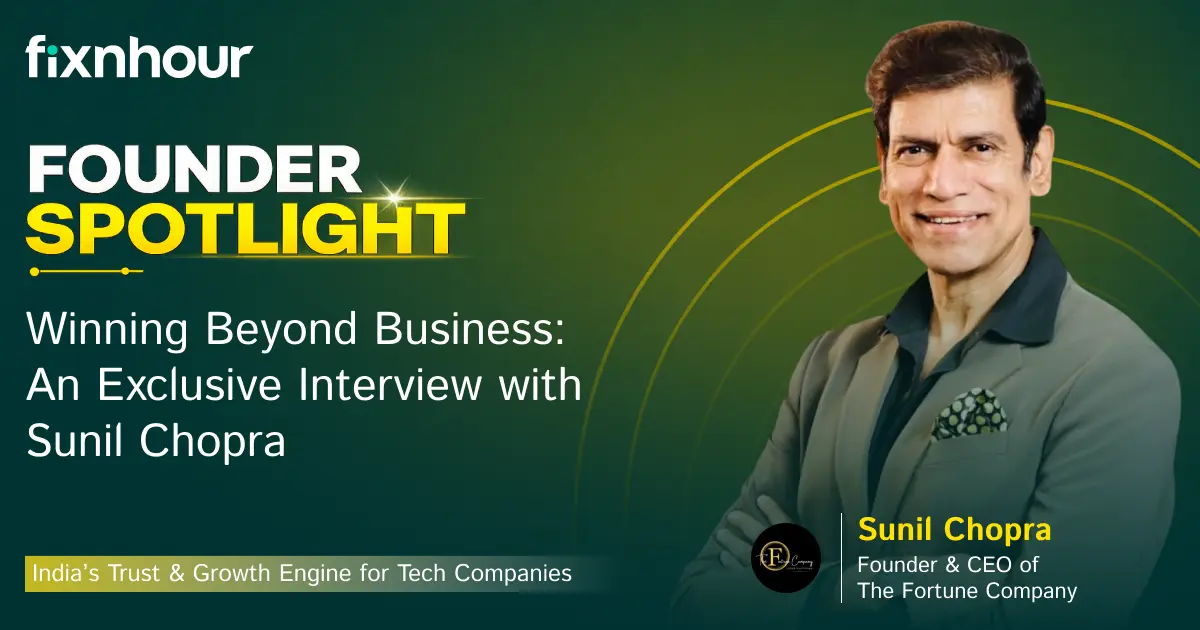
Winning Beyond Business: An Exclusive Interview with Sunil Chopra, Founder & CEO of The Fortune Company Success in business is measured not only by financial growth but also by the ability to create lasting value, inspire people, and embrace innovation. Sunil Chopra, Founder & CEO of The Fortune Company, has built his entrepreneurial journey around these principles, transforming challenges into opportunities while leading with vision and purpose.
In this exclusive interview, Sunil Chopra shares his experiences, leadership philosophy, and the strategies that have driven The Fortune Company’s success. He discusses the importance of innovation, customer-centric thinking, business resilience, and adapting to an ever-changing market. From overcoming obstacles to identifying future growth opportunities, his insights offer valuable lessons for entrepreneurs, business leaders, and aspiring professionals looking to build sustainable and impactful ventures.
Who is Sunil Chopra?
Growth in a business is often measured in terms of its revenue, market share or valuation. For Sunil Chopra, success has never been defined as it is today. Sunil's experience of building growth in various organisations at global level over the past 30+ years, from Xerox to Nokia, GE, Sapient and more recently The Fortune Company, has taught him that achieving sustainable growth means having people at the heart of the business.
As an award-winning CEO, seasoned Board Director, entrepreneur, business consultant and executive coach, Sunil has been in the game for over 20 years to help companies define their profitable growth models, scale sales teams, groom future leaders and create businesses in super competitive markets. He has had experience in multiple industries such as business consulting and e-governance, education technology, executive search, retail, and telecommunications and has a special insight into what truly makes organisations successful.
Now Sunil works with founders, CXOs & leadership teams, enabling fast-track businesses to grow and to establish high performing cultures for sustainable growth and long-term success. During this exclusive Founder Spotlight session with Fixnhour, Sunil Chopra shares his thoughts on Leadership, Entrepreneurship and why strategies don't make business grow, people do believe in a common purpose.
Q1. Before we dive into the details of The Fortune Company, let's get to know you better Sunil. What got you started in your business career?
I have over 30 years experience in various industries, organisations and leadership roles. Out of all those experiences, I discovered that no matter how huge, small, or successful a business is, no matter the industry, there is always a challenge that they need to face, like making decisions that are not always easy, adapting to changes, and building teams, etc. After working with global organisations, I felt it was time to apply all the lessons I had learnt in a more practical way to entrepreneurs and growing businesses. The Fortune Company was motivated to invest in developing leaders for organizations to be profitable, resilient and people driven. I always thought of entrepreneurship as a value creation phenomenon in terms of value creation outside monetary returns.
Q2. What was your inspiration for creating The Fortune Company?
Along the way, I knew that many businesses fail not due to bad ideas. They are in trouble because they don't know what to do. They grow fast and non-scalable. They recruit good individuals and don't develop cultures in alignment. The Fortune Company was established in order to help organisations overcome these problems. We work with founders and leadership teams to create sustainable growth models, improve the leadership capability and skills, increase execution and propel organisations to long-term success. Growth is always by design. It is designed.
Q3. You have experience of running companies in different sectors. What has been the same about leadership?
Industries change. Technology changes. Markets evolve. Leaders are very much alike in the concepts of leadership. The first is trust. No team performs to its best if there is a lack of trust. The second is clarity. When people know the mission, they do best. The third is consistency. Great organizations don't just materialize out of a few large ideas. They are developed in an orderly fashion over many and many years. Leadership is in the end about assisting other people to succeed.
Q4. What are the differences between a successful (high growth) company and a company that is not high growth?
It's not typically opportunity that's the problem. It's execution. Successful businesses don't create systems based on people, they create systems based on systems. They invest in their employees. They measure performance. They remain customer-focused. Most importantly, they make decisions for the long term value and not the short term profit. Organizations that do nothing else have sustainable growth.
Q5. During your life experiences you have established sales teams. What does it look like to have a world class sales culture?
There are no great sales cultures in the world created by pressure, there are great sales cultures created by relationships. Trust comes first before customers purchase products. If the sales team is well-informed about the customer's problems and issues, it will be easier to sell. It's important to maintain a strong sales culture through continued coaching, processes, goals, and a learning rather than blame-oriented leader. The first step in becoming a great salesperson is to know people.
Q6. If you were an entrepreneur, what would you give as some advice to other entrepreneurs that are scaling up their businesses?
Many entrepreneurs get bogged down in their businesses. Initially, that's necessary. As organizations grow, however, the founders will have to move from “doing mode” to “building mode” and build systems and empower leaders. Delegate responsibility. Build processes. Develop leaders. Set vision and priorities. It isn't a matter of doing more. It's all about helping others to be successful.
Q7. What are your strategies for creating high-performing teams?
Trust, accountability and purpose are the three basic elements of building effective teams. People want to feel like they're making an impact.People want to feel they are doing something that matters. Leaders require to create an environment of respect for all, challenge and support. It's not enough to hire great employees; you need to keep them great. A long-term organizational strength is realized by developing them, coaching them and helping them to grow. Great teams are not a result of random selection. They're intentionally built.
Q8. What are your expectations of AI and how do you see digital transformation progressing?
The business world is undergoing a transformation with technology. AI will help in increased productivity, decision making, customer engagement and efficiency. But technology should never be the end-all-be-all solution, it's supposed to be a tool that enables the business strategy. Companies that embrace digital transformation, coupled with good leadership, customer intelligence, and operational efficiency, will gain the most competitive advantage. Those businesses that can manage to balance technology with humanity will have a future.
Q9. What are the challenges that occur in communication when leading a team?
One of the least known leadership skills is communication. Leaders make numerous decisions which can take a significant amount of time. But nothing will happen unless people are told that's what has been decided. Communication fosters trust. It reduces uncertainty. It creates alignment. Leaders must communicate effectively and authentically to staff and clients, investors, and partners. People remember clarity.
Q10. What are the key issues that you see in the importance of branding your founder?
Branding as a founder has now grown to be quite important. Customers want to know who is behind the business, and have a growing desire to know what the business owners are like. They want authenticity. They want expertise. They look for ideals with which to identify themselves. Founders can post their stories, leadership philosophies and business insights on the platforms like Fixnhour . This visibility will foster credibility and ultimately create better business relationships.
Q11. What are the ways you are going to achieve that?
My mission is to cultivate organizations to be stronger, resilient and people centered. Growth is not the only ingredient that makes a successful business. It must also be evaluated on the leadership we are developing, the opportunities we are giving them and the positive impact we are leaving. Hopefully, I will continue to do that in my coaching and consulting work, as a board member and as The Fortune Company. The more successful leaders that we can have, the more the businesses will grow. Sustainable development results in thriving communities.
About Sunil Chopra
Sunil Chopra is a Board Director of several award-winning organisations and an Award-winning CEO, a Business Growth Strategist and an experienced executive coach with 30+ years of leadership experience. He has worked for clients including Sapient, GE, Nokia, and Xerox, and is currently applying his expertise to the development of scalable business models, high performing businesses, and sustainable growth strategies for both founders and CEOs and leadership teams in a range of industries.
Conclusion
The last message to Entrepreneurs is "You have reached the end of the file". All businesses are uncertain. Markets change. Technology evolves. Competition increases. One thing remains constant — leadership. Establish trust prior to transactions. Make investments in people, not processes, the top priority. Keep in mind the long-term effects, not the short! However, keep in mind that the top leaders are not the ones that make successful businesses. They are those who make successful people.
People grow and businesses grow. contact us today to explore more exclusive interviews, inspiring entrepreneurial success stories, and expert business insights that empower innovation, leadership, and long-term growth.