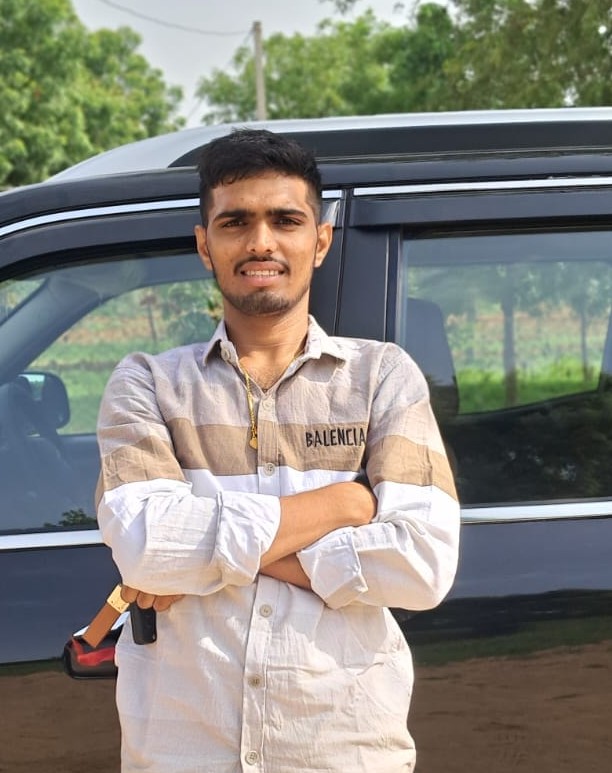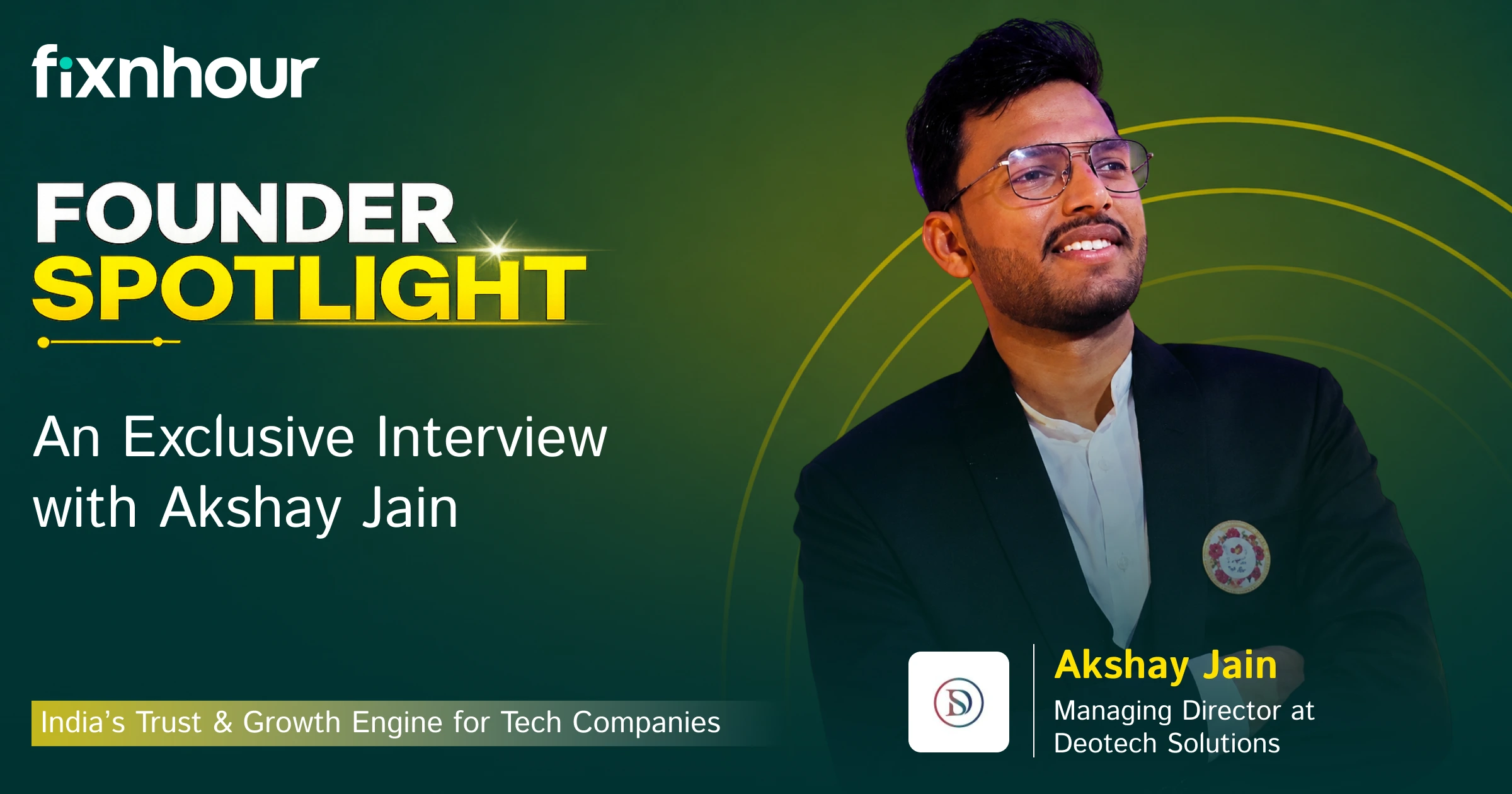
The Akshay Jain journey is a testament to the transformation of technical skills into entrepreneurship, leadership, and business innovation. Having a solid understanding of full-stack development, he slowly shifted his feet away from the code and into the problem-solving, product strategy, scalable business models, and digital transformation of customer needs. Today, he is the Managing Director of Deotech Solutions and the Founder of WorkLeisure.
Akshay has over seven years of experience in working with technologies like React, Node.js, ASP.NET, Angular, MongoDB, Oracle, and AWS. He has a deep passion for and understanding of the value of entrepreneurship: that technology makes the most significant difference when it addresses real problems and enables real business results. Akshay shares his views on startups, hospitality tech, AI, digital transformation, leadership and what developers should know before becoming a founder in this exclusive conversation with Fixnhour.
Key Takeaways
- Although technical expertise is a good foundation, entrepreneurship calls for a wider range of business skills.
- Problems need to be validated before investing too much in product development in startups.
- Technology should be used to achieve business goals, not goals in and of themselves.
- As the lines between work and travel become blurred, hospitality technology has great potential.
- Hospitality innovation is about more than just operations; it's also a matter of user experience.
- Product thinking shouldn't be separated from distribution thinking.
- When everyone is on a cross-functional team, there is a greater chance that the individual's understanding of the common goal will improve.
- AI will speed up software development, and architecture and product thinking will play a more essential role.
- Digital transformation should start with business problems and not software tools.
- A great start-up idea is the fusion of a significant problem, a recognizable customer, a viable market, and able execution.
- Entrepreneurship skills that are important for developers are sales, finance, customer discovery, and communication.
- As an organization grows, it is essential for the founders to delegate.
- Consulting can benefit start-ups by offering fresh insights into actual business challenges, while start-ups can benefit consulting by serving as a valuable resource for problem-solving.
- Creating sustainable technology businesses requires understanding customers, discipline, and learning.
Who is Akshay Jain?
Some founders start with an idea and then acquire the technology. Others start by identifying business problems they want to solve and then find the technology to address them. Akshay Jain is one of those who are part of the latter group.Akshay is the Founder of WorkLeisure and Managing Director at Deotech Solutions, where he has spent the past twenty years working in the software engineering, startup consulting, product innovation, hospitality tech, and digital transformation fields.Akshay has 7+ years experience in cutting edge technologies such as React, Node.js, ASP.NET, Angular, MongoDB, Oracle, and AWS. He has more than just experience from development. His work has since evolved to an understanding of business models, cross functional team development, product strategy and how to make ideas a reality for start-ups to be replicated in a scalable digital product.He works to enable companies to use technology to address operational issues, develop web and mobile applications, modernize digital systems and develop products that can scale with business growth at Deotech Solutions.
In parallel, he is developing WorkLeisure, a business centered around the new concept of the Work + Travel + Lifestyle + Flexible Experience.The mix is indicative of the evolving nature of entrepreneurship today.Founders need to have an in-depth understanding of technology, customer behavior, product-market fit, operations and business strategy at the same time. Writing code can help to build a product, but a broader range of skills is needed to build a sustainable company.The story of Akshay also illustrates the changing nature of the startup landscape. From artificial intelligence to automation, the cloud to remote working, to consumer behavior founders are having the opportunity to reimagine the traditional way of doing things, including in hospitality.Technology isn't the end for Akshay.It's the foundation that makes for improved products, more robust companies and richer customer experiences.In this exclusive Fixnhour Founder Spotlight, Akshay Jain shares his journey from becoming a full-stack developer to venturing into the entrepreneurial realm, reasons behind WorkLeisure, how he built Deotech Solutions and the lessons he has learned in helping startups create scalable businesses.
Q1. Akshay, how did your journey begin, and what inspired you to move from software development into entrepreneurship?
I started my career in technology.I found software development to be an interest because I liked to learn how systems work and how one can turn ideas into actual digital products. Utilizing technologies like React, Node.js, ASP.These technologies provided me a good technical background: NET, Angular, MongoDB, Oracle and AWS. Fixnhour As I worked on more products, however, I did realize that successful products aren't made with code only.All of this can be present and the application still be weak if the customer problem is not clear, user experience weak, business model weak or the product is not attuned to market feedback.It slowly got me thinking about becoming an entrepreneur or a consultant.I started to get more interested in the business understanding of what they should build, and why, as well as how to build technology.That eventually influenced my work at Deotech Solutions, and also was the impetus behind the creation of WorkLeisure.Entrepreneurship was the obvious next career move for me as I could go and fuse engineering, product thinking, business strategy and customer understanding together
Q2. What is the vision behind Deotech Solutions?
“Deotech Solutions is a core belief that technology is not just an operational need, but a growth driver for businesses.”There are many companies that take a reactive approach to technology.Unless it is inefficient or the competitors force them to modernize, they do not build systems.We're trying to do it differently.We collaborate with companies to grasp their objectives, operations, and customer pathways prior to suggesting a technical solution.This may include the development of web apps, mobile platforms, internal systems, Cloud products or digital transformation projects.Always scalability is our focus.A solution must be able to work today. It should be able to scale to support increasing number of users, data, and operational complexity.We also believe by the same token that technology partners should communicate clearly.It is not necessary to explain all the technical aspects to the client, but it should be explained the why and how of decisions and how decisions will be used to support business results.This blend of engineering and business knowledge is at the heart of our approach.
Q3. You are also building WorkLeisure. What problem are you trying to solve through it?
The world of work and work travel is evolving.The traditional boundaries between work, home and play are increasingly blurred. New lifestyle patterns have emerged in this era of remote, hybrid, longer and more flexible working hours and digital entrepreneurship.This change is what inspires WorkLeisure.We are investigating the possibility of enhancing hospitality experiences for those who wish to be productive, travel, build a sense of community, and live a lifestyle.The opportunity is not just to give a place to stay.The overall experience is important.Individuals might require secure and stable workstations, connectivity, flexibility, networking, local experiences, and environments that enable them to stay productive without sacrificing travel.Historically, the concept of hospitality has been defined by fairly distinct categories – business or leisure travel.Those categories are now increasingly merging today.WorkLeisure is all about creating for that intersection.The long-term opportunity is to develop experiences and technology that will make flexible working and travelling more purposeful and coherent.
Q4. Why do you believe hospitality technology has significant growth potential?
In the hospitality sector, customer experience and operations go hand in hand.Technology can enhance both of these.On the customer's side, digital platforms can make it easier to discover, book, communicate, personalize, pay and request services.On the operational end, technology can help with inventory tracking, guest communications, work flow automation, analytics, pricing, and in-house coordination.The personalization opportunity is also great.People are more likely to travel for experiences that align with their tastes and interests, rather than simply travelling to get to another destination.AI may be able to assist hospitality companies in comprehending those preferences and providing more pertinent experiences.Concurrently, the human factor is of paramount importance.The key of the word Hospitality is the feeling.Technologies should eliminate friction and free up time for teams to concentrate on service instead of making it feel automated or impersonal.Those firms that offer a real sense of hospitality along with a touch of tech will be in a strong position.
Q5. As a startup consultant, what are the most common mistakes you see early-stage founders make?
The single worst mistake is building too much, too early.It is easy for founders to get emotionally involved with the idea and start creating a full product right away.This can result in many months of work and finding out that customers are not interested in the problem.Typically, I would start founders with validation.Speak with users.Know how they are resolving this problem today.Recognize what drives them crazy.Figure out if they would be willing to shell out money for a greater answer.Then construct the smallest product possible for testing the most important assumptions.A common error is "technology only.A common error is "technology only".A startup also must have distribution, customer acquisition, pricing, operations and financial discipline.No matter how original and successful a product is, it's a hard business unless there is a path to market.Therefore, product and business model should be considered together from the start for founders.
Q6. How has your background as a full-stack developer influenced the way you make business decisions?
Having a technical background is useful as it gives me an appreciation of what can be done, what's hard, and where complexity isn't warranted.It also aids in estimation.When considering an idea, I can consider the architecture, scalability, development effort, integrations and potential technical risks as well as the business opportunity.But, technical can also lead to a temptation to solve everything with technology.The more time I spend in the business world, the more I feel like not all business problems need a complex software answer.At times, the best option is to make the process as simple as possible.In some cases the fine product is smaller than the founder's vision.Technical knowledge is thus not only the knowledge of how to build more.It is the knowledge and wisdom as to what is worth building.This is a significant difference.
Q7. How do you approach building cross-functional teams?
Cross-functional teams are best when each team member knows the goal and not just his or her own role.Of course, developers, the designers, marketers, members of sales, operations, and business leaders think differently.While those differences are good, they can also cause friction when communication is lacking.I do attempt to bring three things into focus:What is the issue that we are tackling?For whom is it a solution that you're solving it for?How can we determine if we have been successful?After these questions have been established, various teams can add to the pool of knowledge for the same purpose.Ownership is also crucial.Individuals work best when they are trusted to make decisions instead of just being given instructions to follow.Having talented people on a team is not enough.They are formed by providing gifted people with a common vision and the setting in which they are expected to work together.
Q8. What role do AI and automation play in the future of software development?
AI will have a profound impact on software development.AI is already powering developers through the coding, testing, documentation, debugging, and research process at a fast pace.This can potentially help teams to build quicker with less repetition.But I don't believe that the value of software engineers goes away.It changes.The significance of architecture, product thinking, security, integration, system design and business problem understanding is all the more critical.You can use AI to write code.Nevertheless, it still needs to be determined if the code should be written and how it fits into the larger system, and what the business outcome will be.The use of automation will also be growing on the outside of development.AI will be applied in businesses to automate workflows, customer support, analytics, operations and internal decision making.Those who do think, and do it right, will have a lot of efficiency advantages.
Q9. What does digital transformation mean to you?
Digital transformation isn't just about replacing manual processes with software.It's making technology a fundamental part of a business' operations.This can be related to customer experience, internal processes, communication, data, analytics, automation or new models.Some organizations make the error of beginning with tools.Before they can determine what needs to be improved, they ask which software they should purchase.A better way is to start with outcomes.What stalls are there in the customer journey?What are employees doing that isn't necessary?In what places is information hard to find?What are the reasons for delays in decisions?After these issues have been identified, technology can be used in more strategic ways.A business should be simpler, faster and more capable after successful digital transformation.Technology is not transformation if it makes something more complicated without increasing results.
Q10. How do you decide whether a startup idea has real potential?
There are a number of factors that I consider.First is the problem.Is it really painful or is it causing pain?How often does it happen?Who experiences it?What are people doing today that is helping solve it? After the customer comes second.Can it be shown that a group of people is deeply concerned enough about the problem to alter their behaviour or to spend money on a solution?Third is the market.Enough opportunity to build a sustainable business is still needed for a good product.Fourth is execution.Is the team well acquainted with the problem that it can be moved quickly and adapt?Last but not least, I consider the behavior of founders.Are they willing to accept evidence?Are they able to listen to customers and not take offense?Can they adjust to discrepancies in their assumptions?An idea matters.However, the team's capacity to learn and do tends to be more relevant.
Q11. What leadership lessons have shaped you most as an entrepreneur?
An important lesson is that leadership needs clarity.If people don't know what they're expected to do, or what's important, they're not going to do it well.The other is that founders are not able to control everything.As the team expands, you must learn to trust people and to delegate.It can be challenging especially for founders who participated in all aspects at the beginning.I've discovered that often, we can solve a lot of issues before they get serious by communicating.Teams should feel at ease to voice concerns and question ideas.Last but not least, leadership is a process of lifelong learning.The market changes.Technology changes.People change.The one who thinks he already has all the answers becomes the limiting factor in the end.Curiosity thus is one of the key leadership attributes.
Q12. How do you balance running a technology company while building a startup of your own?
The need to prioritize becomes very critical.Always more that can be done than hours available.I'm clear about my value add inside my little box.There are decisions that need to be made by the founders.Other assets should be held by competent team members.Systems and delegation become a must.The cross-over aspect of both also has an interesting advantage.Deotech Solutions gives me a new perspective on the industries, the issues of customers, and the technology issues.As a product thinking Founder, I can directly apply my thinking to WorkLeisure.Lessons can go in either direction.By doing consulting, I stay up to date with real business issues.Being at the Startup building keeps me at a good distance from the uncertainty and execution challenges faced by founders.The combination of the two makes me better at both.
Q13. What advice would you give developers who eventually want to become entrepreneurs?
Skill up in business and simultaneously acquire technical skills.While technical skills are highly desirable, entrepreneurship needs a broader understanding.Understand the decision-making process customers go through.Understand sales.Understand pricing.Understand basic finance.Understand team working.Develop communication skills.Most importantly, learn to identify problems before getting to the point of making a decision on solutions.Builders, of course, want to build.Entrepreneurs are faced with the question: what should be constructed?I would also recommend that developers go one-on-one to customers.Best product insights aren't always found in code.You have the power to create because you are technologically oriented.Business understanding is the ability to make something that people want.
Q14. What is your long-term vision for Deotech Solutions and WorkLeisure?
Deotech Solutions' vision is to maintain a robust technology organization to enable businesses to build scalable products and confidently align with digital transformation.We aim to enhance our skill sets in modern web & mobile development, cloud technologies, AI & automation, and strategic technology consulting.The vision of WorkLeisure is product-oriented.We want to discuss the evolving Work, Travel, Hospitality and lifestyle relationship and create experiences that mirror the way people would want to live and work today.These are two separate business ventures, but they have the same theme.Technology should enable better experiences and better outcomes.Whether it's assisting a company to modernize its digital systems or creating a new hospitality encounter, the goal is to resolve real issues and create lasting value.
About the Founder
Akshay Jain is the founder of WorkLeisure, and the Managing Director of Deotech Solutions, where he has a knack for both software engineering, startup consulting, product strategy, and business leadership.Akshay has 7+ years of experience with full stack development using technologies such as React, ASP, Node.js.NET, Angular, MongoDB, Oracle and AWS, developing scalable web and mobile apps for various industries.He supports organizations in the areas of technology adoption, development of digital products and digital transformation via Deotech Solutions.With the evolving trend of how people want to work and how they want to experience the world, WorkLeisure is looking into opportunities where hospitality, flexible work, travel and lifestyle intersect with Akshay.His entrepreneurial principle is based on one simple thing:When technology provides a solution to a problem, enhances the experience, and can help a business prosper in a sustainable way, it's worth it.
Final Message to Founders and Developers
Avoid getting attached to technology.Become addicted to problem-solving.Technology changes constantly.Programming languages change.Frameworks change.AI tools change.Businesses are a result of customer problems.Stay curious.Talk to users.Practice doing small things first, then big things.Measure what works.Create strong teams.Of course, remember that execution is more important than originality of idea.When you combine technical expertise, understanding of customers, commercial thinking and discipline then you're in a good place to create something valuable.
Final Thoughts on the Founder
Akshay Jain's story is representative of the journey of many technical founders as they transform their application into a business.He is a full stack developer, which means he has the technical depth to comprehend the modern product development process across React, Node.js, ASP.NET, Angular, databases, and cloud infrastructure. However, he has had to think on a much broader level now as a managing director at Deotech Solutions and founder of WorkLeisure.Entrepreneurship is not all about technology.Eventually, customer discovery, product-market fit, hiring, cross-functional leadership, distribution, financial discipline, and strategic decision-making are all equally important.
Akshay's passion for hospitality tech, under the banner of WorkLeisure, is especially relevant in a world of a constantly changing work/life/lifestyle relationship. COVID-19's impact on remote and hybrid working has led to new customer behaviors that were not always catered to within the traditional hospitality model.Meanwhile, his consulting background provides first-hand experience with the challenges that businesses encounter when they're trying to implement new technology.The combination of builder, consultant, and founder is a helpful one.Innovation for Akshay is not just about using the most complex technology.It is the ability to grasp a problem clearly and to select the most straightforward technology that will add value. Talk to Experts