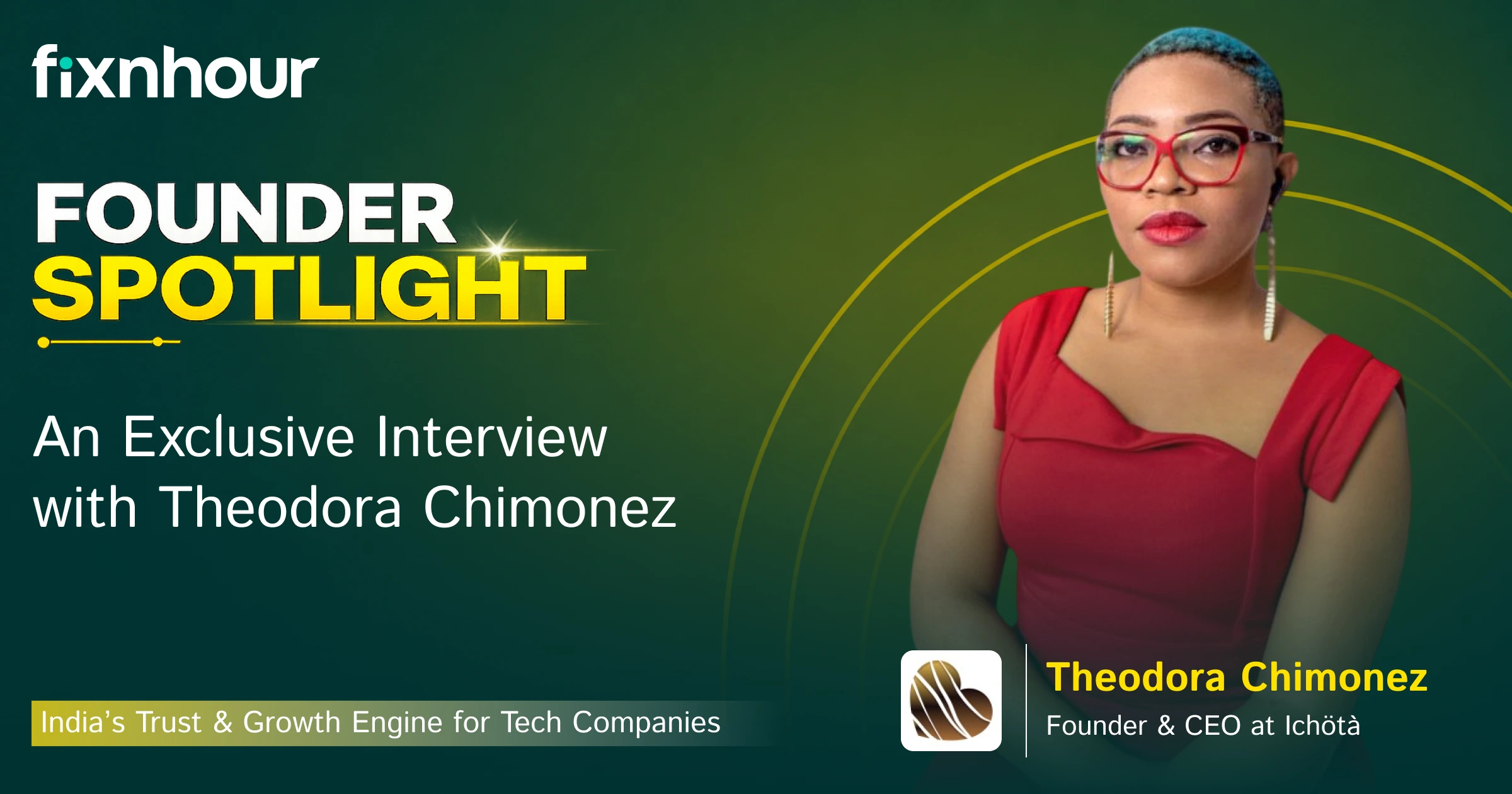
Modern life has been revolutionized by technology in almost every aspect from work to shopping, from communication to daily decision making. However, with increased digital options, more connections don't necessarily equal more meaningful ones when it comes to building meaningful relationships. This is what Theodora Chimonez, the Founder and CEO of Ichötà, is looking to change with a combination of art, science, careful screening, and human-curated matchmaking services.
Theodora has over 15 years of experience in product leadership, FinTech, E-commerce, EdTech, Travel & Hospitality and other technology driven businesses, and is deeply passionate about relationship technology from a product and human-centric view. During this exclusive Fixnhour interview, she shares her experience from product leader to founder, the vision of Ichötà, the importance of responsible AI, trust and safety, product-led growth, and the need for technology to enhance, not replace, human connection.
Key Takeaways
- The point of relationship technology should be to improve results, not engagement.
- Greater number of matches does not equal to better relationships.
- While AI can enhance compatibility discovery, it shouldn't supplant human judgment.
- Psychology can bring more than just 'matching' attributes.
- An understanding of human concierge skills adds context, empathy and direction.
- Trust and safety must be part of the product—not an extra feature.
- Sensitive AI products demand a greater level of privacy, transparency, bias and oversight.
- The first step of a successful 0 to 1 product development is to be discovered and clear.
- With early revenue, it's a great sign of value.
- To scale sustainably, you need to know the reason for growth, and not just that it happened.
- Product-led thinking should be about outcomes and not about removing humans from the mix.
- When mentees become leaders themselves, it has a multiplier effect in the form of mentorship.
- Founders can present complex ideas in a clear manner through the use of storytelling.
- Rather than the goal, AI should be used to achieve human ones.
- Commercial ambition and human-centredness are characteristics of responsible innovation.
- With relationship technology, getting it right could be a matter of enabling customers to cease the platform.
- Love, safety and trust should never be assumed.
Who is Theodora Chimonez?
Technology has revolutionized our communication, our work, our shopping, our travel, our learning and our finances. However, with respect to one of the most human of all human aspects, a meaningful partner technology can offer more alternatives without better connections. Theodora Chimonez believes there is an opportunity to change that.Theodora is Founder and CEO of relationship technology company Ichötà, based in the UK, with Artificial Intelligence, psychology, thorough vetting and human matchmaking concierge helping to create safe, thoughtful and lasting relationships.The first principle of her philosophy is:Technology must help, not hinder, human connection, the most meaningful technology.
It is supported by over 15 years of experience in a variety of technology-driven industries including Product, FinTech, E-commerce, EdTech, Travel & Hospitality, and more.Theodora's career has spanned B2B and B2C sectors, frequently in scenarios where products had to make rapid progress from concept to delivery.It's that mindset in action that's demonstrated through her track record. She spearheaded a strategic initiative at Settl, which resulted in over a 300% increase in net transaction value and always surpassed gross transactions by over 112%. With Patricia Universe, and other endeavors, she has helped develop product concepts from initial to market; and introduced more robust discovery and delivery discipline and product-led thinking into teams.She was also also named a ‘UK Tech Nation Exceptional Talent' and is a part of ‘Techstars '22'.Today a combination of those experiences is happening in Ichötà.
Theodora and her team have already raised early-round funding, manufactured their first product for consumers, and been accepted into various acceleration initiatives such as Amazon's Innovation Accelerator, Barclays' Eagle Labs Funding Accelerator and Built to Rise Accelerator by The Lifted Project.Now the company is looking to grow, enhance its AI and machine-learning capabilities, and put more paid subscribers on its list.But Ichötà is more than just about creating another dating site.Theodora is investigating a bigger idea:Is it possible to use technology to make better decisions about relationships without taking away the human, judgmental, empathetic, safe, and emotional intelligence that meaningful relationships need?Her response is a model that's smart and compatible with humans, not technology taking the place of humans.In parallel with Ichötà, Theodora offers strategic advice to founder and leadership teams on product clarity, early-stage scaling, 0-to-1 execution, and other related topics, especially in regulated and consumer-facing products.She's also passionate about nurturing the next generation of leaders. According to her profile, she has mentored emerging product professionals around the continent as Director of Strategy for Product Managers Africa, of which over 85% have been promoted to leadership positions.In this exclusive Founder Spotlight, Teodora Chimonez shares some of the thinking behind Ichötà, why she believes that trust and safety need to be at the heart of innovation, what relationship tech is missing, and how AI can be used in deeply human experiences.
Q1. Theodora, you have more than 15 years of experience across several industries. What ultimately inspired you to become a founder and build Ichötà?
I've had the opportunity to build and scale products in a variety of different industries from FinTech, to E-commerce, to EdTech to Travel and Hospitality. Fixnhour The industries were distinct but there was always the same thread, the understanding of people, the identification of the meaningful problems, the creation of clarity from the complexity, and the translation of this understanding into products people could use.As time went on, I grew more drawn to the part that technology plays in the most significant human experiences.One of those areas is relationships.Meeting people is easy, but not easy to meet a compatible, trusted, safe and meaningful person.I noticed a need to look at the experience of the viewer from fresh.Rather than wondering why people don't interact more or see more profiles, the question turned to: How can we make better, safer, and intentional decisions about people's relationship?This way of thinking was the bedrock of Ichötà.I wanted to assemble all of my knowledge and understanding about product development, technology, customer experience, execution, and scale and put it to use in solving a problem that is very human.
Q2. What does the name Ichötà represent, and what is the vision behind the company?
It's about intentional connection at Ichötà.To develop relation technology, that facilitates the process of finding meaningful and lasting partnerships, but retains trust, compatibility, safety and human understanding at the centre of the process.The traditional digital dating has generated lots of access.People have the potential to connect with others that they may not have known through their existing social network.That is valuable.However, increased choice does not always lead to increased outputs or results.It can result in more noise, more fatigue and more confusion.We want to approach the problem differently.Ichötà is a fusion of technology, psychology and human concierge expertise.AI can assist in recognising patterns and help with compatibility decisions. The human aspect of relationships can be explained through the lenses of psychology. Human experts can add context, judgement and direction that may not be reflected in algorithms.It's not about automating love.It is using technology wisely and sensibly to assist people to deal with the process in a more considered manner.
Q3. You say that Ichötà goes beyond matchmaking. What makes your approach different?
Matchmaking is certainly a part of what we do, but we consider the bigger relationship story.Finding someone is just a part of it.It is also important that individuals develop self-understanding.They must get clear on their priorities and preferences, as well as the meaning of compatibility in a relationship and beyond physical attraction.Another key element is safety.It is important to nurture trust and make it part of the experience, not an add-on.For this reason, we have a strict vetting procedure in place.We then add intelligent compatibility and high touch human guidance.The overall concept is that it shifts from transaction based matching to active relationship building.We don't seek to add as much as we can of endless interaction.We seek to enhance the quality and relevance of the connections people make.
Q4. Dating apps have already used algorithms for years. What does AI change?
With AI, we have a chance to recognize a much more complex pattern than the traditional matching system.Human compatibility is multi-dimensional.It may be with values, lifestyle, communication, goals, personality, expectations, life stage and much more.History’s approach to systems often makes the human being into a filter of relatively simple things.AI and machine learning enable the ability to assimilate more complex sets of information and make better recommendations based on the learning that occurs over time.But that's where the issue of responsibility comes in.There can't just be a probability score for human relationships.An algorithm can give someone a helpful hint but it can't fully grasp the individual context of someone's life, emotional state, culture or background.For this reason, we don't believe that AI replaces human effort.It's a blend of AI and psychology and a human touch.There are different elements to each.
Q5. Why is the human concierge element so important when AI is becoming increasingly sophisticated?
For high technology doesn't mesh with human understanding.AI can weigh in on vast amounts of data and find patterns very efficiently.Relationships have subtlety in them.People will say they want one thing, while they actually need something else.Data sometimes don't mean as much as context.Experts can guide people to listen, ask questions to deepen their understanding, acknowledge uncertainty, and support reflection on their own decision making process.Also, there is an emotional component.Discussing relationships can be a time where people are vulnerable. Words of trust, empathy, discretion and reassurance are important.Combining technology's scalability and intelligence with people's judgment and emotional intelligence is possible thanks to the concierge layer.To me, a mix there that makes for a much better adventure than either of them on their own.
Q6. You place significant emphasis on safety and rigorous vetting. Why is this fundamental to the product?
Trust is the key to meaningful connection.If the users don't feel safe, then everything else is secondary.Relationship platforms handle deeply personal information and enable interactions which can progress from the digital into people's real lives.This places a considerable burden on them.Safety is not something that can be just a policy page that users are expected to read.It must impact on the product design, onboarding, verification, user behavior, data management, and operational processes.Vetting is therefore not just a 'bonus feature'.It's a component of the way we consider building confidence into the complete experience.It is never going to be an X that can remove all risk of human interaction.
Q7. How do you balance personalization with privacy when building AI-powered relationship technology?
It is one of the most crucial questions for the industry these days.If a system has more information about the user, personalization can be improved.Relationship information can be very intimate.So the question isn't simply how much data can we collect.The more pertinent question is: What information should we really need to create value and how should it be treated responsibly?Trust must come as a result of actions.Users should be aware of the rationale behind the information being sought and understand its value for their use.Security, transparency, consent and responsible data practices must be part of the product considerations.In particular, with AI playing a part, founders must be able to fight the urge to gather as much data as possible, in case it is useful one day.It takes discipline to develop a responsible product.
Q8. You have taken products from concept to launch across different organizations. What have you learned about 0-to-1 product building?
The most important lesson is that it is not about the complexity, but the clarity.In the initial phase, there are typically more ideas than resources for founders.You could have dozens of features, customer segments, and potential directions the product could go.The question is, what's important now?Discovery is very significant.Before getting attached to the solution, you must understand the problem.Speak with users.Test assumptions.Look for the most hazardous aspects of your business.Afterwards construct enough so that you can learn.One of the major lessons learned is that there is no tradeoff between speed and discipline.Rushing does not equal not thinking.It involves establishing sufficient clarity to allow the team to perform without confusion.0-1 product development is a process of learning.The objective isn't to prove that your original idea was perfect.It is to find out what is supposed to be the case for the business to function.
Q9. At Settl, you led an initiative that generated over 300% growth in net transaction value. What did that experience teach you about scaling?
about scaling from that experience?To scale, one must be acquainted with the process of growth.You don't want to just see the number going up.It is necessary to be aware of the reasons for its growth, its repeatability, and whether the associated economics and operations can sustain growth.The experience at Settl really helped to emphasize the need to link strategy to execution.While it's good to have a big growth goal, it's great to have clarity on what actions will make a difference to that growth goal.Product, operations, customer experience and commercial strategy are interdependent.Another lesson: It's all about the numbers.Everybody needs predictors as well as results.If teams understand how their work contributes to the business outcomes, they can make better decisions.The growth should be planned.
Q10. Ichötà has already generated early revenue and launched its first consumer product. What have those early milestones taught you?
One of the best ways to validate is to have someone make a choice to pay for the value that you're providing.Don't think that if you are getting revenue the problem is solved.But it just tells you there's something there you need to learn more about.We have also been able to learn about actual behaviour instead of assumptions in launching our first consumer product.This is really beneficial.Users will interact in a way different than the founders would expect.The important thing is to create feedback loops.What is the object of use?What areas do they need help in?What do they want?What makes them willing to pay for the value?Those learnings inform the next iteration.We are now concentrating on enhancing the product, developing our artificial intelligence/machine-learning skills and growing our paid membership, but we are being disciplined about our product experience.
Q11. What has participating in programs such as Amazon Innovation Accelerator and Barclays Eagle Labs taught you as a founder?
Useful aspects of accelerator environments include the opportunity to gain access to views that founders might not otherwise find within their own companies.You're exposed to people you can talk to, including mentors and other entrepreneurs, investors, experts, and individuals who've seen businesses in various stages.It's not just about taking advice.It's learning what to do for you.A lot of ideas are heard by the Founders.One way to become a better founder is to learn how to tell the difference between constructive feedback that you don't have and non-constructive feedback that isn't in line with your strategy.Programs also establish accountability.During construction, it's easy to get lost on the current issues of operation.If you're in a structured environment, you have to step back and do some thinking on how the business works.
Q12. As a female technology founder, what have you learned about leadership, resilience, and building in challenging environments?
Self-assurance is essential for leadership.Founders are constantly receiving input from their customers, investors, staff, advisors and the marketplace.Some of that feedback is helpful.Some of it contradicts.It takes a healthy sense of self-confidence to sustain your vision while at the same time being humble enough to alter it when evidence indicates otherwise.Resilience is also frequently misinterpreted.Not to say that it is a no-brainer.It's hard to run a building company.Sometimes it is not clear, sometimes it is tough and sometimes things do not go as expected.Resilience involves being able to use those moments to think, learn and make wise choices.I have also had the opportunity to understand the value of community.The presence of supportive individuals who grasp the practicality of construction can make a world of difference.
Q13. You mentor product professionals through Product Managers Africa, with over 85% of your mentees progressing into leadership roles. What do you believe creates great product leaders?
on to become leaders. What are your thoughts on what makes for great product leaders?Exceptional product leaders have a blend of curiosity and accountability.They ask questions.They understand customers.They have knowledge of business goals.They can collaborate with engineering, design, operations, commercial teams and leadership without believing that product has all the answers to the questions.Communication is so critical.Product leaders spend a lot of their time clarifying in between groups that have opposing points of view.They also need judgement.Resources will always be less than potential work.It is sometimes more important to know what NOT to build than what to build.The multiplier effect of leadership is something that I am especially proud about when individuals that I have helped, enter into leadership themselves.Helping one person grow into a better leader means helping them to build better teams and people.
Q14. You describe yourself as both a builder and storyteller. Why does storytelling matter in entrepreneurship?
Founders are always in the business of explaining something that hasn't happened yet.You are communicating to customers the importance of the product.You're educating workers on the importance of their job.You might be educating investors what the market could be.You're doing a bit of convincing for your partners.That requires storytelling.Good storytelling is not hyperbole, though.It is clarity.It makes the purpose understandable and has something complicated.The best stories of origin are the ones that link vision with evidence.You have to want to do it, but you also have to be able to do it.Storytelling is also vital as a product leader as products are based on a story.Whose are the pets?What are the problems they are facing?What happens to them after they use the product?If that story is not clear, teams make poor decisions.
Q15. What do you believe founders get wrong about product-led growth?
A common error with product-led growth is to assume that the product can do it all, and human effort is not needed anymore.I don't believe that's always going to be the case.Variations in products demand various growth models.It is a great thing if the self-service fits well in some categories.For products of high trust, with complex choices, regulations, and personal experiences, this can be a very valuable interaction.At Ichötà, we're intentionally considering how technology and high-touch service will intersect.The product should make things efficient and smart.Context, confidence, and care should be produced by human expertise.Product-led thinking isn't a conversation about getting rid of humans.It is a matter of creating the whole experience based on customer value.
Q16. What advice would you give founders building AI products in highly personal or sensitive categories?
Start with responsibility.If AI can do something, it does not necessarily mean that it should.What is the consequence if the system is incorrect?Ask "Who might be affected?Inquire if users are aware of the impact technology is having on their experience.Consider privacy, bias, safety, transparency, and human oversight.Do not be afraid to take risks, however, to the point that you lose all desire to be innovative.There are many sensitive categories that AI can produce huge value, such as health, finance, education, and relationships, among others.However, the quality must be raised.Trust needs to be considered as product infrastructure.It should impact the design of the system from the get-go.
Q17. Where do you see the relationship technology industry heading over the next five to ten years?
I believe that there is going to be a shift away from maximizing interaction to improving outcomes.Many platforms have been built for the consumer around engagement for years.More swipes.More matches.Additional time spent in the application.In relationship technology, however, it's a different matter.To many users, getting success means they don't need the product anymore, as they have found the right relationship.This makes for an interesting product philosophy.AI can assist in making matching smarter.Trust can be enhanced with better identity and verification technology.Psychology can contribute to the development of more richly-woven compatibility frameworks.Human experts can help in decision-making and readiness to be a good partner.Responsible companies that bring these features together have the opportunity to build a truly unique dating app from what we have seen in the past.
Q18. What is your long-term vision for Ichötà?
Their long term goal is to become a trusted relationship technology firm that can assist people in making meaningful, safe, and lasting relationships.We want to keep refining the intelligence of compatibility, whilst keeping the humanity of expertise to make the experience thoughtful and personal.Growth matters.It is important to grow our paid membership.Making AI and machine learning more powerful is important.However, those things must be for the greater good.We don't want for technology to become more transactional.We want technology to help people to be more deliberate.If Ichotà can help people to know themselves better, connect with people who really are like them, experience more thoughtful interactions in relationships, and achieve meaningful relationship, then we have made something good happen.Love, safety and trust aren't something that can be left up to chance.
About the Founder
Theodora Chimonez is the Founder and CEO of Ichötà, a relationship technology company with a mission to help build lasting, thoughtful, and safe relationships, that is based in the UK and features AI, psychology, and a rigorous vetting process alongside a human concierge matchmaking team.Theodora has over 15 years of product and technology leadership experience in FinTech, E-commerce, EdTech, Travel & Hospitality, and B2B and B2C sectors, as a co-founder of both a UK Tech Nation and Techstars.She is the leader of a strategic initiative at Settl that achieved a net transaction increase of over 300% while gross transactions were consistently surpassed by more than 112% and has worked with other technology initiatives from concept to launch.Combining her expertise in product strategy, execution, scaling, technology, and human-centered design, she is currently working to re-imagine meaningful relationships through Ichötà.In addition to entrepreneurship, Theodora is Director of Strategy for Product Managers Africa where she has mentored emerging members of the product management profession with over 85% of her mentees moving into leadership positions.Her philosophy behind relationship technology goes beyond the product, and it is this philosophy that is at the heart of her work:Develop technology that comprehend their purpose, rather than try to supplant human qualities.
Final Message to Founders
The rate of technological development is accelerating at a rapid pace.That opens up a huge opportunity.However, founders must keep in mind that this is not the same as human value and technical capability.Begin with people.Know and acknowledge their fears.Know their priorities.Know the objectives of their actions.
Or ask what technology can actually do to help.Products can be smarter by using AI.Information can help to make informed decisions.Experiences can be faster via automation.But trust, empathy, judgement and humanity are always fundamental–particularly when creating products that impact upon the most intimate aspects of lives.Build with ambition.Execute with discipline.Measure what matters.Never make the technology more important than the people it is meant to serve.
Final Thoughts on the Founder
Several worlds are woven together in one founder story: product leadership, high growth execution, AI, psychology, relationship technology, mentorship, and human-centred innovation, in this case, in the journey of the Theodora Chimonez.Over 15 years experience in FinTech, E-commerce, EdTech, Travel & Hospitality, enables her with a wide perspective of digital products development and scaling.Her commercial achievements to date – such as delivering over 300% net transaction value growth, and always achieving over 112% gross transaction value growth – indicate the power she has to link product with business results.However, Ichötà is more personal and ambitious.Now Theodora put that experience to work on one of the biggest problems facing technology today: people.This is an important philosophy for the future of technology companies that she has integrated AI with the knowledge of psychology and concierge.It's not always a human vs. AI situation in the future.
The best products can often be the result of knowing what they are best at in many of the most important aspects of life.AI can recognize patterns.Psychology can offer schemas to the understanding of behaviour and compatibility.Human empathy, context, judgment, and guidance can be emulated.The experience can be scaled with technology.The two of them can possibly produce something neither could produce alone.In an age when AI is becoming more integral to our daily routines, Theodora's message serves as a valuable reminder:Technologies are not meant to take away humanity from human experiences. It should enhance our experience of them. Talk to an expert.