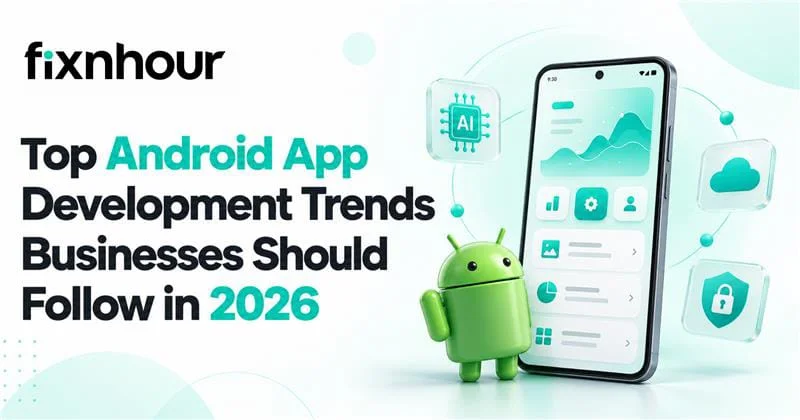
Android app development continues to evolve as businesses look for new ways to improve customer experiences, automate operations, and deliver secure digital services. From artificial intelligence and machine learning to cross-platform development, connected devices, and advanced mobile security, emerging technologies are changing how Android applications are designed, developed, and maintained.
In 2026, businesses across healthcare, education, e-commerce, finance, logistics, entertainment, and other industries are exploring mobile solutions that offer greater personalization, faster performance, and improved accessibility. However, adopting every new technology is not necessary for every business. The right approach is to identify trends that support specific business goals, meet customer expectations, and provide long-term value.
Quick Answer
The top Android app development trends businesses should follow in 2026 include AI and machine learning integration, Kotlin and Jetpack Compose, cross-platform development, 5G connectivity, cloud computing, IoT integration, enhanced mobile security, and personalized UI/UX design. These technologies help businesses improve application performance, automate workflows, strengthen data protection, and deliver better user experiences. Choosing the right trends depends on business goals, target audiences, budget, and technical requirements. Platforms like Fixnhour help businesses discover and compare B2B technology service providers, explore company profiles, and identify potential Android app development partners for their projects.
Key Takeaways
- AI-powered features can improve personalization, automation, and customer support.
- Kotlin and Jetpack Compose support modern Android application development.
- Cross-platform frameworks can help businesses build applications for multiple operating systems.
- Security, privacy, and accessibility should remain essential development priorities.
- Cloud computing and IoT integration can support connected digital services.
- Businesses should select technologies based on practical needs rather than trends
- alone.
Statistics and Market Insights for Android App Development in 2026
Android app development continues to create opportunities for businesses as smartphone usage, digital services, mobile commerce, and connected technologies expand. Companies across healthcare, education, finance, retail, and entertainment are investing in mobile applications to improve customer engagement, streamline operations, and deliver convenient digital experiences. In 2026, trends such as artificial intelligence (AI), cloud integration, cross-platform development, and mobile security are influencing how businesses plan and build Android applications. Mobile App Development Companies help businesses implement suitable technologies and strategies. Understanding market statistics and user behavior helps businesses identify relevant opportunities, prioritize features, and make informed technology investments.
Key Market Insights
- Growing mobile adoption: Smartphones remain an important channel for accessing digital services, shopping, communication, and entertainment.
- AI-powered applications: Businesses are exploring AI chatbots, personalized recommendations, and automated workflows to improve app experiences.
- Mobile commerce growth: Retailers are investing in convenient mobile shopping, digital payments, and personalized product discovery.
- Cross-platform development: Frameworks such as Flutter and React Native help teams develop for Android and iOS using shared code.
- Security and privacy: Secure authentication, data encryption, and responsible data collection remain essential for building user trust.
Top 10 Android App Development Trends Businesses Should Follow in 2026
Explore the top 10 Android app development trends businesses should follow in 2026, including AI integration, on-device computing, cross-platform development, 5G connectivity, advanced security, cloud integration, and personalized UI/UX. Discover how Android App Development Companies help businesses build smarter, faster, and more scalable mobile applications.
|
No. |
Android App Development Trends |
Description |
Key Features |
|---|---|---|---|
|
1 |
AI and Machine Learning Integration |
Makes apps smarter by analyzing user behavior, automating tasks, and providing personalized experiences. |
AI chatbots, recommendations, predictive analytics, automation |
|
2 |
On-Device AI and Edge Computing |
Processes data directly on smartphones to improve speed, privacy, and offline functionality. |
Faster processing, data privacy, offline AI, reduced network usage |
|
3 |
Kotlin and Jetpack Compose |
Simplifies Android development with readable code and modern, reusable user interfaces. |
Modern development, reusable UI, responsive design, easier maintenance |
|
4 |
Cross-Platform App Development |
Enables businesses to build Android and iOS apps using shared code and frameworks. |
Shared codebase, reduced development time, consistent experience, easier updates |
|
5 |
5G Connectivity and Real-Time Features |
Supports faster data transfer and responsive experiences for streaming, gaming, and communication. |
Real-time communication, faster transfers, live updates, streaming |
|
6 |
Advanced Mobile App Security and Privacy |
Protects user information and business data through secure development practices. |
Authentication, encryption, API protection, security testing |
|
7 |
Cloud Integration and Scalable Architecture |
Connects apps to cloud storage and backend services to support data synchronization and business growth. |
Cloud storage, synchronization, scalable services, data backup |
|
8 |
IoT and Wearable App Integration |
Connects Android apps with smart devices, sensors, and wearables for monitoring and control. |
Smart home connectivity, wearable integration, sensor monitoring, device management |
|
9 |
Personalized UI/UX and Accessibility |
Makes apps easier to use through personalized content and accessible, responsive interfaces. |
Personalized content, simple navigation, accessibility, responsive layouts |
|
10 |
App Performance Optimization and Automation |
Improves app speed and reliability while automating testing and software delivery. |
Faster loading, battery efficiency, automated testing, crash monitoring |
1. AI and Machine Learning Integration
AI and machine learning are transforming Android app development by making applications smarter and more efficient. These technologies help businesses understand user behavior, automate repetitive tasks, and deliver personalized experiences. AI-powered features such as chatbots, product recommendations, and predictive analytics can improve customer engagement. Businesses can use these capabilities to enhance app functionality and provide better services.
- AI-powered chatbots
- Personalized recommendations
- Predictive analytics
- Automated workflows
2. On-Device AI and Edge Computing
On-device AI allows Android applications to process certain information directly on smartphones rather than depending entirely on cloud servers. This approach can improve response times, reduce internet usage, and support selected features without an active connection. It can also help protect privacy when information is processed locally. Businesses can use this technology to create faster and more responsive mobile experiences.
- Faster local processing
- Improved data privacy
- Offline AI features
- Reduced network usage
3. Kotlin and Jetpack Compose
Kotlin and Jetpack Compose are important technologies in modern Android application development. Kotlin helps developers write concise, readable, and maintainable code, while Jetpack Compose simplifies the creation of interactive user interfaces. Together, they support reusable components and responsive layouts. Businesses can benefit from more efficient development workflows and easier application maintenance as their requirements change.
- Modern Android development
- Reusable UI components
- Responsive interface design
- Simplified code maintenance
4. Cross-Platform App Development
Cross-platform app development enables businesses to build applications for Android and iOS using a shared codebase. Frameworks such as Flutter and React Native can reduce duplicated development work and help teams manage features across multiple platforms. This approach may save time and resources for suitable projects. Businesses should select a framework according to their budget, performance requirements, and application features.
- Shared codebase
- Reduced development time
- Consistent user experience
- Simplified app updates
5. 5G Connectivity and Real-Time Features
5G connectivity supports Android applications that require fast data transfer and responsive communication. It can improve experiences involving video streaming, live updates, online gaming, and real-time collaboration when suitable network coverage is available. Businesses can use these capabilities to deliver interactive mobile services. Developers should also optimize applications for slower networks to ensure usability across different locations and devices.
- Real-time communication
- Faster data transfer
- Live application updates
- Improved streaming experiences
6. Advanced Mobile App Security and Privacy
Mobile app security is essential for protecting user information, payment details, and business data. Developers should implement secure authentication, data encryption, and appropriate permission controls to reduce security risks. Regular testing and timely updates can help identify vulnerabilities and maintain application reliability. Businesses should also collect only necessary user information and clearly explain how personal data is handled.
- Secure user authentication
- Data encryption
- API protection
- Regular security testing
7. Cloud Integration and Scalable Architecture
Cloud integration allows Android applications to connect with remote databases, storage systems, and backend services. It helps businesses synchronize information across devices and manage application data efficiently. A scalable architecture also makes it easier to accommodate increasing users and changing workloads. With appropriate security, monitoring, and cost management, cloud technologies can support reliable application growth.
- Cloud-based data storage
- Real-time data synchronization
- Scalable backend services
- Reliable data backup
8. IoT and Wearable App Integration
IoT and wearable integration connects Android applications with smart devices, sensors, and fitness trackers. This technology allows users to monitor information, control compatible devices, and receive updates through their smartphones. Businesses can apply it to smart homes, fitness services, healthcare-related applications, and industrial monitoring. Secure connections and device compatibility are important for creating reliable connected experiences.
- Smart home connectivity
- Wearable device integration
- Real-time sensor monitoring
- Connected device management
9. Personalized UI/UX and Accessibility
Personalized UI/UX helps businesses create Android applications that are easy to navigate and relevant to individual users. Applications can provide suitable content, recommendations, and settings based on user preferences. Accessibility features, such as readable text, screen-reader support, and sufficient color contrast, help more people use essential functions. Responsive layouts also ensure a consistent experience across different screen sizes.
- Personalized content
- Simple navigation
- Accessible interface design
- Responsive layouts
10. App Performance Optimization and Automation
App performance optimization helps Android applications load quickly, respond smoothly, and use device resources efficiently. Developers can reduce unnecessary network requests, manage memory, and optimize background processes to improve the user experience. Automation tools simplify testing, bug detection, and software delivery. Regular performance monitoring and updates help businesses maintain application quality as features and user numbers grow.
- Faster app loading
- Reduced battery usage
- Automated testing
- Crash monitoring
Key Benefits for Businesses
Following modern Android app development trends helps businesses build efficient, secure, and user-friendly mobile applications. By adopting technologies such as AI, cloud computing, and performance optimization, companies can improve customer experiences, streamline operations, and respond to changing market needs. Businesses exploring Android App Development Companies in USA can find technology partners to implement these innovations. These improvements can support business growth, strengthen customer relationships, and create new digital opportunities.
- Improved Customer Experience: Deliver personalized features, intuitive navigation, and smoother app performance to meet user expectations.
- Increased Operational Efficiency: Use AI and automation to reduce repetitive tasks, simplify workflows, and save time.
- Enhanced Security: Protect business information and customer data through encryption, secure authentication, and regular updates.
- Better Scalability: Build applications that can support increasing users, growing data volumes, and changing business requirements.
Conclusion
Android app development in 2026 is evolving through advancements in artificial intelligence, machine learning, cloud computing, cross-platform frameworks, connected devices, and mobile security. These technologies are creating new opportunities for businesses to improve customer experiences, simplify operations, and deliver more personalized digital services. However, successful application development depends on choosing the right technologies for a specific business objective rather than adopting trends simply because they are popular.Businesses planning to develop or upgrade an Android application should begin by understanding their target audience, defining essential features, and establishing a realistic budget. Connect with our experts
Frequently Asked Questions
Q1. What are the biggest Android app development trends in 2026?
Ans. The biggest Android app development trends in 2026 include artificial intelligence (AI), machine learning, Kotlin, Jetpack Compose, cross-platform development, cloud computing, 5G connectivity, IoT integration, and enhanced mobile security. Businesses are adopting these technologies to improve application performance, automate repetitive tasks, personalize customer experiences, and create more reliable digital services. The most suitable trend depends on the application's purpose, target audience, budget, and technical requirements. Instead of adopting every new technology, businesses should focus on features that solve real user problems and support long-term growth.
Q2. How is artificial intelligence changing Android app development?
Ans. Artificial intelligence is changing Android app development by enabling applications to provide personalized recommendations, intelligent chatbots, voice assistance, image recognition, and automated workflows. For example, e-commerce applications can recommend products based on customer preferences, while healthcare applications can support selected monitoring and information-management tasks. AI can also help businesses analyze application usage patterns and identify opportunities to improve customer engagement. Developers can integrate AI through cloud-based services or on-device machine learning, depending on privacy, performance, and connectivity requirements. Businesses should also consider implementation costs, data protection, and the accuracy of AI-generated results before introducing these features.
Q3. Is Kotlin better than Java for Android app development?
Ans. Kotlin is widely used for modern Android app development because it offers concise syntax, null-safety features, and compatibility with existing Java code. These capabilities can help developers reduce repetitive code and maintain applications more efficiently. Java remains useful for existing Android applications, enterprise systems, and projects built around established Java libraries. The right choice depends on the development team's experience, the existing codebase, project requirements, and long-term maintenance plans. Businesses starting a new native Android project can consider Kotlin, while companies with established Java applications can modernize their software gradually instead of rewriting everything at once.
Q4. Should businesses choose native or cross-platform app development?
Ans. The choice between native and cross-platform development depends on the project's complexity, budget, performance requirements, and target platforms. Native Android development using Kotlin or Java can provide direct access to Android-specific features and platform capabilities. Cross-platform frameworks such as Flutter and React Native allow developers to share much of the code between Android and iOS, potentially reducing duplicated development work. Cross-platform development can be suitable for startups and businesses launching applications on multiple platforms, while native development may be preferable for applications requiring specialized device functionality or platform-specific optimization. Businesses should compare development costs, user experience, available expertise, and future maintenance before making a decision.
Q5. How much does it cost to develop an Android application in 2026?
Ans. The cost of developing an Android application in 2026 depends on its features, design complexity, backend infrastructure, integrations, security requirements, and development team's location and experience. A basic application with limited functionality generally requires fewer resources than an advanced platform involving AI, real-time communication, payment processing, or IoT connectivity. Additional expenses may include testing, cloud hosting, third-party services, app maintenance, and future updates. Businesses should request itemized quotations that clearly separate design, development, testing, deployment, and ongoing support. Preparing a minimum viable product (MVP) with essential features can help control initial expenses while allowing the business to validate demand before investing in additional functionality.
Q6. Why are security and privacy important in Android applications?
Ans. Security and privacy are essential because Android applications may process personal information, payment details, authentication credentials, business records, and location data. Weak security practices can expose users and businesses to unauthorized access, data breaches, financial losses, and reputational damage. Developers should implement secure authentication, appropriate authorization controls, encrypted communication, protected data storage, and regular security testing. Applications should also request only the permissions they genuinely need and explain their data practices clearly. Businesses must maintain their applications after launch by addressing vulnerabilities, updating dependencies, and reviewing access controls. Applications operating in regulated industries may also need additional safeguards to meet applicable legal and industry requirements.
Q7. How can businesses integrate AI and IoT into Android apps?
Ans. Businesses can integrate AI and the Internet of Things (IoT) by identifying tasks that would benefit from automation, intelligent analysis, or connected devices. AI can support chatbots, recommendation systems, document processing, and predictive analytics. IoT integration allows Android applications to communicate with supported devices such as smart appliances, wearables, industrial sensors, and tracking equipment. For example, a logistics company may use connected devices to monitor shipment conditions, while a fitness application can display activity data collected by a compatible wearable. Implementation may require APIs, cloud services, Bluetooth Low Energy, Wi-Fi, or specialized SDKs. Businesses should evaluate device compatibility, battery consumption, data security, connectivity, and development costs before implementing these features.
Q8. How can I find a reliable Android app development company?
Ans. Finding a reliable Android app development company requires evaluating its technical expertise, previous projects, client feedback, communication process, pricing, and post-launch support. Businesses should check whether the development team has experience with relevant technologies such as Kotlin, Jetpack Compose, Flutter, React Native, cloud services, and API integrations. Ask for detailed proposals that explain project milestones, testing procedures, estimated costs, deliverables, and maintenance arrangements. It is also important to clarify source code ownership and intellectual property rights before signing a contract. Platforms such as Fixnhour can help businesses discover and compare B2B technology service providers, explore company profiles, and shortlist potential Android app development partners according to their project requirements.