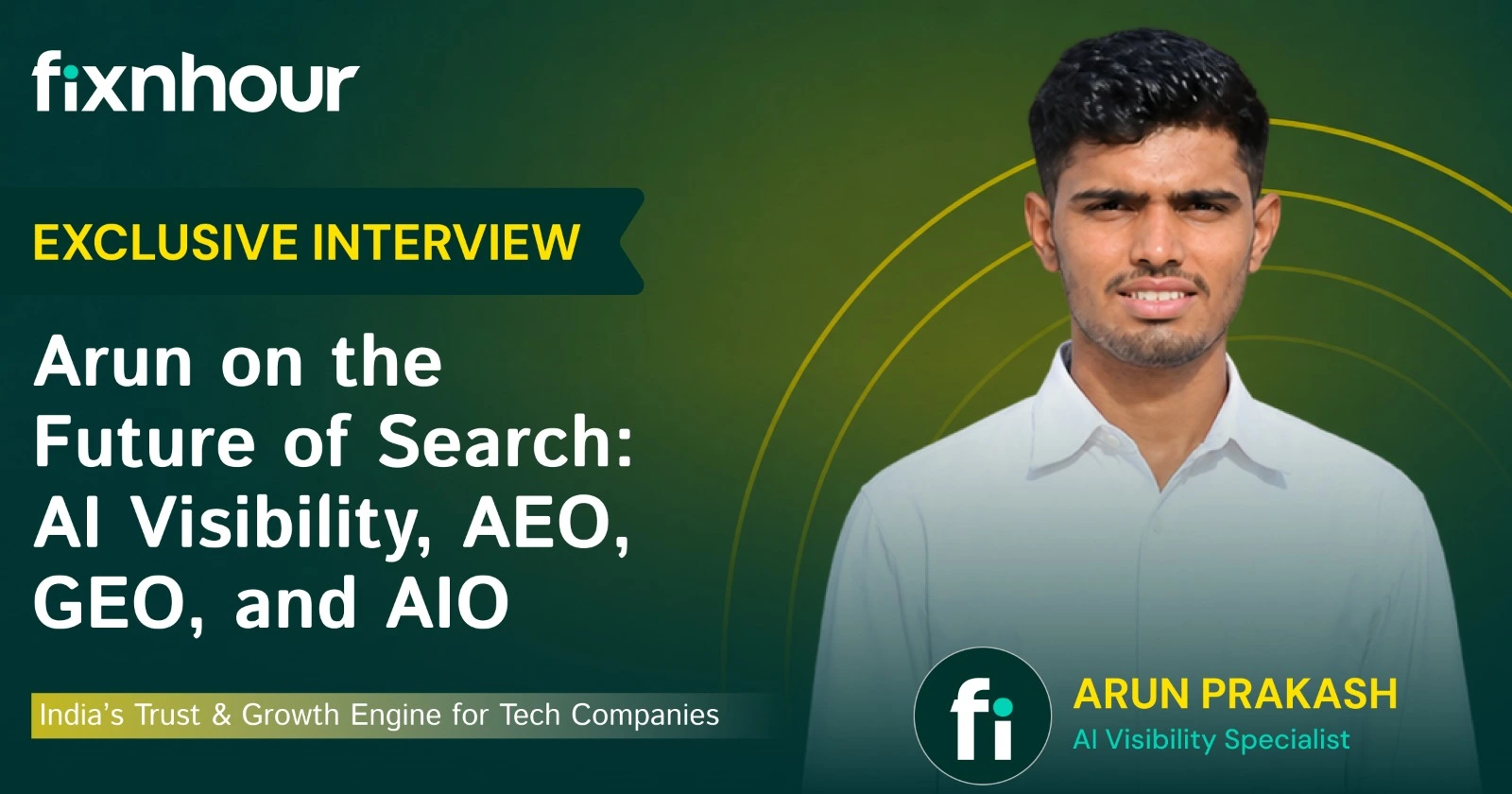
Search is turning into a dialogue. Consumers seek transparency in who is knowledgeable about them and what each company's services will cost, and who should be considered for their needs. For companies, this raises the real-world issue of how to ensure they become visible when the customer's path involves AI-driven assistants and synthesized responses.
This interview delves into that question from Arun's point of view and discusses AI visibility, answer engine optimization, generative engine optimization and the concept of AI optimization in general. These concepts are related to regular marketing decisions, such as web content, company profiles, customer reviews, technical accessibility, and performance measurement.The emphasis is on the practical because they need to know what customers require, and give them the evidence to check, and ensure that business information is accurate. While each new acronym may be a new concept, the discussion here’s about how they can complement each other for discovery, credibility and customer decision making.
Q1. Arun, how do you see the future of search evolving, and why should businesses focus on AI visibility alongside traditional SEO?
I think we're going to see more of search being conversational, more of search being contextual, and more of search being about making decisions.Arun Prakash A development partner seeker might want to have an AI assistant run a comparative analysis of companies, shed light on pricing models, and outline a set of questions they should ask before reaching out to any. That alters my vision of visibility. I would still do SEO, but I also wanted to make sure that the business was well-documented wherever buyers looked it up. Useful answers, credible evidence, and consistent information are the most important things to me. The future for me is to be a reliable source that someone can find, comprehend and trust in any search environment on the internet.
Q2. How do you define AEO, GEO, and AIO, and how does each contribute to a brand’s visibility in AI search?
I would define these terms before developing a strategy, as they're used differently by people.
- AEO stands for answer engine optimization, which involves creating content that's helpful and readable to the answer engines.
- Generative engine optimization (GEO) involves optimizing the way content can be found and referenced in the generated responses.
- AIO is not as standardized, meaning here the use of AI optimization for relevant discovery experiences.
The overall goal we're looking to understand is AI visibility: if a business is appearing, how does it get described, and whether or not those appearances are beneficial to customers. I think these are all sort of overlapping and it's good to have strong SEO and credible and useful content.
Q3. What practical steps can businesses take to improve their chances of being mentioned or cited by ChatGPT, Gemini, and Perplexity?
I would start with questions that a potential customer would ask: Is this correct? What is the cost? What are other options? What are the risks to the project? I would then create pages with specific evidence to answer those questions instead of salesy language. My first list of items is:
- Clearly communicate services, customers, locations and expertise.
- Share applicable case studies demonstrating outcomes.
- Verify the accessability of important pages to the appropriate search crawlers.
- Keep business details up-to-date on reliable external presence.
Allows OAI-SearchBot to be eligible for ChatGPT search. But just getting in doesn't equal citations. Visibility would be a thing I would test, document and improve over time on a consistent basis. OpenAI Help Center
Q4. What makes content useful enough for AI search platforms to reference when answering customer questions?
Creating content that is useful to readers begins with an actual question and provides a satisfying response without forcing the reader to search for it. First, I would present the answer, then give the reasons for the choice, any constraints or limitations, and then what I would do next. Specific examples are important because they allow people to make a judgment about whether the advice is applicable to their situation or not. If I'd say something about development costs, I'd describe the assumptions made in computing that estimate. When I talk about results, I would give the evidence. Readability is aided by clear headings and brief summaries, but it must be more than just the formatting. The aim is to get something out there that will be worth referring to for its understanding, detail, or point of view.
Q5. How do brand authority, customer reviews, and third-party mentions contribute to AI visibility?
I believe that authority is facilitated by the link to evidence. The only thing that a company that claims to be an expert tells me is very little. If there's a case study or an in-depth review of a customer, or a standalone reference, then I have something to work with. I would like businesses to provide that as proof of their good works or helpful contributions. Reviews must be authentic experiences and company information should be the same at trusted sites. I wouldn't say the more mentions, the more AI recommendations. I think that if the information you're using is credible and external it enhances the information you have to use to evaluate a brand.
Q6. What role do technical SEO, structured data, and website accessibility play in supporting AEO and GEO?
For me, technical SEO is the building blocks that facilitate the availability and comprehensibility of valuable content. I'd first want to know if critical pages load properly, can be crawled, and information is readable, before moving onto advanced tactics.
- Repair defective pages and confusing navigation.
- Check indexing/crawler access settings.
- Employ descriptive internal linking and clear page headings.
- Include relevant structured data, consistent with the content on screen.
Google states that generative search doesn't need a schema. I'd therefore apply the markup as needed, with the emphasis on the content and accessibility. Technical improvements are provided as a means towards eligibility and do not guarantee the selection or any specific citation. developers.google.com
Q7. How can B2B service providers build company profiles that help buyers and AI systems understand their expertise?
Don't hesitate to use a company profile as a valuable tool for your purchase. It is important for a buyer to grasp the business's mission, clientele and why the company has value. Rather than to mention all the capabilities, I would stress the service focus and evidence.
- Explain the industries and types of projects that you back.
- Use relevant case studies and client testimonials.
- Maintain of accurate names, locations and contact information.
- Be honest about the processes available for delivery and the options for engagement.
On sites like Fixnhour, I would prefer it if it was complete and consistent. A good profile can help people assess fit without resorting to general, unsubstantiated claims.
Q8. Which metrics should businesses track to measure AI visibility and connect it with qualified leads and business growth?
I would look at AI visibility by both observation and business outcomes. First, I would develop a set of questions that I could repeat for customers and note whether the brand comes up or if there is a citation or if the brand is described correctly. I would maintain the same platform, date and test conditions if possible as answers can differ. Next, I would take a look at the identifiable referrals, enquiries, and qualified opportunities. I would also inquire about a prospects source of information about the business. There is no single ‘visibility score'. I would focus on learning if there is a positive impact on the conversation, right product/messenger, and real progress toward business objectives after improving discoverability.
Q9. What common mistakes should businesses avoid when using AI-generated content for SEO, AEO, GEO, and AIO?
For me, the worst thing one can do is create more content and provide no added value. While AI can assist in structuring thoughts and drafting documents, it cannot replace the need for human review and enhancement, nor can it provide valuable expertise or fact checking. I would avoid:
- Creating statistics, testimonials or project outcomes that are fictional.
- Using words over and over again without it sounding natural.
- Making numerous web pages that contain similar content.
Q10. Looking ahead to 2027, what should businesses prioritize to prepare for the next phase of AI search?
This involves a grasp of customer queries, optimization of critical pages, knowledge sharing and documentation, and regular performance analysis. I would begin by one service category, develop robust supporting content, and then conduct business visibility testing to verify how well the business comes across in relevant search experiences. I would also assign someone to keep information up to date. I'd expect that interfaces and tools will continue to evolve, so flexibility is important. The real objective is simple: be discoverable, understandable and believable to a customer.
Conclusion
The future of search is not only about climbing up the search engine ranks on Google, it's about being a trusted source on AI-powered search platforms. As Arun mentions, businesses need to use all three of these AEO, GEO, AIO along with traditional SEO to become more discoverable, credible and engaging to customers. Content quality, genuine customer reviews, accurate business descriptions, and robust technical structures are going to be key components of AI visibility.
In 2027, companies need to prioritize providing actionable answers, showcasing knowledge, and tracking real results instead of going after AI buzzwords. In the end, brands that focus on transparency, relevance, and trust will be more successful in the changing search landscape. Talk to our experts