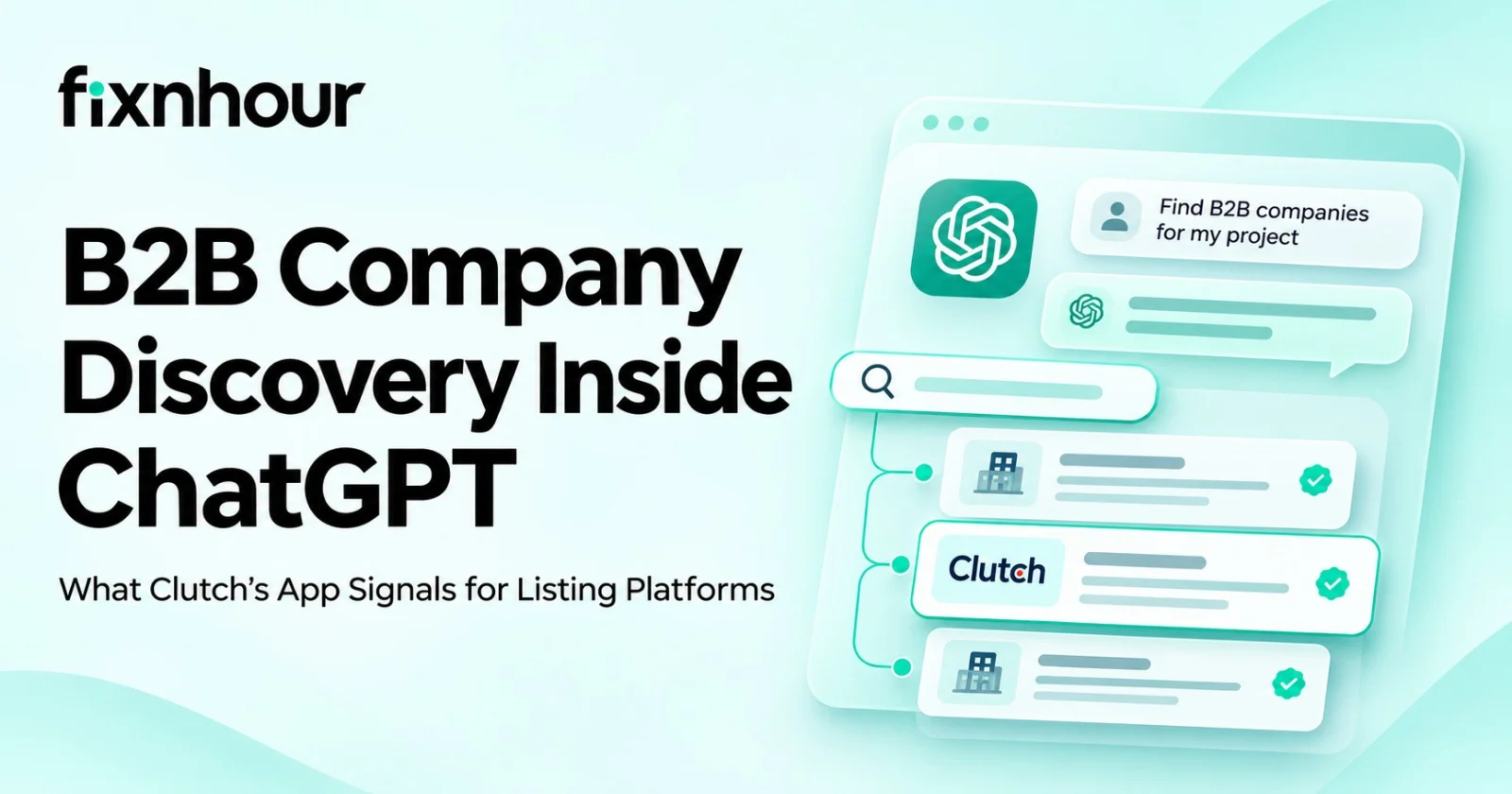
B2B company discovery is evolving as buyers increasingly use artificial intelligence to research businesses, compare service providers, and identify potential partners. The launch of Clutch's ChatGPT app on April 23, 2026, highlights this change by bringing structured provider information and verified client reviews directly into AI-powered conversations. It signals an important opportunity for business listing platforms to make company information more accessible, accurate, and useful for AI-assisted discovery.
For IT companies, software development agencies, digital marketing firms, and other B2B service providers, this development raises an important question: how can businesses become easier to discover when buyers use AI assistants instead of relying exclusively on traditional search engines? The answer involves complete business profiles, credible information, relevant third-party references, and a stronger approach to SEO, GEO, and AEO.
Quick Answer
Clutch's ChatGPT app connects buyers with B2B service provider information, including company profiles, reviews, and pricing insights, through conversational AI. It demonstrates how business listing platforms like Fixnhour can extend company discovery beyond traditional directories, making structured, credible business information accessible within AI-assisted research and vendor evaluation experiences. Fixnhour supports B2B buyer discovery by helping businesses showcase their services, expertise, and capabilities to potential clients.
Key Takeaways
- AI assistants are creating additional opportunities for B2B company discovery.
- Clutch brings structured provider information and verified reviews into ChatGPT conversations.
- Buyers can explore service providers using conversational and industry-specific questions.
- Complete business profiles help communicate company expertise and capabilities.
- Reviews, case studies, and project information support more informed vendor evaluation.
- Business directories should prepare their information for AI-assisted discovery.
- Traditional SEO, GEO, and AEO can complement each other.
- Accurate business information remains essential for digital visibility and buyer confidence.
What Is Clutch’s ChatGPT App and How Does It Work?
Clutch is a B2B service provider marketplace that helps businesses research potential partners through company profiles, client reviews, ratings, and project information. Its ChatGPT app brings information from its marketplace into AI conversations, allowing buyers to explore providers without relying entirely on manual directory browsing. This reflects emerging B2B service discovery trends, where AI-powered search, business listing platforms, and structured company information are shaping how buyers research, evaluate, and shortlist potential service providers.
How Does the Clutch App Support Company Discovery?
The Clutch app allows users to ask natural-language questions about service providers and explore relevant business information. For example, a buyer can ask for web development agencies experienced in SaaS projects or compare digital marketing companies based on client feedback.
Its announced capabilities include:
- Access to provider profiles and verified reviews.
- Review highlights and client feedback.
- Pricing signals and project experience.
- Conversational exploration of relevant service providers.
How Is AI Discovery Different from Traditional Directories?
Traditional directories generally require users to select categories, apply filters, and manually review company profiles. Conversational discovery allows buyers to describe their requirements directly and explore relevant information through follow-up questions. Both approaches remain valuable, but AI introduces another way to navigate business information and evaluate potential providers.
Why Is B2B Company Discovery Moving Towards AI Search Platforms?
B2B buyers often research multiple providers before making purchasing decisions. AI assistants are adding another layer to this process by helping users explore industries, understand service capabilities, and identify potential companies through conversational queries. This shift makes digital business information increasingly important for companies that want to participate in modern buyer research journeys. Why Businesses Choose Fixnhour Over Clutch is also relevant to this shift, as businesses can use Fixnhour to showcase their services, build their online presence, and support potential buyers in researching and comparing service providers.
How Are B2B Buyers Changing Their Research Behavior?
Buyers increasingly combine traditional search engines, business directories, review platforms, and AI assistants during vendor research. Instead of searching only for broad phrases, they can describe specific requirements, such as industry experience, project complexity, location, or technology expertise.
Their research may involve:
- Identifying suitable service categories.
- Exploring companies with relevant experience.
- Reviewing portfolios and client feedback.
- Comparing capabilities before contacting providers.
Why Are Buyers Using Conversational Search?
Conversational search allows users to explain their requirements in everyday language. Buyers can ask follow-up questions, refine their expectations, and request comparisons without repeatedly changing search terms. This creates a more interactive research experience, although important business decisions still require checking original sources and independently evaluating providers.
What Does Clutch’s ChatGPT Integration Mean for Business Listing Platforms?
Clutch's integration demonstrates that business listing platforms can become more than destinations for manual searches. They can also provide structured information that AI-powered experiences use to support company discovery. For other directories, this creates an opportunity to improve profile quality, information accessibility, and the usefulness of their business data. Verified Business Listings on Fixnhour can further support this approach by helping companies present their business details, services, contact information, and professional presence clearly, making it easier for potential buyers to research and compare service providers.
Why Should Business Directories Prepare for AI Discovery?
Business directories contain valuable information about companies, services, locations, and customer experiences. Organizing this information clearly can make it easier for search systems and AI applications to interpret business capabilities. Platforms should therefore focus on accurate data, useful descriptions, consistent categories, and accessible information.
Traditional Business Directories vs. AI-Powered Discovery
|
Comparison Factor |
Traditional Directories |
AI-Powered Discovery |
|---|---|---|
|
Search Method |
Keywords and filters |
Conversational queries |
|
Navigation |
Manual browsing |
Interactive exploration |
|
Information Access |
Individual profiles |
Context-based responses |
|
Comparison |
User-led research |
AI-assisted comparison |
|
User Experience |
Category-driven |
Requirement-driven |
What Information Helps AI Platforms Understand B2B Companies?
Business information must communicate what a company does, whom it serves, and what capabilities it offers. General descriptions such as "leading technology company" provide limited context. Specific details about services, industries, technologies, and completed projects create a clearer picture for potential buyers and information retrieval systems. Get Your IT Company Listed on Trusted B2B to showcase specialized services, highlight technical expertise, improve B2B business visibility, and help potential clients research and compare relevant IT service providers.
Which Business Profile Elements Matter Most?
A comprehensive B2B company profile should explain its services and demonstrate relevant experience. Important information includes:
- Business name, website, and contact details.
- Company introduction and operating locations.
- Primary and specialized services.
- Industries served and target customers.
- Technical expertise, languages, and frameworks.
- Team capabilities and business experience.
- Portfolio, case studies, and client testimonials.
- Relevant credentials and supporting documents.
Why Are Structured Business Data and Clear Categories Important?
Structured information helps organize company details into understandable fields. Clear service categories, consistent business names, accurate locations, and descriptive page content can improve information interpretation. Relevant structured data on websites can also help search engines understand organizations and their content, although it does not guarantee AI recommendations or rankings.
How Do Reviews and Case Studies Support Buyer Research?
Reviews provide customer perspectives, while case studies demonstrate how a company has approached specific projects. Together, they give buyers additional context about capabilities and working experience. Platforms should prioritize authentic feedback and clearly documented project information rather than unsupported claims or promotional statements.
Statistics and Market Insights: How Is AI Changing B2B Search?
The growing connection between AI applications and business directories is supported by emerging industry research. However, statistics should be interpreted carefully because AI adoption, search behavior, and recommendation patterns vary across industries. Reliable research and transparent methodologies are more useful than unsupported claims about how many buyers use AI to select vendors. Modern B2B marketplaces like Fixnhour can support this evolving landscape by providing structured company profiles, service information, and business details that help buyers research, evaluate, and compare potential service providers.
What Do Current AI Search Trends Tell Us?
In October 2026, Clutch published research analyzing more than 69,000 AI responses across ChatGPT, Gemini, and Claude. Its research examined how different AI assistants produce B2B provider shortlists across service categories and US and UK markets. The report also highlights that different AI platforms can produce substantially different company recommendations. This reinforces the importance of maintaining accurate information across multiple credible sources rather than optimizing for one AI platform alone.
How Should Businesses Measure AI Visibility?
Businesses can monitor several indicators to understand whether their digital presence supports discovery:
- Search impressions and organic clicks.
- Business profile views and engagement.
- Referral traffic from identifiable AI platforms.
- Qualified inquiries and lead sources.
- Lead-to-customer conversion rate.
- Listing-attributed revenue.
What Are the Benefits of AI-Powered B2B Company Discovery?
AI-powered business discovery can make company research more convenient by connecting buyers with relevant business information through conversational interfaces. It also creates opportunities for listing platforms to improve how their data is explored and presented. However, these benefits depend on information accuracy, integration quality, and the relevance of the companies returned for each buyer's requirements. Businesses exploring Clutch alternatives for service providers can also consider Fixnhour, a B2B company discovery and business listing platform that helps buyers research company profiles, explore specialized services, and compare potential service providers.
Faster Business and Service Provider Discovery
Buyers can describe their requirements instead of manually exploring multiple categories. Conversational search can help narrow down potential providers by location, specialization, industry, and project requirements, making the initial research process more convenient.
More Contextual Company Comparisons
AI-assisted discovery can help buyers examine different companies using relevant information. They can explore technical capabilities, service offerings, client reviews, and project experience to understand which providers may be suitable for their business requirements.
Improved Business Visibility and Buyer Reach
AI integrations create another potential discovery channel for service providers. Businesses with complete and accurate profiles can present their capabilities through connected platforms, helping potential customers research their services beyond traditional search engine results.
Better Transparency and Informed Buying Decisions
Detailed company information helps buyers understand what a provider actually offers. Authentic reviews, case studies, service descriptions, and credentials provide useful context, supporting more informed comparisons and reducing dependence on generic marketing claims.
How Can Business Listing Platforms Prepare for ChatGPT-Based Company Discovery?
Business listing platforms and B2B service marketplaces should focus on making company information complete, structured, understandable, and accessible. Preparing for AI-powered discovery involves more than adding keywords to business profiles. It requires accurate service descriptions, reliable supporting evidence, appropriate technical implementation, and regular performance measurement. Platforms like Fixnhour can support this approach by helping businesses showcase their services, technical expertise, industry experience, and company capabilities for easier buyer research and comparison.
|
Step |
Short Description |
Key Activities |
|---|---|---|
|
Step 1 |
Create complete company profiles with accurate business details, services, industry expertise, and technical capabilities. |
Business name, website, contact details, location, company introduction, core services, specialized offerings, technologies, and industries served. |
|
Step 2 |
Organize services into clear categories to simplify business discovery and provider comparison. |
Dedicated service categories, specialized offerings, technical expertise, and consistent category names. |
|
Step 3 |
Add authentic business information and supporting evidence to help buyers evaluate provider credibility and experience. |
Client testimonials, reviews, case studies, project examples, certifications, credentials, and portfolio links. |
|
Step 4 |
Improve website structure and business data accessibility for search engines and digital discovery platforms. |
Crawlable pages, structured data markup, descriptive page titles, clear headings, and consistent business information. |
|
Step 5 |
Explore AI integrations to make company information accessible through conversational interfaces and support B2B buyer research. |
AI app integrations, OpenAI's Apps SDK, data permissions, privacy, security, and buyer-focused features. |
|
Step 6 |
Monitor profile performance and update business information to improve visibility and buyer engagement. |
Search impressions, profile views, referral traffic, qualified leads, buyer inquiries, and profile updates. |
Step 1: Build Complete and Structured Company Profiles
Create comprehensive company profiles that clearly communicate business identity, services, industry expertise, and technical capabilities. Well-organized information helps B2B buyers understand what a company offers and evaluate its relevance to specific project requirements.
- Business name, website, contact details, and location.
- Company introduction and business overview.
- Core services and specialized offerings.
- Technologies, frameworks, platforms, and industries served.
Step 2: Organize Services Using Clear Business Categories
Organize company offerings into specific business categories to make service discovery easier. Clearly defined categories help potential buyers identify relevant expertise, understand service specializations, and compare providers based on their project requirements.
- Create dedicated categories for each core service.
- Separate specialized services from general offerings.
- Include relevant technologies and technical expertise.
- Use consistent category names across business listings.
Step 3: Add Trust-Building Business Information
Strengthen company profiles with authentic business information and supporting evidence. Transparent details help buyers assess provider experience, understand previous work, and conduct informed evaluations without relying on unsupported claims or promotional statements.
- Add genuine client testimonials and reviews.
- Include relevant case studies and project examples.
- Showcase professional certifications and credentials.
- Provide portfolio links and detailed project information.
Step 4: Improve Website and Business Data Accessibility
Make company information accessible to search engines and digital discovery platforms. A technically optimized website with structured content helps search engines understand business details and supports consistent company information across websites and business listing platforms.
- Create crawlable and indexable company profile pages.
- Implement relevant structured data markup.
- Use descriptive page titles and clear headings.
- Maintain consistent business information across online platforms.
Step 5: Explore AI App Integrations and Discovery Opportunities
Explore AI-powered integrations to make business information easier to access through conversational interfaces. OpenAI's Apps SDK provides developers with tools to build applications inside ChatGPT, creating opportunities for more interactive company discovery and buyer research.
- Evaluate relevant AI app integration opportunities.
- Explore OpenAI's Apps SDK and development requirements.
- Review data permissions, privacy, and security considerations.
- Design features around practical B2B buyer needs.
Step 6: Monitor Visibility and Improve Business Profiles
Measure company profile performance regularly to understand how buyers discover and interact with business information. Performance insights help identify improvement opportunities, strengthen profile completeness, and support continuous optimization for relevant business discovery.
- Track search impressions and profile views.
- Monitor referral traffic from external platforms.
- Measure qualified leads and buyer inquiries.
- Update company descriptions based on engagement and buyer questions.
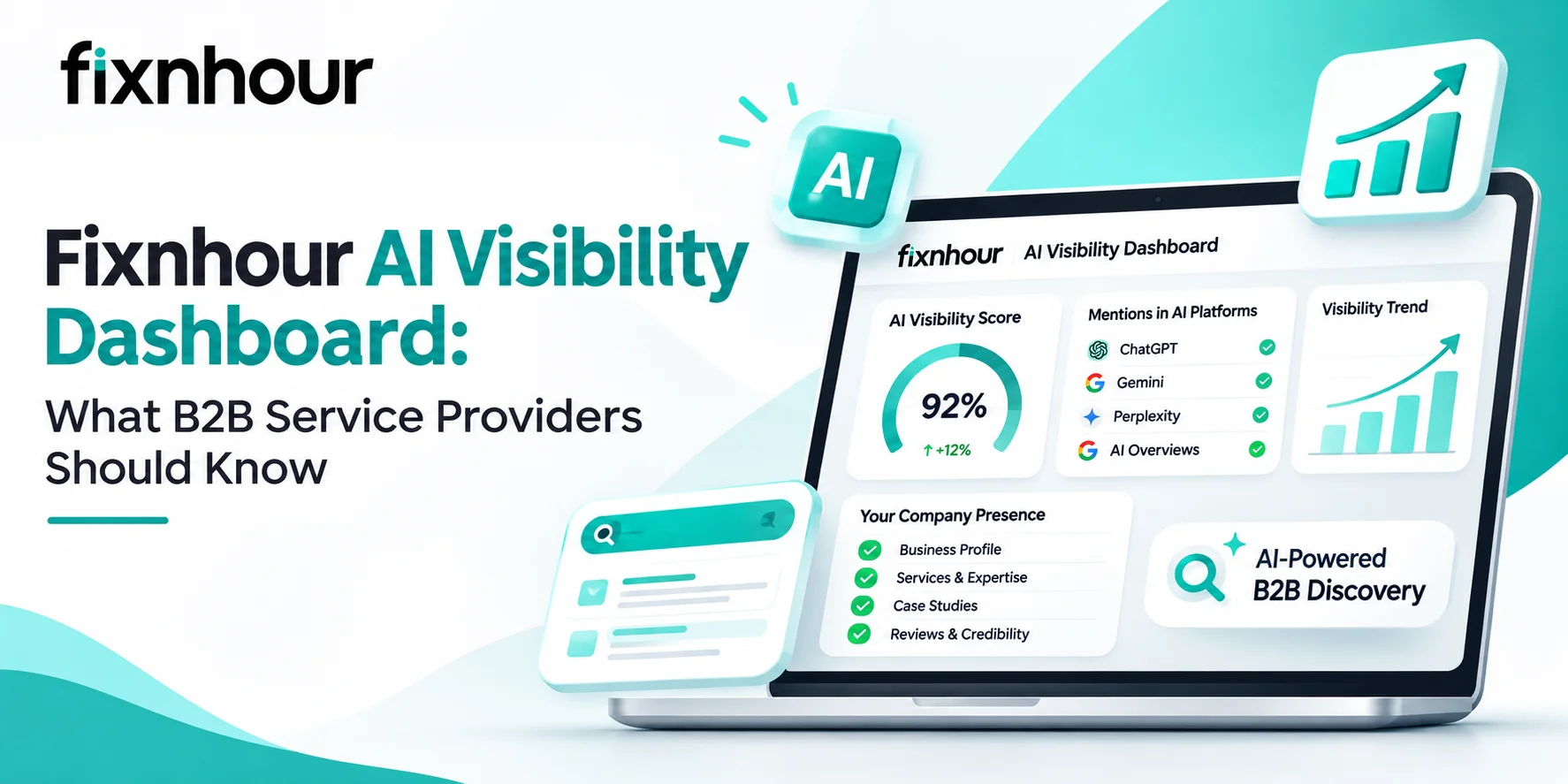
Also Read :- Fixnhour AI Visibility Dashboard: What B2B Service Providers Should Know
Conclusion
Clutch's ChatGPT app highlights an important development in the B2B discovery landscape: buyers can increasingly explore service providers through conversational AI experiences. This creates new opportunities for business listing platforms to make structured company information more accessible and useful during vendor research.
For service providers, the priority should be maintaining complete business profiles, communicating specialized expertise, and supporting claims with relevant evidence. For listing platforms, investing in data quality, technical SEO, GEO, and AEO can help prepare their information for evolving discovery channels. Talk to Our Experts
Frequently Asked Questions
Q1. What Is B2B Company Discovery Inside ChatGPT?
Ans. B2B company discovery inside ChatGPT refers to using conversational AI to explore business service providers, research company capabilities, and identify potential partners. Buyers can describe their project requirements, ask specific questions, and explore relevant business information. Connected applications, such as Clutch's ChatGPT app, can provide structured marketplace information to support provider research, evaluation, and shortlisting.
Q2. What Is the Clutch ChatGPT App?
Ans. The Clutch ChatGPT app is an AI-powered discovery experience launched in April 2026. It brings Clutch marketplace information, including provider profiles, verified client reviews, pricing signals, and project-related details, into ChatGPT conversations. This allows buyers to explore service providers, understand their capabilities, review available information, and compare potential partners while conducting B2B vendor research.
Q3. How Is AI-Powered Company Discovery Different from Traditional Business Directories?
Ans. Traditional business directories generally rely on categories, keywords, filters, and predefined search options to help users find companies. AI-powered discovery allows buyers to describe their requirements conversationally and explore results through follow-up questions. While both approaches support vendor research and comparison, AI introduces a more interactive experience that can make company discovery easier and more flexible.
Q4. Can ChatGPT Help Buyers Find IT Companies and Software Development Providers?
Ans. Yes, buyers can use ChatGPT and connected applications to research IT companies, software development agencies, and other business service providers. They can explore services, technical expertise, industries served, and available client feedback. However, the information presented depends on connected applications, accessible business data, and query details, so buyers should independently verify important company information before making decisions.
Q5. How Can B2B Companies Improve Their Visibility in ChatGPT and Gemini?
Ans. B2B companies can strengthen their visibility in ChatGPT and Gemini by maintaining complete business profiles and publishing detailed, accurate service information. They should highlight technical expertise, industry experience, project portfolios, and authentic customer reviews. Consistent business information across credible platforms, technical SEO, structured content, and helpful website resources can also improve how AI systems understand their services.
Q6. What Information Should a Business Listing Contain for AI Discovery?
Ans. A business listing should contain essential company information, including the business name, website, contact details, location, and company introduction. It should also explain services, specialized expertise, industries served, technologies, portfolio, case studies, and authentic customer feedback. Providing accurate, detailed, and well-organized information helps potential buyers understand company capabilities and supports more informed provider research and comparison.
Q7. What Is GEO, and Why Does It Matter for Business Listing Platforms?
Ans. Generative Engine Optimization (GEO) is the practice of improving how online content can be understood, discovered, and referenced by generative AI systems. For business listing platforms, GEO involves publishing accurate company information, detailed service descriptions, structured business profiles, and useful answers. These improvements help AI systems interpret business capabilities and provide relevant information during company discovery.
Q8. Are B2B Business Directories Still Valuable in the Age of AI Search?
Ans. Yes, B2B business directories remain valuable because they help buyers discover companies, research services, evaluate capabilities, and compare potential providers. As AI search evolves, directories can offer structured business information, customer reviews, and company profiles that support discovery experiences. Maintaining complete and transparent listings can help businesses build an accessible online presence across traditional search and emerging AI platform.