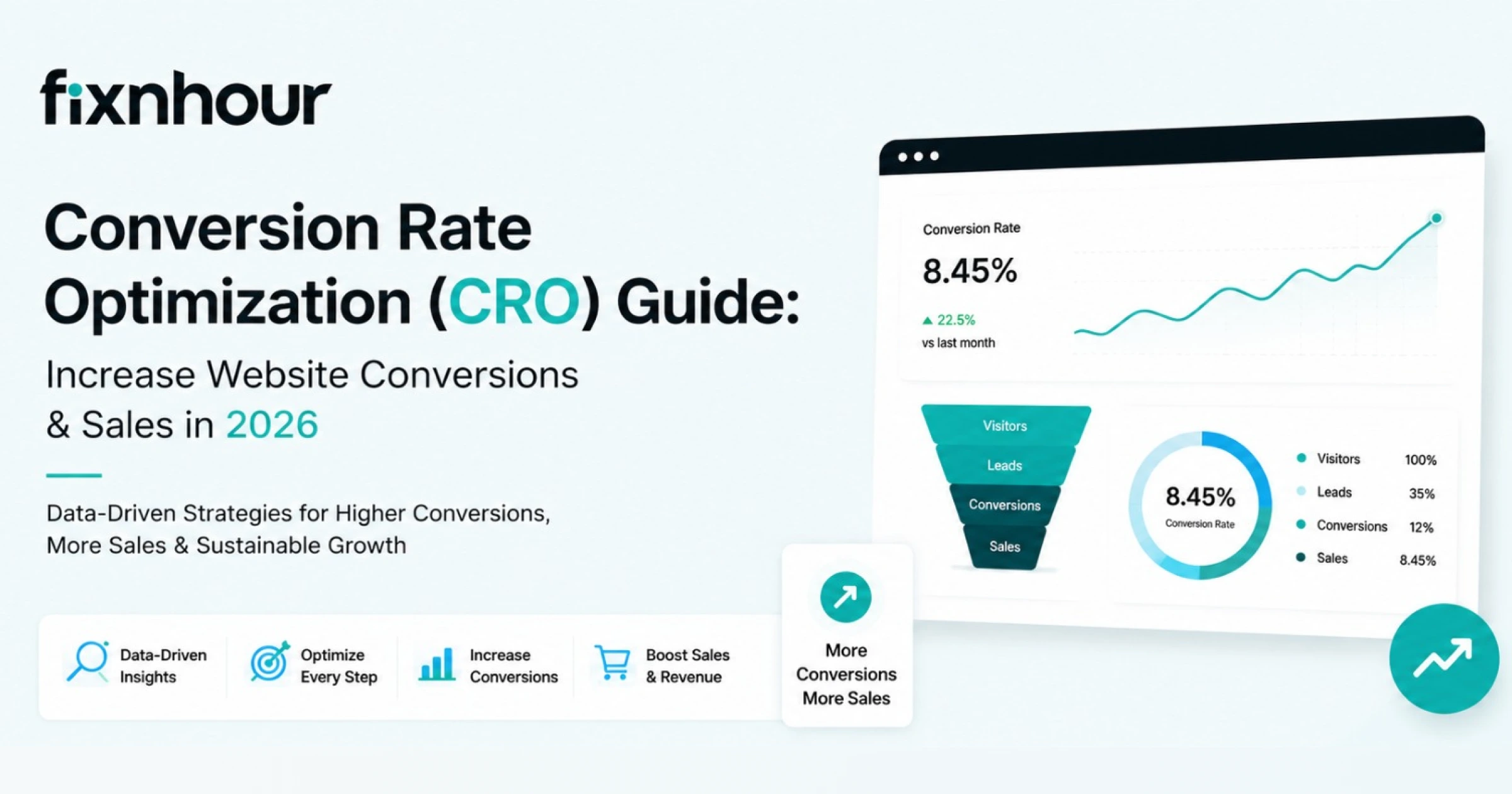
In today’s digital world, traffic is not enough. You need results. That is where the Conversion Rate Optimization Guide comes in. It helps businesses turn visitors into customers. At Fixnhour, we focus on smart growth, not just traffic growth. That’s why Conversion Rate Optimization is a core part of every digital strategy. If your website gets visitors but no sales, you need better Website Conversion Optimization. This blog will help you understand how to Increase Conversion Rate using simple and practical steps. We will also break down CRO Strategies that actually work in 2026. Conversion Rate Optimization (CRO) is the strategic process of improving your website to increase the percentage of visitors who take a desired action, such as making a purchase, signing up, or filling out a form. In today’s highly competitive digital landscape, driving traffic alone is not enough—what truly matters is converting that traffic into real business results.
This CRO Guide for 2026 will help you understand how to analyze user behavior, identify conversion barriers, and implement data-driven improvements that enhance user experience and boost sales. From optimizing landing pages and improving page speed to refining calls-to-action and A/B testing, every small change can significantly impact performance. Whether you run an e-commerce store, SaaS platform, or service-based website, mastering CRO ensures you get maximum value from your existing traffic while reducing customer acquisition costs and increasing revenue growth sustainably.
What is Conversion Rate Optimization (CRO)?
Conversion Rate Optimization means improving the website so more visitors take action. A strong Conversion Rate Optimization Guide focuses on user behavior. It studies what users click, where they leave, and what stops them from converting. At Fixnhour, we use data-driven methods for Conversion Rate Optimization to improve business performance without increasing ad spend.
- Buying a product
- Filling a form
- Signing up
- Booking a service
Common Types of Website Conversions
Each type needs different Conversion Rate Optimization Guide tactics. That’s why Conversion Rate Optimization is never one size fits all. Common types of website conversions include actions that show user interest or generate business value. These include lead generation through form submissions, product purchases for direct sales, newsletter sign-ups for audience growth, video views and clicks for engagement, and app downloads for expanding user base. Each conversion type helps businesses measure performance and optimize strategies for better results.
| Type of Conversion | Example | Impact on Business | CRO Focus Area |
|---|---|---|---|
| Lead Generation | Form submission | Builds potential customer list | Landing page + CTA optimization |
| Sales | Product purchase | Direct revenue generation | Checkout flow + trust signals |
| Engagement | Video watch, clicks | Improves user interaction | Content placement + UX design |
| Sign-ups | Newsletter subscription | Long-term audience building | Popup timing + offer clarity |
| App Downloads | Mobile app install | Expands user base | App landing page optimization |
Also Read: Not Getting Leads? Proven Lead Generation Strategies Guide (2026)
Why Conversion Rate Optimization Matters
If your traffic is high but sales are low, your Website Conversion Optimization is weak. Good CRO Strategies help businesses get more value from existing traffic. Instead of spending more money, businesses should optimize what they already have. Fixnhour always suggests businesses focus on Increase Conversion Rate before scaling ads.
- Saves marketing cost
- Increases revenue
- Improves user experience
- Boosts ROI
Also Read: Small Business Websites in 2026: Growth, Gaps, and Where to Invest Next
Best Conversion Rate Optimization Strategies
Conversion Rate Optimization (CRO) strategies focus on improving website performance to turn more visitors into customers. Key methods include optimizing landing pages, enhancing page speed, improving CTAs, running A/B tests, and building trust with reviews and secure payments. By understanding user behavior and removing friction points, businesses can increase conversions, boost sales, and maximize ROI from existing traffic.
- Improve Website Speed - Slow loading websites directly reduce conversions. Faster pages improve Website Conversion Optimization instantly.
- Clear Call to Actions (CTA) - Use simple words like “Buy Now” or “Get Started.” This helps improve Conversion Rate Optimization quickly.
- Mobile Optimization - Most users are mobile. Fixnhour ensures every site is mobile-friendly for better Conversion Rate Optimization Guide results.
- A/B Testing - Test different layouts and content. Small changes can strongly increase Conversion Rate.
- Trust Signals - Add reviews, ratings, and testimonials. Trust increases conversions naturally.
Essential CRO Tools for Marketers & Businesses
Essential Fixnhour CRO tools help marketers and businesses analyze user behavior, test website changes, and improve conversion rates effectively. Popular tools include Google Analytics for traffic insights, Hotjar for heatmaps and session recordings, and Google Optimize for A/B testing. These tools help identify drop-off points, improve UX, and make data-driven decisions that increase leads, sales, and overall website performance. Fixnhour uses advanced tools to improve Conversion Rate Optimization for clients across industries.
| Tool | Purpose | Best Use Case | Benefit |
|---|---|---|---|
| Google Analytics | Track user behavior | Traffic analysis | Understand user journey |
| Hotjar | Heatmaps & recordings | UX behavior tracking | Identify drop-off points |
| Google Optimize | A/B testing | Experimenting layouts | Improve conversion decisions |
| SEMrush | Traffic insights | SEO + competitor analysis | Improve overall website strategy |
| Microsoft Clarity | Session recordings | User interaction tracking | Free behavior insights |
Also Read: How Business Listing Platforms Help Companies Generate Leads in 2026
Conclusion
In 2026, competition is high. Just getting traffic is not enough. Businesses must focus on Conversion Rate Optimization Guide techniques to grow faster. Strong CRO Strategies help businesses to turn clicks into customers. And proper Website Conversion Optimization ensures that the business grows without extra ad cost. At Fixnhour, we believe smart optimization is better than hard spending. With the right Conversion Rate Optimization, any business can Increase Conversion Rate and boost profits. If you are serious about growth, start improving your website today with proven Conversion Rate Optimization Guide methods. Fixnhour is here to help you scale smarter.
Essential CRO tools help marketers and businesses analyze user behavior, test website changes, and improve conversion rates effectively. Popular tools include Google Analytics for traffic insights, Hotjar for heatmaps and session recordings, and Google Optimize for A/B testing. These tools help identify drop-off points, improve UX, and make data-driven decisions that increase leads, sales, and overall website performance. Contact us today to optimize your conversions and grow your business.
Frequently Asked Questions
Q1. What is Conversion Rate Optimization (CRO)
Ans. Conversion Rate Optimization (CRO) is the process of improving a website or landing page to increase the percentage of visitors who complete a desired action, such as making a purchase, signing up, or filling out a form. It focuses on understanding user behavior, identifying barriers, and making data-driven improvements. CRO combines analytics, UX design, and testing methods like A/B testing to enhance performance. The goal is to maximize the value of existing traffic without increasing advertising costs, ultimately improving leads, sales, and overall business growth in a sustainable and measurable way.
Q2. Why is CRO important for businesses
Ans. CRO is important because it helps businesses get more value from their existing website traffic. Instead of spending more on ads, CRO improves the effectiveness of current visitors by turning them into customers or leads. It reduces customer acquisition costs and increases return on investment (ROI). A well-optimized website also improves user experience, builds trust, and increases customer satisfaction. Businesses that use CRO strategies can outperform competitors by converting more visitors efficiently. In today’s competitive digital market, CRO is essential for sustainable growth, higher revenue, and better marketing performance across all industries.
Q3. What are the main elements of CRO
Ans. The main elements of CRO include landing page optimization, call-to-action (CTA) improvements, A/B testing, user experience (UX) design, page speed optimization, and trust-building factors like reviews and secure payments. Analytics tools are also essential to track user behavior and identify drop-off points. Each element works together to reduce friction in the customer journey and guide users toward conversion. By improving these areas, businesses can increase engagement, reduce bounce rates, and improve overall website performance. CRO is a continuous process that requires testing, analyzing, and refining strategies for better results over time.
Q4. What tools are used in CRO
Ans. Common CRO tools include Google Analytics for tracking user behavior and traffic sources, Hotjar for heatmaps and session recordings, and tools like Google Optimize or VWO for A/B testing. These tools help businesses understand how users interact with their website, where they drop off, and what changes can improve conversions. Other tools include Crazy Egg, Optimizely, and Microsoft Clarity. Each tool provides valuable insights into user experience and performance metrics. By using these tools, marketers can make data-driven decisions, improve website design, and increase conversion rates effectively and efficiently.
Q5. How does A/B testing help in CRO?
Ans. A/B testing helps improve conversion rates by comparing two versions of a webpage to see which performs better. For example, businesses can test different headlines, images, CTAs, or layouts to understand what users prefer. Traffic is split between both versions, and performance is measured based on conversions. The winning version is then implemented for better results. A/B testing removes guesswork and ensures decisions are based on real user data. It is a powerful CRO technique that helps businesses continuously optimize their website, improve user experience, and increase sales or leads over time.
Q6. What are common CRO mistakes to avoid?
Ans. Common CRO mistakes include ignoring data, making changes without testing, focusing only on traffic instead of conversions, and using unclear or weak CTAs. Other mistakes are slow website speed, poor mobile optimization, and not understanding user intent. Many businesses also fail to track results properly or rely on assumptions instead of analytics. Avoiding these mistakes is crucial for successful CRO implementation. A structured, data-driven approach with continuous testing and optimization leads to better user experience, higher engagement, and improved conversion rates. Businesses should always prioritize user needs and ongoing performance analysis.