Today's dynamic technology environment has made building a fantastic product just the first step. But, to realize sustainable growth from innovation, businesses must also have a clear go-to-market strategy, robust positioning, trusted partnerships, understanding their customers and disciplined execution. Understanding markets and providing continuous business value is increasingly becoming an advantage, as AI technology keeps advancing the product development and brings it closer than ever.
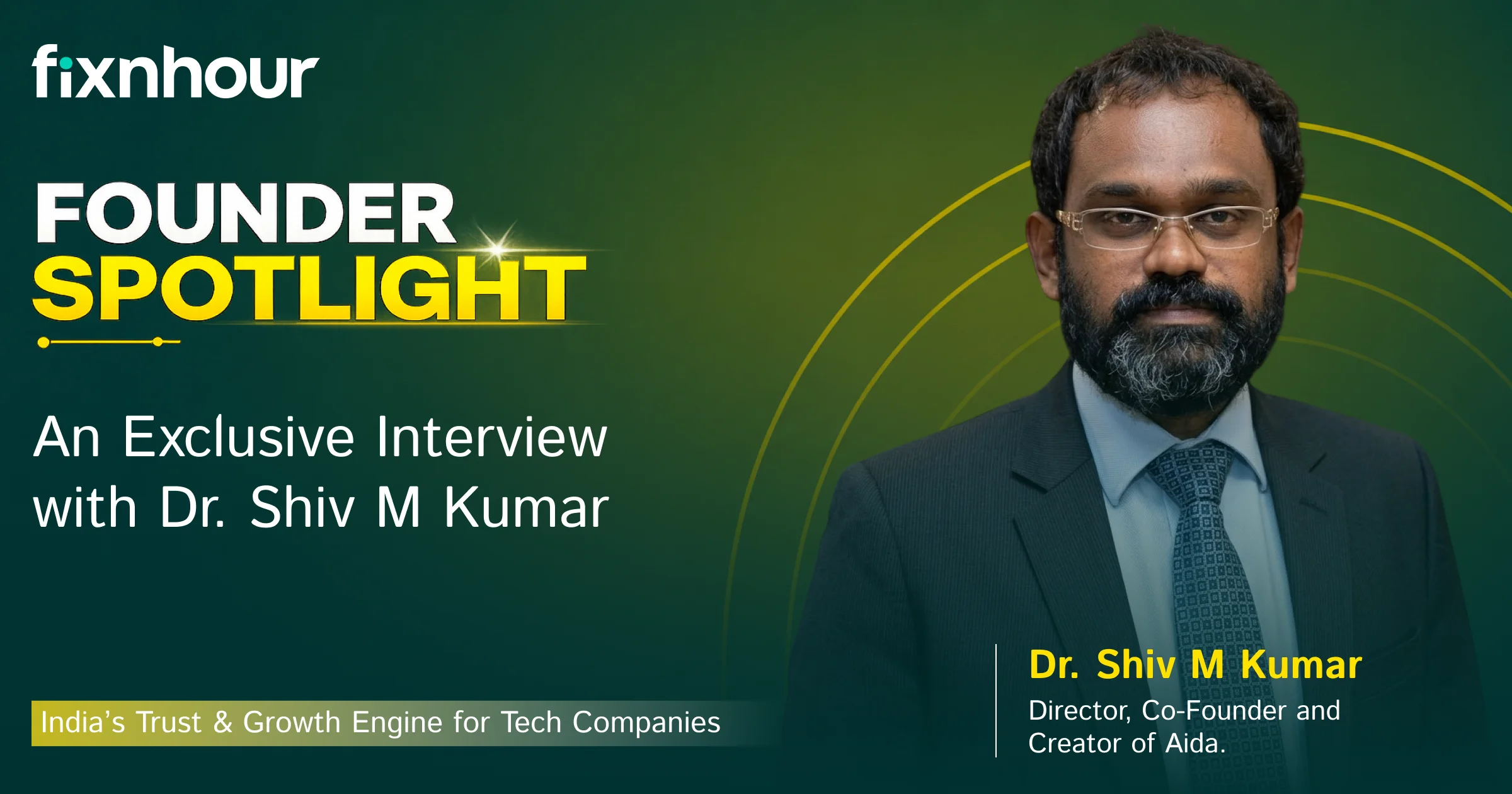
Dr. Shiv M Kumar has 20+ years of experience spanning technology, business strategy, go to market, alliances, corporate communication and leadership. His career also encompasses former CMO of Tally, a Worldwide Leadership Program at Microsoft Redmond, as well as service to management education as a Visiting Professor at top institutions around the world. As Director, Co-Founder and Creator of Aida, he is still applying technology innovation and strategic market thinking.
Key Takeaways
- To make technology products successful, they must have robust go-to- market strategies that enable them to be adopted.
- Customers do not purchase features, they purchase results.
- Ecosystems and alliances can fast-track growth of tech companies.
- Structured value exchange and accountability are important for partnerships.
- Doing things well and in a systematic way will produce results; doing things well and with a strategy will produce direction.
- Global companies must be consistent and be relevant locally.
- AI will accelerate development but not generate strategic clarity.
- The easier the technology gets to build, the stronger the differentiation is going to be in terms of customer understanding and distribution.
- Branding is more than just visual – it's the total customer and market impression.
- The corporate communication must be consistent with the real corporate behaviour.
- Don't confuse access to AI-generated information with deep expertise.
- Mastery is acquired through repeated use, experience and judgment.
- Local market knowledge is essential for international expansion.
- In today's global competitive markets, it is becoming more and more critical to communicate clearly.
- Clarity, focus, ownership and accountability are essential qualities in strong leadership.
- Past success should not prevent leaders from continuing to learn.
- AI can make you fast, mastery can make you competitive.
Who is Dr. Shiv M Kumar?
Certain tech CEOs create products. Others develop markets based on products. Dr. Shiv M. Kumar has worked for over 20 years on the business strategy/technology, go-to-market execution, alliance and corporate communication and leadership interface. Shiv has a deep and unique combination of experience from some of the world's most recognized technology brands and institutions as the Director, Co-Founder and Creator of Aida. Leadership experience includes being former CMO of Tally and having worked earlier in Worldwide Leadership Program at Microsoft Redmond, and continuing academic engagements as Visiting Professor at IIM Indore, IIM Raipur, IIM Rohtak and NMIMS. In all these positions there's been one common challenge: getting the strategy to the execution.Shiv's great ideas aren't sufficient. Product positioning is the key to a good product. Unless a firm has market clarity, it will not be a strong company. A partnership must be organized. A strategy must be executed in a disciplined way.This hands-on approach is reflected in his specialization in Go-to-Market strategy, alliance policy, corporate communication and methodological execution.
Throughout the years, Shiv has operated in complex business and technology environments where not only did he need to know his customer, but he also needed to coordinate his team, partner, communication, distribution and market timing to be successful. As Co-Founder and Creator of Aida, he's using those insights today to tackle a new chapter focused on innovation and intelligent technology.Meanwhile, his academic career gives him the opportunity to interact with next generation business leaders and pass on insights gained from experience in execution, market development, and organizational development. Today's significance of Shiv's journey is that technology companies are in a new reality. Developing software has become quicker.Development cycles are being shortened with the help of AI.The distribution is becoming more and more global.Competition is intense.In a context like this, clarity, positioning, alliances, and discipline in executing GTM are even more crucial. As a Fixnhour Founder, Dr. Shiv M Kumar shares his insights into building markets, designing GTM strategies, building strong alliances, adapting to technology changes, and the importance of mastery in a more automated world.
Q1. Shiv, you have spent more than two decades across business and technology. What shaped your professional journey?
My path has always been a mix of curiosity, drive and a fascination with what makes businesses grow. So technology is a small part of it. Fixnhour A product may be great, but if the market doesn't appreciate its worth or if the positioning is not clear or the organization doesn't execute it consistently, the product can still falter. It's what attracted me to things like go-to-market strategy, alliances, communications and execution within the corporate world. In the course of the years, I got to work with big companies and multinational companies with top-level technology brands. These were all learning moments for me, allowing me to gain insight into the ways that large companies think about markets, partnerships, customers and scale. They also drove home one point: A strategy is only useful if it can be put into action in a systematic fashion. I have always been a firm believer that one should have definite objectives and strive to acquire mastery over the skills needed to attain these objectives.This frame of thinking has affected all parts of my way of life.
Q2. What did your experience at Tally teach you about building and marketing a technology brand?
Tally is a very interesting example, since it is both interesting in the realm of technology, and interesting in the realm of real business utility. There he learned how crucial it is to know your customer intimately. In the technology industry, some companies tend to get stuck with features. Consumers don't purchase features. They buy outcomes. They want efficiency. They want reliability. They want simplicity. Their goal is to find a solution that works within their working method. Marketing is therefore tasked with making technology "business value.Marketing is therefore required to make technology "business value. Further important lessons were learned about the strength of ecosystems. Being directly connected to software companies isn't enough to make them grow. There are many factors that influence adoption; among them are partners, distributors, accountants, consultants, businesses, and communities. So, ‘customer understanding and ecosystem thinking' is essential to building a strong technology brand. It is still the case today.
Q3. You also had exposure to leadership at Microsoft Redmond. What did that experience teach you about global technology organizations?
Global organisations are incredibly complicated. Creating a good product isn't the challenge. It is connecting all the product, markets, partners, teams, communication and execution points across geographies. An important take-away from many technological systems in the world is the significance of frameworks. In the world of scale, decisions cannot be made just on intuition of individuals. There need to be repeatable systems. Meanwhile, international businesses must stay ‘local' as well. The strategies that work well in one market can not necessarily be replicated the same way in another. The balance between global consistency and local adaptability is very crucial. The challenge of leadership at scale is about having sufficient structure to keep the organization clear but not so much that it becomes slow.
Q4. Go-to-Market strategy is one of your key areas of expertise. What do companies commonly get wrong about GTM?
There are many organizations that consider GTM as a launch plan. It's so much more than that. To get products to market, some basic questions need to be addressed. So who's the customer? What do we want to learn/ accomplish? What's the point in them caring? How to get to them? Who will make the choice? What channels matter? Which partnerships can help to drive growth? What is the position of the product? So, what is it that will make the customer select us over another choice? When the questions are not clear marketing can be costly noise. The second mistake is to try and appeal to everyone. Focus is required for good GTM. When the first users of a product are well-defined, the product is likely to gain traction more quickly. With the organization's understanding of what works, expansion is easier.
Q5. How important are alliances in building technology businesses?
When properly planned, alliances can be a significant growth facilitator. Tech companies will attempt to build everything by themselves. However, ecosystems are forces to be reckoned with. A strong partnership may offer distribution, access to customers, credibility, complementary technology or market knowledge. The error is in entering into partnerships without clarity. Alliances should have a clear value exchange. What do each of the sides bring to the table? What are the benefit(s) that each side receives? What will be the success criteria? Who owns execution? What happens when priorities change? Getting a partnership announcement is simple. It is important to structure the partnership outcomes. This is why alliance policy and methodical execution is crucial.
Q6. What does methodical execution mean to you?
It involves translating the strategy into a series of clear actions, assignments, tracking, and review. Numerous companies have excellent strategies. The lack of clarity about roles or responsibilities, the lack of weak or unambiguous metrics, or the lack of alignment of teams are all reasons why execution breaks down. A strategy will eventually be converted into: What do you need to do? Who is responsible? By when? What will be our indicators of progress? But what if we get it wrong? Having a disciplined execution is essential for methodical execution too. Not all new ideas are worthy of attention. Organizations must be able to maintain a focus long enough to allow a strategy to have an impact. Often it's execution that isn't as interesting as strategy. Execution is the place where businesses truly are created.
Q7. You are now building Aida. What excites you most about this chapter?
When you build again you have the chance to take with you decades of learning and transfer it to a new problem. That is exciting. Things have undergone a huge transformation in the field of technology. AI has revolutionized the capabilities of products, their fast production, and user interaction with software. The fundamentals however are the same. So, there is still a need for customer clarity. There is still positioning to do. You still need to be executed. There has to be some justification for the market's interest. The opportunity of Aida is a chance to merge technologic innovation with market thinking. That combination is crucial in today's world where it is easy to create technology. Meaningful adoption is much more difficult to make.
Q8. How do you see AI changing the competitive landscape for technology companies?
Many of the barriers that stand in the way of traditional methods of communication are being removed by AI. Now, development is speeding up. Creating content is getting easier. More research is becoming available. Automation is increasing. That is, the advantage of being able to build tech is diminishing. The benefit will be greater knowledge and understanding of the customer. Choosing better problems. Creating stronger positioning. Building trusted distribution. Designing better experiences. And carrying them out in a more disciplined way. Average execution will be even faster with the help of AI. It won't necessarily provide strategic clarity. This continues to be a human duty.
Q9. You also teach at leading management institutions. What do you emphasize when working with future leaders?
I do attempt to relate theory to reality. The role of frames: They enable people to organize their thinking. However, business doesn't always operate exactly like a case study. Some data missing. Conflicting priorities. Human emotions. Organizational politics. Changing markets. Judgement is thus the key to leadership. I am encouraging students to get an understanding of both strategy and execution. Easy to say what a company should do, from the outside. That's a surefire way to make it difficult to follow in a budget, with people, time, customers and constraints. This is a practical approach that's significant.
Q10. What do young founders misunderstand about branding and corporate communication?
Brands are commonly perceived as visual identity. A logo is a part of branding. It's not the brand. A brand is the sum of the impression that a company has left on consumers. What is the meaning of the company name? What is its promise?Does the customer experience live up to that promise? How do staff refer to the organisation? What is the partners' experience? Is communication consistent? Corporate communication should back up clarity and trust. When a company claims that one thing when doing something completely different, they will lose the trust of the customers over time. Brands are built with the alignment of message and experience.
Q11. How should founders think about mastery in an age where AI makes information widely available?
Knowledge and understanding are two different animals. AI can give information in real-time. It can summarize. Can brainstorm ideas. It can be used to assist analysis. But practice makes perfect. It stems from decision making. Experiencing consequences. Correcting mistakes. Developing judgement. AI can speed up learning. It cannot take the place of practical experience. I think people with a deep understanding of a field coupled with AI skill will be making extraordinary value. The error would be to think that with information there is no need for expertise.With everyone having access to similar information, it actually makes true expertise more valuable.
Q12. What leadership principles have remained important throughout your career?
Clarity. Focus. Accountability. And continuous improvement. Purpose has to be communicated by leaders. When everything seems equally important, people can't execute properly. Ownership should also be created by leaders. A team that waits to approve on each decision cannot be speedy. The need for accountability is a consequence of the demand for strategy results. Last, but not least, leaders must continue to learn. You can rely on experience but this can lead to blind spots. Markets change. Technology changes. Customers change. A good leader must be confident but not inflexible.
Q13. What advice would you give technology founders preparing to enter international markets?
Don't think that a successful campaign can be simply replicated in other markets. Local understanding is required for international expansion. Customer behavior may vary. Different prices can be charged. It's okay if channels vary. Trust signals are not the same. The regulations may vary. Partnerships are thus very helpful. It can be a long time on the learning curve without a strong local partner in place. Founders should also focus on positioning their business. Never market into a new market with just the statement that you offer “software development” or “technology services”. State the reason of your relevance. What are you particularly good at? What customer need do you fulfill more effectively? International markets are averse to uncertainty.
Q14. What does success mean to you today?
Success is different at different stages of your career. The successful person at one time might mean someone who achieves. Financial outcomes. Titles. Recognition. Building expertise. Those things matter. After a while, however, mastering becomes its own reward. The value of being able to take learning and make something out of it is there. Education is also a mind change. If your experiences are helping another person make a better decision, then your journey creates value that is greater than your own career.I believe success now is based on persevering to build, to learn, to contribute and to stay relevant.
About the Founder
Dr. Shiv M Kumar is Director, Co-Founder and Creator of Aida with over 20 years experience in technology, business strategy, go-to-market execution, alliances and corporate communication. He has leadership experience, as the former CMO of Tally and has been a part of a Worldwide Leadership Program at Microsoft Redmond, where he gained exposure to the Indian and global technology landscape.
Shiv also serves as a Visiting Professor at IIM Indore, IIM Raipur, IIM Rohtak and NMIMS, imparting his decades of industry experience in the classrooms.His expertise centers on GTM strategy, alliance policy, corporate communication, and a methodology perspective, with a personal touch on objectives clarity, learning and mastering skills.As leader and academic, Shiv is still continuing his research into the convergence of technology, market strategy, and disciplined execution to achieve sustainable business advantage.
Final Message to Founders and Business Leaders
Have clear goals.Build mastery. Understand your customer. Activity is not the same as a strategy. Do not mix up strategy and execution. Don't equate tech with value. Technology changes quickly. Business basics evolve at a much slower rate.
Businesses that can provide solutions to real-world problems will continue to be rewarded by customers. Focusing on clarity will remain a profitable strategy in the markets. Leaders will remain required for teams.Trust will remain a key component for partners. Leverage new technologies with great intensity, but establish solid groundwork with great care. There are tools that can make speed. Mastery creates advantage.
Final Thoughts on the Founder
Dr. Shiv M Kumar's experiences are particularly relevant to today's tech-driven economy which is deeply impacted by artificial intelligence.His background includes a number of key technology brands, GTM leadership, alliances, corporate communication, entrepreneurship and academia. This partnership allows him to experience business from all angles: from development of technology to its commercialisation, to ecosystem design and development to instruction of the frameworks which drive all of the above.What he does excel at is a systematic manner of execution. Ideas, innovation and disruption are a welcome thing in the technology industry.
However, ideas are not the only factors that lead to the creation of businesses. They are developed when the organization knows its market, has priorities, has partnerships, has organizational alignment, measures, and acts consistently. This is even more crucial in the era of AI. The democratization of software development, analysis and content creation will not provide a lasting edge if access to the technology is all anyone needs. Strategic clarity will. Distribution will. Brand trust will. Domain mastery will. And execution will. While he's starting another entrepreneurial journey with Aida and working with future entrepreneurs in the classroom, his career serves as a valuable reminder that: Technology might alter the requirements for execution, but it doesn't remove the necessity for strategy, judgment and mastery. Talk to experts