The telecommunications industry is rapidly evolving beyond traditional phone systems. Cloud infrastructure, VoIP, data analytics, automation, and AI voice agents are reshaping how businesses communicate with customers. Companies now expect communication platforms to provide reliable connectivity, operational insights, intelligent workflows, and personalized support.
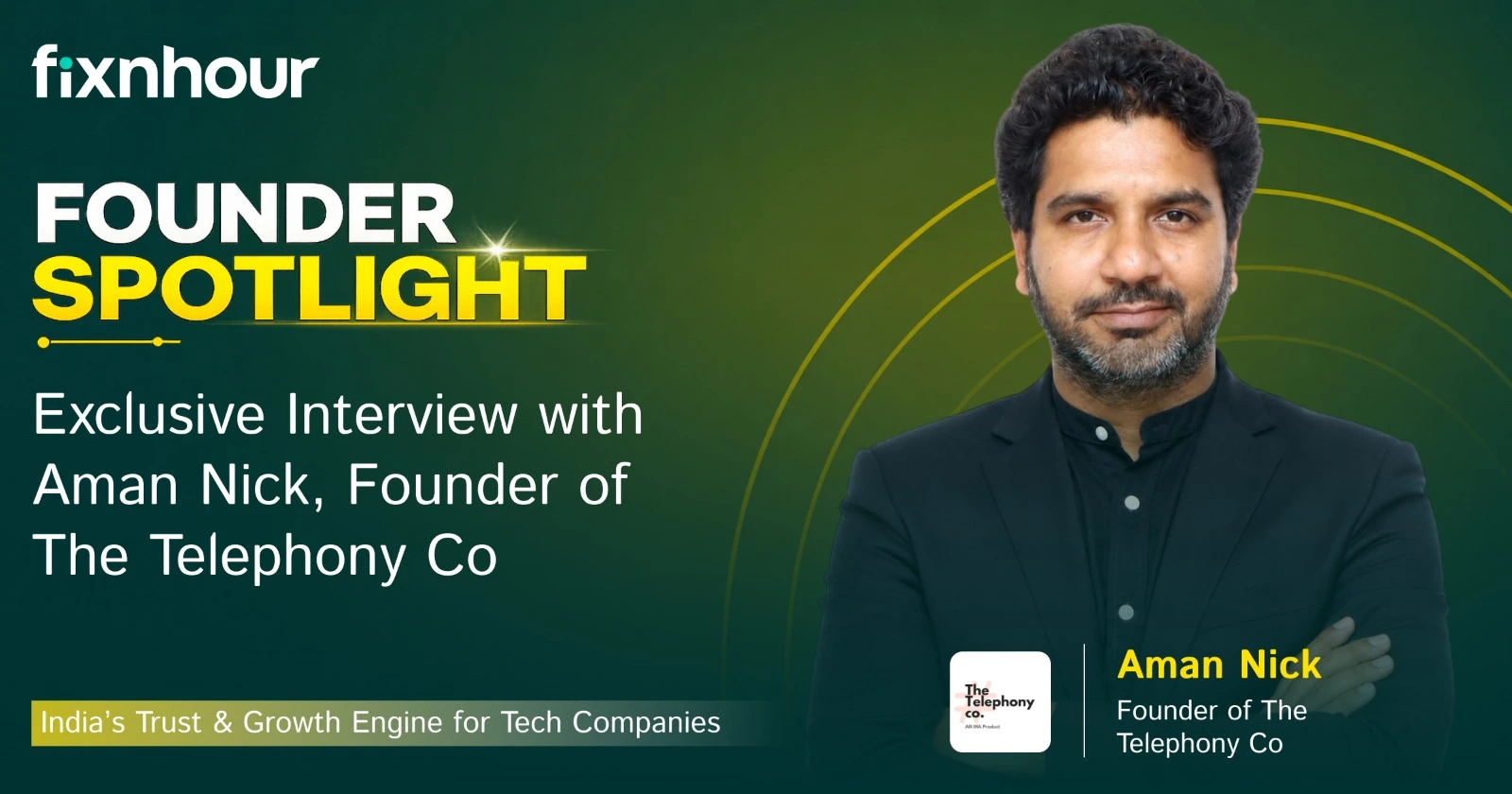
In this exclusive interview, Aman Nick, founder of The Telephony Co, shares his journey from a call-centre agent to an entrepreneur. He discusses the company’s evolution, the growing role of AI in contact centres, the importance of strategic partnerships, and his vision for building intelligent, secure, and customer-focused communication solutions.
Q1. Let’s start with your personal journey. How did you enter the telecommunications industry, and what eventually gave you the confidence to build The Telephony Co?
My journey into telecommunications and business communication actually started much earlier than The Telephony Co. Around 2006, I began my career as a call-centre agent with HCL Technologies. At that stage, I was working with network companies such as British Telecom and AT&T, dealing with internet connectivity, network issues, and customer communication.FixnhourThat experience gave me an early understanding of how dependent businesses and individuals are on communication infrastructure. I was not looking at telecommunications from the perspective of an entrepreneur at that point; I was experiencing it from the ground level speaking to customers, troubleshooting connectivity issues, and understanding what happens when communication systems do not work.
From there, my career gradually evolved. I moved from being an agent into team leadership and management, and eventually into senior operational roles. I was involved in managing teams, understanding call-centre operations, developing strategies, and looking at the technology that supported those operations.That progression was extremely important to me because I did not enter the industry from the top. I experienced almost every level of it. I understood what an agent needed, what a manager needed, what an operations team needed, and eventually what a business owner needed.
I later started IHA, which initially operated as a call-centre business. Over the years, I continued to see gaps in the technology and infrastructure supporting communication businesses.COVID-19 became an important turning point. The pandemic accelerated the movement towards remote work and cloud-based communication. It also made it very clear that traditional telephony had significant limitations. Businesses needed communication systems that were more flexible, accessible, measurable, and intelligent.That was when I started looking at telephony differently.The confidence to build The Telephony Co did not come from thinking that I knew everything about telecommunications. It came from having spent years experiencing the industry from different perspectives and seeing the same problems repeatedly.I had travelled the journey from call-centre agent to management and eventually to founder. At every stage, I had encountered different gaps. The Telephony Co became an opportunity to address those gaps from the business and technology side.
Q2. What problem did you originally set out to solve with The Telephony Co, and how different is the company today from the business you first imagined?
When we initially started, the VoIP industry was very different from what it is today. Around the time I was operating a VoIP business, the market was still relatively small, and only a limited number of companies were doing it at scale and doing it intelligently.One of the biggest things I noticed was the cost. Customers were often paying significantly higher prices because there were very high margins built into the industry.But cost was only one part of the problem.The bigger issue was that businesses were buying telephony without getting enough intelligence from it. They could make and receive calls, but they did not necessarily have the tools to understand what those calls were telling them.There was limited analytics. There was limited automation. There were fewer systems designed to identify abandoned calls, overloaded shifts, missed opportunities, or operational inefficiencies.
My own experience in the call-centre industry had taught me a very simple principle: every call matters.That became one of the philosophies behind The Telephony Co.We wanted to move the conversation beyond simply selling a phone connection. We wanted customers to understand what was happening behind the connection.Where are you losing calls? Where are you gaining calls? When are your busiest periods? Where are operational bottlenecks occurring? What is causing calls to be abandoned?Those questions are much more valuable to a business than simply knowing how many phone numbers it owns.
That philosophy led to the development and adoption of solutions such as VoIP Setu, our partnership with 3CX, and CallAtlas.Another problem we wanted to address was the cost of customisation. In many traditional systems, if a customer wanted a particular dashboard, feature, or modification, they could be charged significantly for even a relatively small change.Our approach was different. A lot of the data businesses need already exists within their systems. Instead of making customers pay heavily for every additional feature, we wanted to make better use of the data already available to them.So, initially, we were trying to solve cost, accessibility of data, and accessibility of service.Today, the company has evolved significantly.We are no longer looking at telephony simply as a communication connection. We are increasingly looking at the intelligence behind communication analytics, automation, AI, reporting, quality assurance, and business insights.The business we imagined at the beginning was largely about improving access to telephony. The business we are building today is about making communication more Intelligent.
Q3. Telecom is an established industry with several large global players. How did you identify an opportunity for The Telephony Co to differentiate itself and build its position in the market?
The honest answer is that, in the beginning, I did not have a clear strategy for differentiating ourselves.I would rather be honest about that than create a story after the fact.When we started The Telephony Co, I knew there were already major global players in telecommunications. I knew we were entering an established industry, and during the first two or three years, we were still figuring out where we could genuinely create value.We were serving customers, solving their immediate problems, and learning from the market.
The differentiation came gradually.The more we listened to customers, the more we realised that their fundamental problems were changing.The problem was no longer simply, "I need a telephone connection."It was becoming:Why are my calls not connecting?Why are my calls being flagged as spam?Why am I losing calls?How are my agents performing?How can I improve quality?How can I automate repetitive communication?Can AI handle part of my customer interaction?That shift in the problem itself created our opportunity.Today, I believe the pain point in communication is moving away from the basic phone connection and towards connectivity, intelligence, analytics, spam management, automation, and AI-powered agents.That is where we want to build our position.We do not necessarily want to compete with the largest companies by trying to become another traditional telecom provider. We want to occupy the space where telecommunications infrastructure, data, analytics, automation, and AI come together.That is the position we believe will become increasingly important in the next phase of the industry.
Q4. The Telephony Co works across cloud telephony, VoIP, SIP, 3CX, call tracking, APIs, and communication infrastructure. How do you see business communication evolving over the next five years?
I believe we are entering a fundamental shift in the way businesses think about communication.For a long time, businesses asked, "What phone number should I buy?" or "How many extensions do I need?"I think that question will increasingly become, "What communication infrastructure does my AI agent need?"AI agents are already becoming capable of handling conversations, understanding context, accessing information, scheduling appointments, sending notifications, and interacting with other business systems.That means the value of the underlying telephony infrastructure is going to change.Telephony will continue to exist, but it will increasingly become the infrastructure that enables intelligent communication.For businesses, the important thing is not to completely abandon their existing systems.
The transition needs to happen intelligently. Companies should be able to take their existing phone systems, communication infrastructure, CRM, APIs, and workflows andgradually add intelligence to them.That is exactly the direction in which we are moving.We are working towards AI agents, smart reporting, smart quality assurance, and smart MIS.The future will not necessarily be about having hundreds of phone numbers and extensions. It could be about having intelligent agents capable of handling hundreds of concurrent interactions while integrating with the systems the business already uses.So, when I think about the next five years, I do not think of telephony disappearing. I think telephony is becoming the foundation on which a much more intelligent communication ecosystem will be built.
Q5. How important have technology partnerships and strategic alliances been in the growth of The Telephony Co? What have you learned about creating partnerships that deliver genuine long-term value?
Partnerships have been one of the most important elements of our journey.When I started The Telephony Co, I was essentially a single employee. One of the first major partnerships we established was with 3CX.They gave us something that was extremely valuable at that stage not just technology, but trust.They allowed us to use their name, their reputation, and their ecosystem. That gave us credibility and helped us build our own identity in the market.
I will always give credit to partners who believed in us when we were still building.Our growth has been a collective journey. We have gone from handling individual calls to handling significant call volumes, and from very small amounts of traffic to millions of minutes of communication.That did not happen because of our efforts alone.Our partners invested in us through their time, their knowledge, their technology, their trust, and their willingness to work with us.The biggest lesson I have learned is that a genuine partnership cannot be based only on commercial terms.The strongest partnerships are built when both organisations believe there is a longterm opportunity and are willing to invest in each other's growth.We are where we are today because our partners trusted us.
Q6. AI voice agents and AI receptionists are beginning to transform customer communication. Do you believe AI will eventually replace traditional IVR and a significant portion of first-level call-centre operations?
Yes, I believe it will have a significant impact.If businesses are not preparing for AI-powered communication, they risk being left behind.I believe AI will go beyond traditional IVR and will eventually be capable of handling significant portions of Level 1 and Level 2 operations.We are already seeing practical examples of this.Our AI agents can take calls, check calendars, schedule meetings, send WhatsApp messages, and notify customers. These are not theoretical possibilities anymore. They are examples of how AI can execute an entire workflow rather than simply answer a question.
However, I think it is important to change the way we describe this transformation.I do not necessarily see AI as simply "replacing" L1 and L2 employees.I see AI as powering L1 and L2 operations.The difference is important.AI can dramatically increase the volume of work that a business can execute. It can handle repetitive interactions, gather information, perform initial qualification, and complete routine workflows.Human employees can then focus on complex situations, judgement, relationships, escalations, and areas where human interaction continues to be important.The future is therefore not necessarily human versus AI. It is increasingly going to be humans working with AI, with AI dramatically increasing operational capacity.
Q7. As AI-powered voice communication becomes more sophisticated, how should companies balance automation with transparency, privacy, security, and customer trust?
I think the starting point is not AI itself. The starting point is organisational discipline.Businesses cannot expect AI to operate safely if the underlying organisation does not have structured systems and clearly defined processes.For example, if you have a CRM, email systems, WhatsApp APIs, communication tools, or other business applications, you need to know exactly what information exists within each system and who has access to it.
The next stage is defining guardrails.Which employee should have access to which information?Which AI agent should have access to which system?What can an AI agent do?What should require human approval?What information should never be accessible to a particular user or system?These are becoming fundamental business questions.We have moved from a world where many systems operated within relatively closed infrastructure to a world where businesses use cloud platforms and publicly accessible AI services.That makes access control and data governance even more important.Security cannot simply mean blocking everything. It needs to mean understanding your operations well enough to determine where access should exist and where it should not.For me, the future of secure AI adoption will be based on clearly defined roles, permissions, policies, workflows, and data structures.The better a company understands its own data, the more responsibly it can automate.
Q8. What changes are you seeing in the BPO and contact-centre industry around telephony, AI, analytics, automation, and customer experience? What will define the next generation of successful contact centres?
The biggest change I see is that AI is moving from being a customer-facing tool to becoming an operational intelligence layer across the entire contact centre.A lot of attention is currently focused on AI voice agents, but I believe some of the most valuable applications are actually behind the scenes.Take quality assurance.Instead of having a team manually listen to calls and identify problems, AI can monitor conversations continuously, identify patterns, assign quality scores, and flag exceptions.The same applies to fraud management.Large contact centres should be thinking seriously about automated fraud detection and identifying unusual patterns before they become major problems.MIS is another area that is changing.
Traditionally, teams would extract Excel files, create pivot tables, prepare dashboards, and spend considerable time preparing reports.We are moving towards a world where businesses can provide AI access to structured data and ask questions in natural language or schedule automated reports.The next-generation contact centre will therefore be highly data-driven.But I do not believe the answer is to remove humans entirely.Human agents remain extremely important for complex conversations, empathy, judgement, escalation, and relationship management.The successful contact centre will be the one that understands where AI creates the greatest value and where humans continue to create value.The objective should be to make the entire operation smarter not simply to replace People.
Q9. Technology companies increasingly need to move beyond selling individual products and instead solve complete business problems. How is The Telephony Co approaching this transition?
We are moving in exactly that direction.The market is changing, and customers increasingly want solutions rather than individual products.A customer does not necessarily care whether the solution is built from a particular PBX, API, AI agent, WhatsApp integration, or reporting system. They care about whether the business problem gets solved.That is why our team spends considerable time understanding the customer's use case.Technology itself is becoming increasingly accessible. Many companies are offering AI agents, WhatsApp automation, email automation, APIs, and similar capabilities.The differentiator is increasingly how those technologies are combined and applied to a particular business problem.This is where our team plays an important role.
We can understand the customer's requirement, look at the data already available, and build or customise a solution around that requirement without unnecessarily increasing the cost.Customer support is also a major part of this approach.Our customers should not feel that they have purchased a product and are then left alone to figure it out.They should have the ability to self-serve, but when they need assistance, they should also have access to a team that understands their business.That combination of technology, data, customisation, and human support is what we believe creates real value.
Q10. Telecom infrastructure can be mission-critical for businesses. How do you approach reliability, scalability, security, and customer support while continuing to grow?
Our philosophy is that reliability should never be compromised simply to reduce cost.If a customer is looking only for the cheapest solution, we may not be the right provider for them.We prefer to build on technology that we believe can support mission-critical business communication.That is one of the reasons we chose 3CX and why we work with Amazon for our infrastructure. Our communication infrastructure, including extensions and lines, is hosted on enterprise-grade cloud infrastructure.But infrastructure alone does not guarantee a reliable customer experience.The next layer is our own systems our SOPs, workflows, training, onboarding, and support.
We invest in training customers so they understand the systems they are using. And when they need help, our team is available through personalised support.Our relationship managers are an important part of this model.The objective is to resolve a customer's problem within minutes rather than forcing them through lengthy queues or processes.As we scale, we want to preserve that personal element.For me, scalability does not mean becoming impersonal. It means building the technology and processes necessary to serve more customers without losing the quality of support that made customers trust us in the first place.
Q11. What has been the most challenging phase of your entrepreneurial journey so far, and what did that experience teach you about business and leadership?
Entrepreneurship teaches you many lessons, but one of the most important lessons I have learned is the importance of listening.As entrepreneurs, we often want to immediately explain what our company can offer.But the better approach is to first ask: What does the customer actually need?The same principle applies internally.You need to listen to customers, vendors, employees, and your team.When you genuinely listen, you understand the problem before trying to solve it.I have learned that you do not always need to talk more to become a better leader. Sometimes you need to listen more.Instead of immediately responding, understand the situation first and then respond.That has made both business and life easier for me.It is a simple lesson, but it is one I continue to carry with me.
Q12. As The Telephony Co has grown, how has your own role as a founder changed? What have you learned about delegation, leadership, and building a team that can take ownership?
One of the biggest changes has been learning to delegate and trust the team.As a founder, there is always a temptation to remain involved in everything. But if the business can only function when the founder is present, then you have not really built a scalable organisation.Today, I have the freedom to work from different parts of the world. Technology allows me to stay connected with the business through a laptop while still having the ability to step away from day-to-day operations.
That freedom has allowed me to spend more time with my daughter, my wife, my dogs, and my family. It has also allowed me to enjoy personal interests such as travel, learning, and gaming.For me, that is one of the great benefits of entrepreneurship.The role of a founder changes as the company matures.Initially, the founder may have to do everything.Later, the founder's responsibility becomes building people, systems, processes, and culture that can operate without constant intervention.That is what delegation really means to me not simply giving someone a task, but giving the team enough trust, responsibility, and ownership to make decisions and deliver outcomes.
Q13. If you were starting The Telephony Co again today with everything you have learned, what would you do differently? What advice would you give founders building in telecom, SaaS, cloud communications, or enterprise technology?
If I were starting again, the first principle would remain the same: listen to the customer before trying to sell anything.Entrepreneurs sometimes become too focused on the product they have built.The customer, however, is not necessarily interested in the product itself. They are interested in the problem the product can solve.So my advice would be: do not start with, "What can I sell?"Start with, "What problem can I solve?"The second thing I would emphasise is the importance of accepting change.
Technology companies operate in an environment where change is constant. New software, new applications, new business models, and new technologies will continue to emerge.You have to be willing to experiment.We have made mistakes throughout our journey. We have tried different software, different applications, and different approaches.But those mistakes became part of our learning process.If we had avoided every mistake, we would also have avoided many of the lessons that helped us grow.I strongly believe that change is not necessarily a sign that something is going wrong. Change can be a sign that it is time to grow.So I would tell founders: listen carefully, solve real problems, experiment, accept change, and do not be afraid of making mistakes.
Q14. What is your long-term vision for The Telephony Co? Where would you like to see the company over the next 5–10 years, and what would you ultimately like it to be known for?
The most important thing I want The Telephony Co to be known for is simple: solving customer problems.I do not want our reputation to be based only on the number of customers we have or the amount of revenue we generate.I want customers to be able to say, "We had a problem, and The Telephony Co solved it."
If a customer tells us that their communication works reliably, that they experienced minimal or no downtime, and that they are genuinely happy with our service, that is a much more meaningful achievement for me.Financial success follows when you consistently create that kind of value.Looking ahead over the next five to ten years, I want to build an organisation that is respected by all sides of the ecosystem.I want our customers to recommend us.I want our vendors and partners to trust us and recommend us.And I want our employees to be happy, proud of the organisation, and excited about their own growth.If those three groups customers, partners, and employees are happy, then I believe we have built something sustainable.That is ultimately what I want The Telephony Co to represent: reliable technology, genuine problem-solving, strong relationships, and a company people are happy to Recommend.
One Final Question
Beyond revenue, customers, and company growth, what does success personally mean to Aman Nick, and what kind of legacy would you like to create as a founder?For me, success is ultimately about having the freedom to enjoy life while continuing to grow.I want to be able to travel, learn new things, enjoy the work that I do, and most importantly, spend meaningful time with my family.My daughter, my wife, my dogs, and my family are a very important part of that definition of success.I do not want entrepreneurship to become something that takes away from life. I want it to create the freedom to enjoy life.When it comes to legacy, I am not sure I would define it as something belonging to one founder.
I believe a company's legacy is created by the people behind it.If people remember IHA and The Telephony Co because they had good experiences with us, because our customers were happy, because our vendors trusted us, and because our employees were proud to be part of the organisation, then that is a legacy worth creating.Legacy is not an individual achievement. It is the result of many people contributing over many years.Ultimately, I would like The Telephony Co to be remembered for having a good name, providing good service, treating people well, and solving genuine business problems.If people hear the name IHA or The Telephony Co and associate it with trust, service, reliability, and good people, I would consider that a successful legacy.And personally, if my family is happy, my team is happy, our customers are happy, and our partners are happy, then I feel that everything is going in the right direction.Talk to our experts