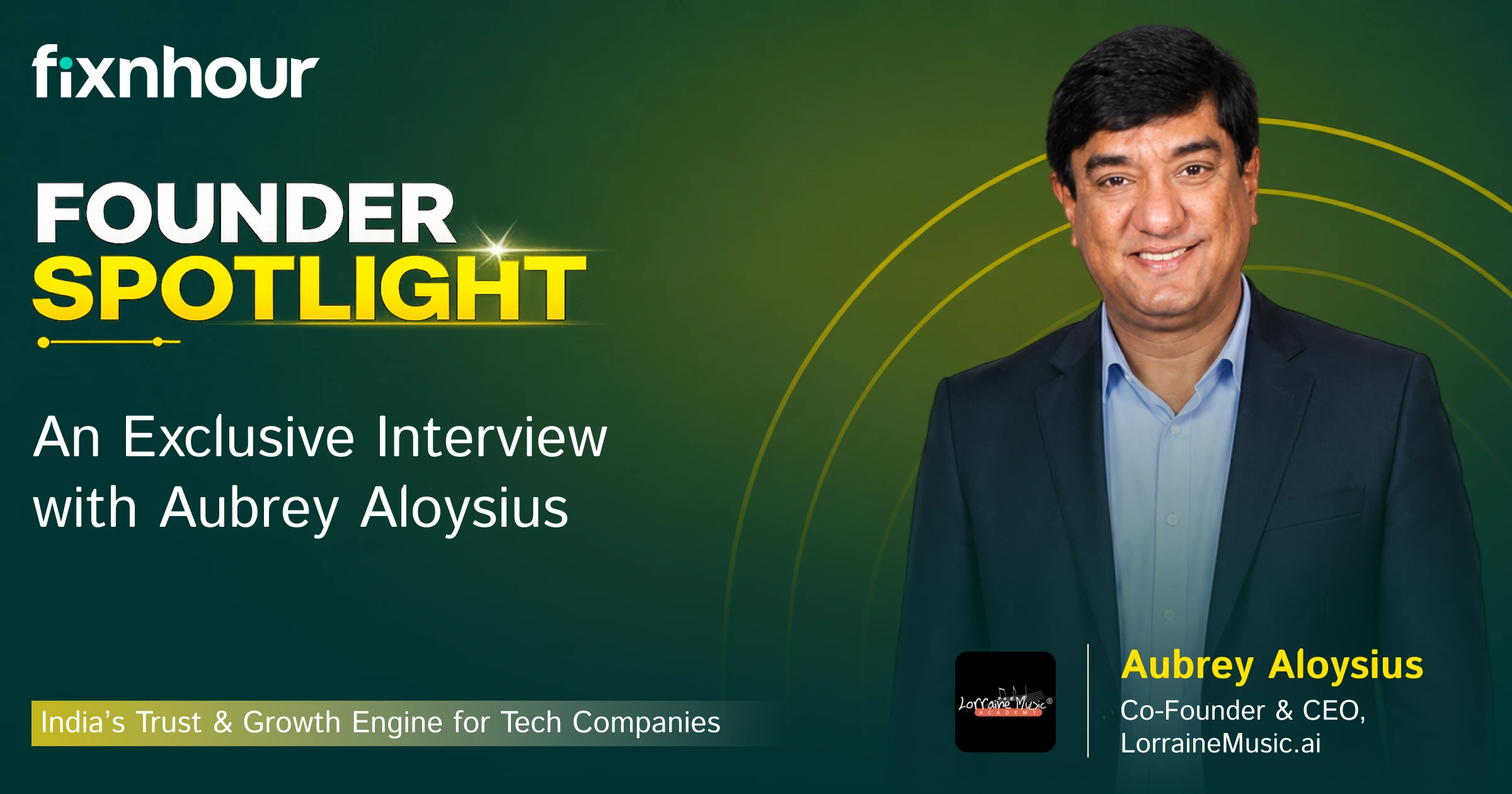
Music has always been a universal language, but for many learners, access to structured music education has been limited because of scarcity of skilled teachers, resources and scalable learning systems. Aubrey Aloysius, Co-Founder & CEO of LorraineMusic.ai, is on a mission to do so with an AI-powered music education. His vision is that music is a birthright and not a privilege and he aims to bring quality music education to the schools, universities, the corporations and the families.
Aubrey has traveled the paths of international banking, filmmaking and over 21 years of entrepreneurship, bringing the disciplines of finance, storytelling and resilience to his vision for education technology. LorraineMusic.ai is an artificial intelligence-powered tool that aims to overcome the barriers to traditional music instruction by using a structured curriculum, teacher enabling, progress tracking, and digital learning. During this exclusive Fixnhour interview, Aubrey shares experiences from his entrepreneurial endeavors, how AI is impacting education, the future of music education, and his vision for 100% music literacy.
Key Takeaways
- Music education can be considered as literacy more than just an extra-curricular.
- AI has the potential to solve for issues in accessibility and scalability caused by a lack of qualified music teachers.
- Technology should be used to help teach and facilitate learning, but not to be the end goal.
- Structured music programs can be more easily implemented at scale in existing school infrastructure.
- There are school, university, work place, and family dimensions to music education.
- There will be new crossovers between AI, music, health and education.
- Learning, wellbeing, engagement and family involvement can all be integrated into a corporate music program.
- Business CAN be profitable and purposeful without being mutually exclusive.There is no conflict between purpose and profitability, and there can be viable businesses with impact.
- Commitment to mission must be balanced with detachment from methods.
Who is Aubrey Aloysius?
Music is NOT a privilege, it is a birthright!It's this faith that lies at the core of the mission of LorraineMusic.ai, the AI-first music learning platform whose goal is to be the path to 100% music literacy.It is indeed a peculiar journey that Aubrey Aloysius embarks on. Prior to developing in music technology, he served as an international banker, a film maker and a serial entrepreneur. He says these chapters have equipped him with three essential entrepreneurial skills: Financial discipline, Storytelling and Resilience.Aubrey and his staff have spent 21 years trying to make structured music instruction more readily available. On today's episode of LorraineMusic.ai, Lorraine Music introduces a new and innovative solution that combines AI, music education, curriculum, teacher enablement, and digital learning in order to tackle one of the core issues in music education: the lack of qualified music teachers.The platform has already achieved 10000+ students and learners from India and 5 continents according to Aubrey's professional profile.
His vision goes beyond giving people lessons on how to play an instrument, though.Aubrey is convinced that music has a role to play in education and human development that is as significant as it is beneficial for cognitive development, emotional resilience, creativity, wellbeing and cultural intelligence.LorraineMusic.ai is, therefore, applicable to various sectors: K-12 schools, Universities, corporations and families. From the AI-assisted music-literacy and keyboard programs in schools, to higher-education courses, to corporate wellbeing and the structured music education for families.Now, a recipient of Karmaveer Puraskaar and SNP Nation Achiever Award, Aubrey is seeking to answer a much bigger question.Is there a way to make quality music education accessible at a scale larger than that of traditional teaching models, with the help of technology?This Fixnhour Founder Spotlight plunges into that mission, his entrepreneurial journey, how AI can be applied to education, and how would it even be possible to make music literacy accessible for everyone?
Q1. Aubrey, your journey has taken you from international banking to filmmaking and entrepreneurship. How did those very different chapters eventually lead to LorraineMusic.ai?
Every stage of my life has been a valuable one.It was in the banking that I learned financial discipline and understanding of numbers. Making films fostered my communication skills, storytelling skills, and my capacity to relate with people on an emotional level. Learning how to be an entrepreneur taught me about being resilient. FixnhourAll these experiences put together, and you start seeing things differently when it comes to problems.I saw a huge amount of value in music education and also a great opportunity for accessibility.The question eventually turned to: how do we develop a model which does not restrict quality music instruction to those who have the opportunity to access the "right" person or place, or the "right" resources?That was one step closer to LorraineMusic.ai.
Q2. You often say, “Music is a birthright, not a privilege.” What does that philosophy mean to you personally?
Music permeates Culture, Community, Generations and Geography.However, the concept of structured music instruction is sometimes seen as something that can be done, or at least is done, only by those who can access specialized music educators and resources.I think we should change that.Think in terms of other types of literacy and Music literacy can be a capability for all.The goal is not for all students to be professional musicians.The goal is to ensure that all people have the ability to learn, experience and be involved in music in a meaningful way.I mean when I say music is a birthright and not a privilege.
Q3. You have been building in this space for more than 21 years. What problem have you consistently seen in traditional music education?
One of the fundamental challenges is access to quality teaching.A school might desire to offer structured music instruction but may not have sufficient qualified music teachers.The quality of teaching may also be poor.Measurement is another difficulty.Sometimes, music lessons can turn into any activity other than a music lesson that makes it harder to see the learning path.Sometimes, music lessons become activities instead of a well structured learning journey that you can see the learning path.A system to support curriculum, learning progression, enablement of teachers, assessment, and measurable outcomes is necessary if we are to give music a greater importance in mainstream education.Technology presents an opportunity to solve a number of these problems, at scale.
Q4. Where does AI fit into LorraineMusic.ai, and what can AI do that traditional music-learning models struggle to achieve?
AI can help us develop more scalable and responsive learning experiences.Music teachers are in short supply, which represents a structural problem all over the world. When all learners must have 1:1 access to a master musician, teaching music literacy at a global scale becomes very challenging.Technology can be used to help teachers reach the students.AI can help in learning journeys, give feedback, monitor progress, customize learning and make learning more systematic for the institution.I don't view AI as a substitute for teachers, though.The bigger opportunity is to leverage technology to bring quality education where traditional resources might not go.AI should be used to increase access and enhance outcomes.
Q5. LorraineMusic.ai works with schools without necessarily requiring additional teachers or hardware. How does this change the economics of music education for schools?
Schools currently have good infrastructure.There are many who have smart boards, classrooms, already have teaching staff, and digital systems.Schools don't have to build a new ecosystem when they want to have structured music education in place if this infrastructure can be utilized intelligently.We work towards making adoption realistic.Schools can use AI to run keyboard and music-literacy programs and offer teacher training, tracking progress, and communicating with parents.The goal is to integrate music into a quantifiable learning time.Ease of implementation and outcomes that are measurable and observable make music education much more likely to be viable for institutions.
Q6. You describe music as a lever for cognitive growth, emotional resilience, and cultural intelligence. Why should schools treat music as more than an extracurricular activity?
Education is to be for life, not exams.Creativity matters.Focus matters.Emotional wellbeing matters.Confidence matters.Cultural understanding matters.Music can help to foster a wider field of learning in which these capabilities are nurtured in addition to the traditional classroom.The difficulty is that if it is just defined as “extra”, it's easy to make it voluntary or erratic.We want to get the institutions to consider music in a systematic way.With structure, measurement, and correlation to other educational outcomes, the role of music education can be stronger in education.
Q7. Your vision extends from kindergarten all the way to universities and corporate boardrooms. Why is music literacy relevant across such different stages of life?
Education should not end at the end of formal schooling.One of the things around which life can remain meaningful is music.In the eyes of children it can be a part of their basic education.There are interesting overlaps in the crossovers between Art, Health, Technology, AI, and Creativity for University Students.Music can be a part of wellbeing, stress management, engagement, and personal development for professionals.It can provide an experience for the family that can be enjoyed by all generations.The need is different but Music is relevant.We believe that music literacy should be considered throughout the life span, not just during childhood.
Q8. What opportunity do you see at the intersection of AI, music, health, and higher education?
I believe this intersection will go on getting more interesting.Universities are being called on to develop learning experiences that are interdisciplinary and relevant to the changing industries at a high speed.Music can link up with technology.It can be linked with AI.It can be related to health and wellbeing.It can relate to psychology and human performance.That creates room for coursework to be based on credit, lab work, research, industry collaborations, and even new courses.Future education will further require combinations of disciplines, that are presently taught separately.
Q9. You also work with corporations. What does music offer companies that conventional employee-wellbeing programs may not?
More organisations are aware that employee wellbeing impacts performance, retention, engagement and culture.But wellbeing initiatives need to create genuine participation.Music can provide a different type of experience.It is creative.It can be social.Families may be involved.And it is a source of satisfaction for the people to learn a new skill instead of a wellness activity.Measurement is the key component for organizations.Corporate programs should align participation with engagement to the results that HR and leadership teams are interested in.Once this occurs, music can transform from being an occasional staff member activity into a wider wellbeing and engagement approach.
Q10. After building for 21 years, what have you learned about resilience and staying committed to a mission for the long term?
There are rarely smooth, linear paths to entrepreneurship.Markets change.Technology changes.Customer expectations change.You change what you know about the problem.You update your knowledge of the problem.Conviction is needed and so is flexibility.The mission doesn't change, but the approach, or method to achieve it does.That's a significant distinction.If you are so engrossed in one product or technique, you might overlook other methods to accomplish the more important goal.The mission on music literacy has stayed strong for us.In particular, technology – including AI – is providing us with new methods to do that mission on a scale that was more difficult to imagine.
Q11. What are the biggest misconceptions founders have about using AI in education?
There's a misconception that if you add AI to a product it is an innovative product.It doesn't.The question should always be, "If using AI to enhance the learning outcome.Is it more accessible to education?Does it aid in the comprehension of something?Is it useful for teachers?Does it enhance feedback?Is it possible to make personalization possible?Does it decrease an important constraint?Learning is a process of growth of human beings.Technological solutions should be used to achieve that aim.When the result of using AI is a product that is indeed impressive but not helping learning, we need to ask ourselves whether AI is adding value.
Q12. You have worked across India and five continents. What have you learned about building an education product for a global audience?
Education has universal aspects, there are contextual aspects.Curricula differ.Institutions differ.Cultures differ.Expectations differ.Technology infrastructure differs.A global product should be strong on foundation and have some flexibility to operate in various education environments.Music is a special gift to us: universal and yet culturally unique.Both sides need to be respected.Technology can be developed to provide a common infrastructure but the learning experience must be sensitive to the people and institutions who use it.
Q13. What advice would you give entrepreneurs trying to build purpose-driven companies while still creating commercially sustainable businesses?
It is important to recognise that purpose (and commercial sustainability) is not an either/or scenario.It's all well and good to make a splash, but the organisation itself must be sustainable in order to have an impact at scale.Revenue enables you to invest in technology.It enables to recruit great talent.It helps you enhance products.It enables you to connect to more customers.It makes it possible to keep the mission going.The key challenge is to see whether your business model is strengthening or undermining your purpose.In a business with a strong purpose, the value created for customers contributes to advancing the mission.The alignment is strong that.
Q14. Your stated mission is 100% music literacy. What would success look like for LorraineMusic.ai over the next decade?
Long-term goals include drastically making structured music learning more accessible.I hope music literacy is equally seen as a powerful and valuable aspect of learning, not a luxury that only a few students are provided.This translates to additional schools.More universities.More organizations.More families.It is about further enhancing the role of AI in music education.It means developing models that can be adopted on a global scale, but that retain their quality and intent.In the end, success would be facilitating the progression of music literacy to being a global norm.That is a lofty goal to achieve.However, good missions must be lofty.
About Aubrey Aloysius
Aubrey Aloysius is the Co-Founder & CEO of LorraineMusic.ai, an AI-first music learning platform that is dedicated to bringing music literacy to the reach of schools, universities, corporations, and families.He has 21+ years of entrepreneurial experience and has touched the lives of 10,000+ learners in India and five continents according to his professional profile, LorraineMusic.ai.Prior to entrepreneurship, Aubrey has been a filmmaker and international banker, skills he attributes to his entrepreneurial toughness, storytelling skills, and financial discipline.He has also won the Karmaveer Puraskaar and SNP Nation Achiever Award.Now, his mission is focused on one grand plan:Music is NOT privilege, it is a right.And with LorraineMusic.ai he is bringing this even further; he is aiming for a bigger goal:100% music literacy.
Final Thoughts on the Founder
Aubrey Aloysius' tale of a journey reminds us that some of the most interesting use cases for AI might not be about displacing existing industries, but about making capabilities that were previously hard to scale to more people.This challenge LorraineMusic.ai is tackling is a scaling problem.Traditional music education relies critically on the availability of trained music teachers. If there are few qualified teachers, there will be limited access.AI potentially changes that equation.However, it is Aubrey's vision that is interesting because technology is not the mission.The mission is to learn music. Technology is the means by which it is possible.
His path from international banking to filmmaking to entrepreneurship also introduces three skills that are of great value to a founder working in the education technology space: financial discipline, storytelling and resilience.Over the past 22 years, Aubrey has been constructing and developing the space, and has a goal that is more ambitious than is commonly seen in the field of music education—a goal of making music education more universal instead of merely extra-curricular.If that vision comes true, it would mean that the effect is more than just another EdTech platform.It may help to influence the ways institutions perceive music.The core idea is very basic in nature and is applicable from kindergarten to universities, in households and in the workplace.Music should not be for the muscled. Music literacy is a right of all. Talk to our experts