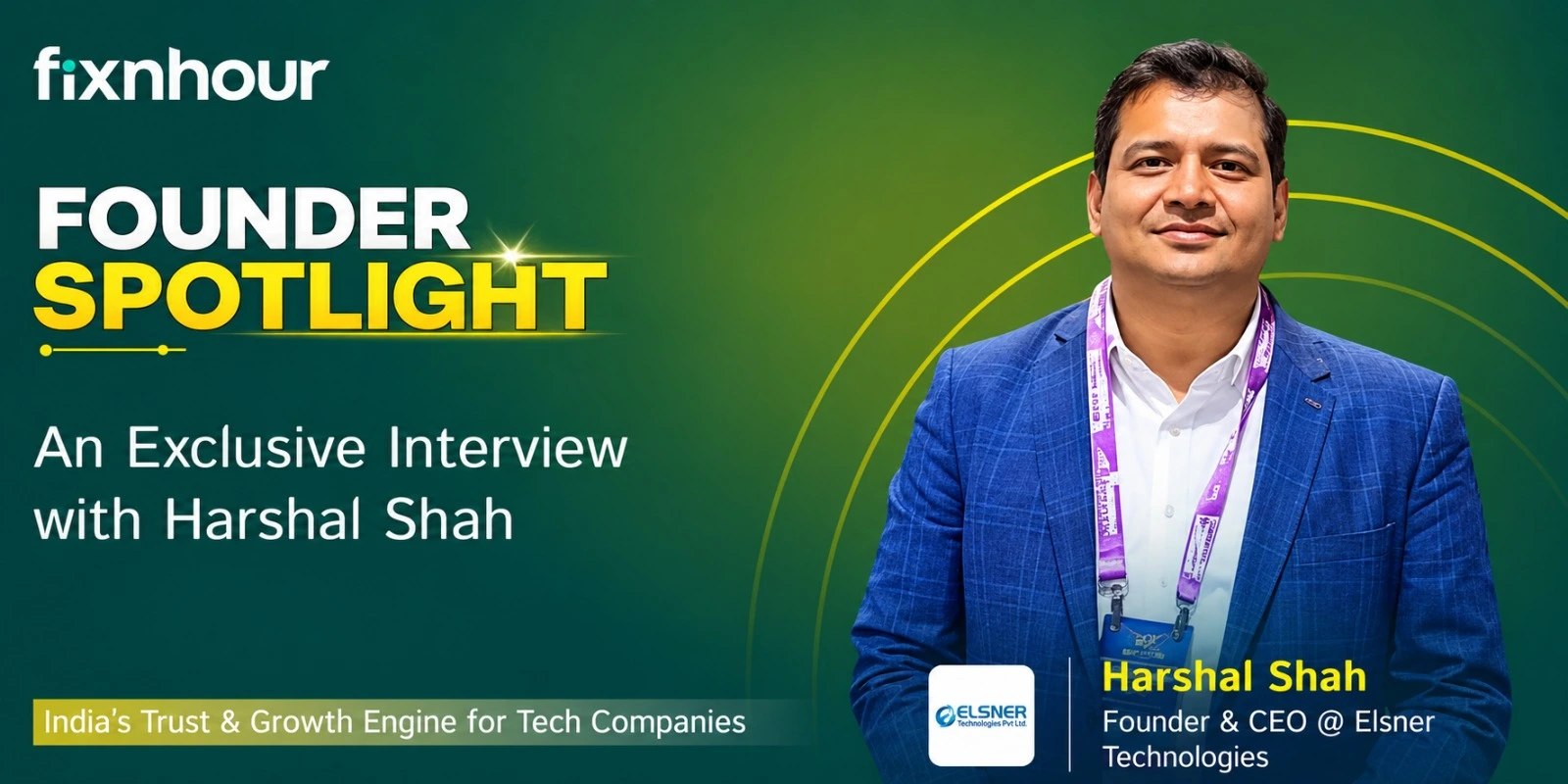
The current dynamic technology environment demands more than just technical competency for running a successful business; it calls for learning, adjustment, leadership and understanding of customer needs. Harshal Shah is the Founder & CEO of Elsner Technologies and Founder & Co-Founder of Link Publishers where he has been involved in building and shaping the technology businesses in eCommerce, AI, automation, ERP, digital marketing, software development, and digital transformation for over 18 years. His business experience has developed into a web of enterprises that provide service to companies in global markets.
Harshal Shah discusses this in this exclusive Fixnhour Founder Spotlight interview, where he shares insights gleaned from his entrepreneurial journey, from scaling tech businesses to building high-performing teams, going international, leveraging AI, and creating future-proof businesses. His experience provides valuable lessons for founders, tech leaders and entrepreneurs aiming to create sustainable businesses with the use of technology in the solution of real business problems.
Who is Harshal Shah?
Harshal Shah is the Founder & CEO of Elsner Technologies, and Co-Founder of Link Publishers, an AI-powered link-building marketplace.Harshal has successfully created and developed an ecosystem of ventures such as Elsner Technologies Pvt. Ltd., Braincube, Link Publishers, EcomVA, MyAppGuru, WeekMate and ERPocean with over 18 years of entrepreneurial and technology expertise.He started working with companies like Reliance Infocom and TCS, acquiring a deep understanding of the importance of good foundations, structured processes, rigor and discipline in execution, and learning from what went right and wrong. He has also acquired these skills and lessons in entrepreneurship, creating businesses in eCommerce, HR technology, ERP, automation, digital marketing, software development, and digital transformation.His ventures today focus on and go to work within businesses in international markets such as UK, USA, Canada and Australia.
The uniqueness of Harshal's journey is that instead of building one technology company, he has not held back from building more than that. He has instead slowly built up an interconnected network where experience, teams, technology, customer understanding and market knowledge can generate business opportunities for new businesses.His work with Link Publishers is also the next step in this journey—leveraging AI to existing workflows within businesses, including digital marketing and link building.Harshal's focus is always on the application of technology, not the technology itself. The goal is to discover purposeful challenges within the enterprise and to continually seek out new solutions.Harshal shares lessons learned from over 18 years of entrepreneurship, founding technology companies, expanding internationally, innovating with AI, leadership, and developing businesses that adapt to evolving markets in this Fixnhour Founder Spotlight.
Q1. Harshal, your entrepreneurial journey spans more than 18 years. How did it begin?
I started my journey learning and understanding how good organisations work.It was during my initial days of work, at places like Reliance Infocom and TCS that I became aware of the significance of discipline, processes, execution and constant improvement.I would always have questions about things to build, as well. FixnhourTechnology was a thing I was fascinated with as it could solve business problems at scale. This curiosity turned into entrepreneurship later on.As you start to become a founder, you realize that technology isn't enough to build a company. Knowing customers, selling, teams, operations, finance, marketing and leadership is a must.It has been a constant process of evolution, therefore.The technology we use now is quite different from that I worked with when I began, but the basic rules are the same: know what the problem is, continue to learn, and perform consistently.
Q2. What was the original vision behind Elsner Technologies, and how has that vision evolved?
The core concept has always been to make companies successful with technology.As the market evolved, so did the technology and services used to achieve that.eCommerce evolved. Mobile became essential. The cloud revolutionized business operations. Automation was getting more significant and there is now AI transforming nearly all aspects of the technology ecosystem.We adapted our ways to those changes.The key is not just about incorporating new technology, though.We ask about the technology's ability to enhance a customer's business.Is it likely to increase efficiency?Does it provide an opportunity to generate additional income?Is it capable of enhancing customer experience?Can it support growth of the organization?The entrepreneurial mindset has been integral to our thinking around technology.
Q3. Elsner Technologies, Braincube, Link Publishers, EcomVA, MyAppGuru, WeekMate, and ERPocean cover different areas. What connects all these ventures?
ERPocean focus on different aspects. What do all these ventures have in common?The common denominator is business problems that need to be solved using technology.If you do business with clients over a long period of time, you start noticing trends.You find issues that are universal to industries.Sometimes they can be resolved in an existing company. Sometimes they provide an opportunity for a whole new product or business.This is the process by which an ecosystem is formed over time.The good news is that knowledge piles.In starting a new business, you don't always need to start from scratch.You're already a technology expert, you already know how to acquire customers, how to enter international markets, how to run a business, how to hire people, how to market digitally, and how to develop products.Those skills may be the stepping-stones to creating something new.
Q4. Link Publishers is an AI-driven link-building marketplace. What opportunity did you identify in this space?
Link building is a manual process, which is very time consuming.There's a lot of effort involved to discover relevant publishers, reach out to them, assess opportunities, negotiate, organize campaigns and monitoring.A marketplace can provide a structure to that process.AI can make it even more intelligent.Can be used to enhance discovery, relevance, recommendations, analysis and workflow automation.It's not merely about articulating that the product is AI powered.AI needs to create a measurable improvement in the user's experience.If technology can take the repetitive work and can support marketers to make better decisions, then it's adding value.That's what we want to do with Link Publishers.
Q5. How do you see AI changing SEO, digital marketing, and link building over the next few years?
The execution is becoming much quicker thanks to AI.There are already a variety of repetitive marketing tasks that can be accelerated, such as research, analysis, content creation, reporting, etc.However, once everyone can produce similar types of AI-generated content, it won't truly provide an advantage.I think things like authority, brand, trust, relevancy, original thinking, distribution are going to be even more important.Search is evolving as well.Beyond search engines, people are finding out more and more this way in an AI-powered way.Companies will, therefore, have to consider a wider perspective on their digital authority and the way that their brand is depicted on various discovery platforms.AI will change SEO.However, it will not take the place of credibility.
Q6. You have built businesses serving markets such as the UK, US, Canada, and Australia. What does it take for an Indian technology company to grow globally?
It is likely that trust is one of the most critical factors.There are numerous options for international customers.They must feel confident that you are familiar with their business, understand their professional needs, perform as expected, and are responsible.Attractive prices can get you the ball rolling, but results are the key to a sustainable relationship.This is especially crucial for teams that are spread out across other countries and time zones.It's important for customers to know what's going on at all times.It is important for international companies also to understand the difference in markets.The methods effective in India may be not as effective in the US/UK/Canada/Austr.The methods successful in India may not be successful in the US/UK/Canada/Austr.Knowing customers and market expectations, competition, positioning, and buying behavior is key.There's a difference between being global and being local, and it takes ambition, as well as localization, to get there.
Q7. What are the biggest mistakes technology founders make when trying to scale?
The first error is to scale up before establishing sufficient clarity.Founders can hire rapidly, add services, go into various markets, and develop numerous features without realizing what is actually growing.Scale amplifies everything.Scale can be a multiplier of a good process.A broken process can make the problem bigger, if there is a scale.The other error is to have too much control in the hands of the founder.When the company is small, the founder can be engaged in all aspects.It can't go on like that forever.You need leaders.You need systems.You need accountability.You must have those who can make good decisions without waiting for the Founder.Scale is actually when the organisation becomes more powerful than the individual.
Q8. How has your leadership style evolved while building multiple businesses?
Sometimes, the first step in leadership is doing.Enabling becomes the increasing aspect of leadership as the company expands.You have to create clarity, build teams, develop leaders, and establish systems.Delegation is really essential.Delegation isn't just about passing off a job.It's about providing them with enough context, authority and accountability to be responsible for a result.Leaders must also be curious, I have found.You can learn from employees, customers, competitors, technology and even failure.The founder doesn't always have to be the most intelligent person in the room.It is the responsibility of the founder to establish a culture where smart people can contribute well.
Q9. With AI making software development faster, how should traditional IT service companies reinvent themselves?
The usefulness of just coding is shifting.AI can already play a crucial role in coding, testing, documentation, debugging, and the other aspects of development.Therefore, technology service companies should shift to the higher levels of the value chain.Clients require partners that know their businesses.They need architecture.Product thinking.AI strategy.Automation.Security.Integrations.Data.User experience.And quantifiable business results.The future IT company does not necessarily have to win because of the number of developers.There are reasons why it will win: its ability to use technology, including artificial intelligence, to solve customer problems intelligently.
Q10. What does digital transformation mean to you after working with businesses across different sectors?
Digital transformation isn't a matter of buying more software.It is about efficiency in the operation of the business.Start with the problem.What are workers doing that isn't necessary?What is causing dissatisfaction among customers?What is the information broken up into?What are some of the processes that are hard to scale?What's holding up decision-making?Then identify the spaces for improvement in the use of technology.This may include automation at times.Sometimes ERP.Sometimes AI.An application that is designed for a specific purpose.At times, the best solution is just to tweak an existing process.Business goal driven by technology and not the other way round.
Q11. How do you decide when an idea deserves to become a separate product or company?
The first question that one might ask is: is the problem real?Next, to understand the importance of that problem.Who experiences it?How frequently?What are the current solutions they are using?Will they be willing to pay for a better solution?Is there sufficient market size?Is there a benefit to us which we can use to help solve it?Patterns can be suggested by experience and will still be necessary, but customer validation is still crucial.It's common for founders to have a lot of ideas.The art of the discipline is knowing what things to avoid.Years of attention is required to run a business.The opportunity must warrant that commitment.
Q12. What role does curiosity play in your approach to entrepreneurship and leadership?
Eagerness to learn keeps you alive.Technology is evolving quickly and leaders need to realize that their current knowledge often isn't sufficient.This is emphasized by AI.What used to be considered a super-power can now be adopted by virtually every business.Leaders do not require the expertise of all the technologies.However, they should be able to take advantage of opportunities and identify risks.The curiosity also involves listening.You can learn from customers.Staff are able to teach you.Young professionals can be your teachers.It's possible to learn from competitors.You can learn from the market.There's value in experience but experience and curiosity is even more powerful.
Q13. After 18+ years of building businesses, what advice would you give first-generation technology entrepreneurs?
Think long term.Entrepreneurship can seem a lot quicker on the outside than inside.Creating a successful firm is an enterprise that requires a number of years.Look at real customer issues and try to address them.Build credibility.Keep your commitments.Understand your numbers.Employ those who are capable of becoming leaders.Establish systems in advance of their being forced.Avoid simply following every trend, but don't turn a blind eye to big and important tech changes either.The most important thing: Keep learning.As an entrepreneur, technology will evolve constantly throughout your career.It will be up to you to adapt if you want your company to adapt.Consistency compounds.Knowledge compounds.Relationships compound.Trust compounds.That's where and when long-term entrepreneurial advantage lies.
Q14. What is your long-term vision for Elsner Technologies and the wider ecosystem you are building?
The vision is to develop sustainable technology companies that serve organisations' growth and evolution needs.New opportunities will persist with AI, automation, intelligent business systems, eCommerce, digital transformation and connected platforms.We want our ecosystem to grow with those opportunities.I also don't think that technology will make for a sustainable business.However, it does require capable team members.You must have the confidence of your customers.It requires a disciplined approach in execution.You need leadership.You also need to be willing to continually be a student.The ecosystem can continue growing for many years if we are able to continue developing businesses that address interesting challenges, offer opportunity for our employees, and provide real value to our users around the world.
About Harshal Shah
Harshal Shah is the Founder & CEO of Elsner Technologies and Co-Founder of Link Publishers, an AI-powered link-building marketplace.He has led and developed businesses such as Elsner Technologies Pvt. Ltd., Braincube, Link Publishers, EcomVA, MyAppGuru, WeekMate and ERPocean for over 18 years.His entrepreneurial passions are in eCommerce, AI, automation, ERP, HR tech, digital marketing, software development and digital transformation, supporting and creating for businesses across several markets, such as the UK, US, Canada and Australia.On his path, he has developed a simple formula:Keep learning. Keep building. Continuously adapt to market and make impactful business value with technology.
Final Thoughts on the Founder
The story of Harshal Shah is an example of how entrepreneurship can have a multiplicative effect.He has been moving from one organization to the other for more than 18 years from Reliance Infocom, TCS to build an ecosystem from Elsner Technologies to Braincube, Link Publishers, EcomVA, MyAppGuru, WeekMate and ERPocean.It is the individual companies that make the news, but it is the ability that's being developed behind them.Technology expertise compounds.Customer understanding compounds.The more international market experience the better.Leadership compounds.Distribution knowledge compounds.Relationships compound.
Sure, and perhaps most of all, improvement in identification of good business opportunities accumulates.His collaboration with Link Publishers also shows the value of using new technologies like AI on existing business areas rather than just technology for technology's sake.This distinction will become more important as AI becomes easier to build software.The competitive edge can no longer be just about building ability.It will be a matter of increasing understanding of what to build, who wants it, how to distribute it and how to build a sustainable business around it.Harshal's journey is a great lesson for the new generation of tech entrepreneurs:Be inquisitive enough to develop, hard-working enough to perform, and patient enough to accumulate experience. Talk to our experts