In today's fast-changing business landscape, founders face increasing pressure to scale efficiently while maintaining quality, profitability, and customer satisfaction. As artificial intelligence and automation continue to reshape how organizations operate, having the right systems and operational strategies in place has become more important than ever.
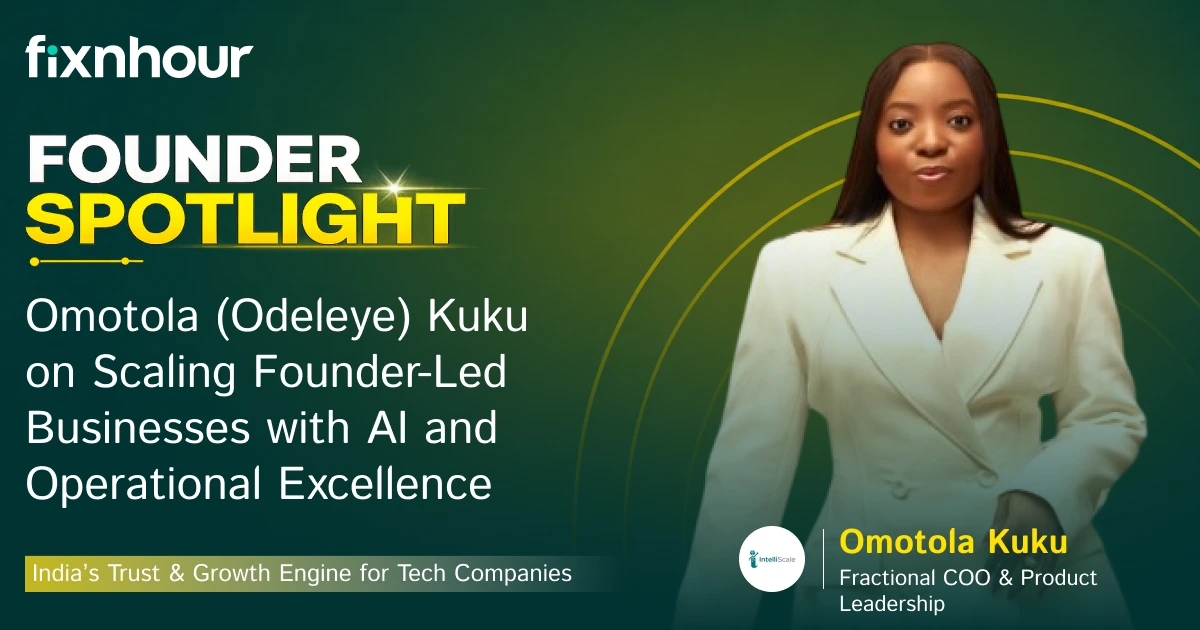
In this Founder Spotlight interview, we speak with Omotola (Odeleye) Kuku, a business operations strategist dedicated to helping founder-led businesses unlock sustainable growth through AI integration, streamlined systems, and operational excellence. With a passion for transforming complex processes into scalable frameworks, Omotola empowers entrepreneurs to work smarter, improve efficiency, and build businesses that can thrive without constant founder involvement.
Join us as Omotola shares her professional journey, insights on leveraging AI for business growth, common scaling challenges founders face, and practical strategies for creating resilient, high-performing organizations in an increasingly competitive market.
Who is Omotola (Odeleye) Kuku?
Building a successful company is one challenge. Scaling it into a sustainable, high-performing organization is another entirely. Many founders successfully launch businesses, attract customers, and build momentum. However, as growth accelerates, operational complexity often grows even faster. Teams expand, communication becomes fragmented, decision-making slows, and founders find themselves trapped in the center of every major business function. This is where Omotola (Odeleye) Kuku creates exceptional value.
Omotola is a respected Fractional COO, Product Leader, AI Automation Consultant, and UK Global Talent Coach with over 12 years of experience helping founder-led businesses build the systems, leadership structures, and operational frameworks required for sustainable growth. Having worked with startups and scaling businesses across Africa, the United Kingdom, and Europe, she has witnessed firsthand the challenges organizations face when transitioning from startup mode to scale-up mode.
Her expertise lies at the intersection of:
* Operations
* Product Strategy
* Leadership Development
* Artificial Intelligence
* Organizational Design
* Business Scaling
What makes Omotola's approach unique is her belief that businesses should not rely solely on founder effort to grow. Instead, she helps organizations design AI-driven operating systems that combine human leadership, accountability, operational clarity, and intelligent automation. Her goal is to help founders build companies that can scale without chaos, burnout, or execution bottlenecks. As the founder of ReliAssist and a trusted strategic advisor to growing businesses, Omotola has built her career around one core belief:
"Growth doesn't fail because of a lack of ambition. It slows when systems fail to evolve."
In this exclusive Founder Spotlight Interview, Omotola kuku shares her insights on scaling organizations, AI adoption, leadership development, operational excellence, and the future of founder-led businesses.
Exclusive Interview with Omotola (Odeleye) Kuku
Q1. Tell us about your professional journey and what inspired you to become a Fractional COO?
My career has always been centered around helping businesses execute effectively. Over the years, I worked across operations, product management, customer success, and leadership roles. While working with growing businesses, I repeatedly noticed the same pattern: companies rarely struggled because they lacked opportunity or talent. They struggled because their systems had not evolved to support their growth. As organizations expanded, complexity increased. Communication became more difficult, decision-making slowed, and founders became involved in every aspect of execution. I became increasingly interested in solving those challenges. That eventually led me into operational leadership and Fractional COO work. Today, I help founders build systems that create sustainable growth, allowing them to focus on strategy rather than constantly managing operational bottlenecks.
Q2. What common operational challenges do you see among scaling founder-led businesses?
The most common challenge is operational complexity. Many founders build successful businesses through speed, agility, and direct involvement. However, the systems that work for a team of five rarely work for a team of fifty. Communication becomes fragmented. Responsibilities become unclear. Decision-making slows. Execution becomes inconsistent. Many organizations continue using startup-stage processes long after they have outgrown them. The result is operational drag. The solution is not necessarily hiring more people. Often, it is creating clearer structures, stronger accountability systems, and better operational frameworks.
Q3. Many founders become bottlenecks as their companies grow. Why does this happen?
In the early stages of a business, founder involvement is a strength. The founder makes decisions quickly, solves problems directly, and drives execution. As the organization grows, however, this approach becomes difficult to sustain. Every decision requiring founder approval creates delays. Teams become dependent. Managers hesitate to take ownership. Eventually, the founder becomes overwhelmed. This is one of the most common scaling challenges I encounter. The answer is not for founders to work harder. The answer is to build systems that distribute ownership, clarify decision-making authority, and enable leaders to operate independently.
Q4. You often talk about AI-Driven Operating Systems. What exactly does that mean?
Many people think AI implementation means adding software tools to existing processes. I see it differently. An AI-driven operating system is about redesigning how work happens across the organization. It combines:
* Leadership systems
* Operational processes
* Accountability frameworks
* Communication structures
* Intelligent automation
* AI-supported workflows
The objective is not replacing people. The objective is enabling people to operate more effectively. When AI becomes part of the operating system, teams spend less time on repetitive tasks and more time creating value.
Also Read: Santosh Tamrakar: Transforming Businesses Through Technology, Fintech, and Innovation
Q5. What mistakes do organizations make when implementing AI?
The biggest mistake is attempting to automate broken processes. Many businesses become excited about AI and immediately start implementing tools without first understanding how work actually flows through their organization. Technology cannot solve operational confusion. If ownership is unclear, communication is poor, and workflows are inconsistent, AI will simply accelerate those problems. The most successful AI implementations begin with operational clarity. Once strong systems exist, AI becomes an accelerator.
Q6. How can AI agents transform business operations over the next five years?
AI agents will fundamentally change how businesses operate. Many routine activities currently performed by employees can be automated or supported through intelligent systems. AI agents can:
* Generate reports
* Manage workflows
* Coordinate tasks
* Support customer interactions
* Analyze information
* Improve operational visibility
This allows teams to focus on higher-value activities such as innovation, leadership, strategic planning, and relationship building. Organizations that successfully integrate AI into their operations will create significant competitive advantages.
Q7. What are the warning signs that a company has outgrown its existing systems?
There are several indicators. The founder becomes involved in too many decisions. Meetings increase while execution slows. Communication becomes inconsistent. Projects take longer than expected. Employees struggle with accountability. Customer experiences become less predictable. These signs indicate that the organization has reached a level of complexity that requires a more structured operating model. Recognizing these signs early can prevent significant growth challenges later.
Q8. How do you help leadership teams improve execution and accountability?
Execution improves when expectations become clear. Many organizations struggle because responsibilities overlap or accountability is unclear. I help leadership teams establish:
* Clear ownership structures
* Performance frameworks
* Decision-making systems
* Meeting rhythms
* Strategic priorities
When people know what they are responsible for and how success is measured, execution becomes significantly more effective. Accountability is not about control. It is about clarity.
Q9. Why is product thinking important beyond product teams?
Product thinking is ultimately about solving problems effectively. That mindset should not be limited to product teams. Operations can benefit from product thinking. Leadership can benefit from product thinking. Customer experience can benefit from product thinking. Organizations that approach challenges through a product mindset become more intentional about designing systems, improving workflows, and creating value. It encourages continuous improvement throughout the business.
Q10. What role does culture play in scaling organizations?
Culture becomes increasingly important as organizations grow. Systems determine how work gets done. Culture determines how people behave. As companies scale, leaders can no longer personally influence every interaction. Instead, culture becomes the mechanism through which values and expectations are reinforced. Strong cultures create alignment, trust, and consistency. Without culture, even the best operational systems eventually break down.
Q11. How can founders effectively delegate without losing control?
Many founders fear delegation because they associate it with losing visibility. In reality, effective delegation increases organizational visibility. The key is creating systems around delegation. Founders should establish:
* Clear expectations
* Accountability mechanisms
* Reporting structures
* Decision boundaries
When these systems exist, leaders can delegate confidently while maintaining strategic oversight. The goal is not to remove founders from the business. The goal is to remove unnecessary dependency on them.
Q12. What leadership capabilities will become essential in the AI era?
The future belongs to leaders who can combine human intelligence with technological capability. Technical understanding will become increasingly important. However, human skills will become even more valuable. These include:
* Strategic thinking
* Emotional intelligence
* Adaptability
* Communication
* Decision-making
* Leadership
AI can process information. It cannot replace human judgment, vision, or trust. The most successful leaders will know how to combine both.
Q13. What trends do you believe will shape the future of work?
Several trends are already reshaping organizations. AI adoption will continue accelerating. Organizations will become more outcome-focused. Operational efficiency will become a competitive advantage. Leadership expectations will evolve. Businesses will increasingly prioritize adaptability and continuous learning. The organizations that thrive will be those capable of balancing innovation, technology, and human leadership.
Q14. Fixnhour is building a trusted ecosystem of technology companies worldwide. How do you think platforms like Fixnhour can help founders identify the right technology partners?
One of the biggest challenges founders face today is not finding technology companies—it is finding the right technology company. The market is crowded with agencies, consultants, software development firms, and digital service providers. Many appear similar on the surface, making it difficult for founders to evaluate credibility, expertise, and long-term fit. Platforms like Fixnhour can play a significant role in creating transparency and trust within the technology ecosystem. By providing verified company profiles, founder interviews, client reviews, service expertise, industry experience, and company insights, founders can make more informed decisions. I also believe platforms like Fixnhour create value beyond simple listings. They help founders learn from other founders, understand different business approaches, and discover partners aligned with their goals. As digital transformation continues accelerating globally, trusted ecosystems will become increasingly important.
Q15. What advice would you give founders when selecting a technology partner for scaling their business?
Many founders focus primarily on cost. While budget matters, it should never be the only factor. Founders should evaluate partners based on:
* Technical expertise
* Business understanding
* Communication quality
* Industry experience
* Long-term support capability
* Cultural alignment
The best technology partners do more than write code. They help solve business problems. A strong technology partnership can accelerate growth, while the wrong partnership can create delays, additional costs, and operational challenges. Think of technology partners as strategic collaborators, not vendors.
Q16. What is your vision for the future of founder-led businesses?
I believe founder-led businesses will continue driving innovation globally. However, the most successful organizations will be those capable of scaling beyond founder dependency. Founders should not have to choose between growth and quality of life. With the right leadership structures, operating systems, and AI-enabled workflows, businesses can achieve both. My vision is to help founders create organizations that maintain performance, culture, and momentum regardless of whether the founder is involved in every decision. That is the true definition of scale.
Leadership Lessons from Omotola Kuku
Build Systems Before You Need Them Strong systems prevent future bottlenecks. AI Should Enhance Operations, Not Replace Thinking Technology works best when supported by clear processes and leadership. Delegate Through Structure
Effective delegation creates freedom and scalability. Scale Leadership Alongside Business Growth. Organizations grow when leaders grow. Remove Founder Dependency. The strongest companies are not dependent on one individual. Sustainable Growth Beats Constant Firefighting. Long-term success is built through intentional systems and disciplined execution.
Final Thoughts
Omotola (Odeleye) Kuku represents a new generation of operational leaders helping founder-led businesses navigate growth in an increasingly complex and AI-driven world. Her work sits at the intersection of operational excellence, leadership development, product thinking, and intelligent automation. Through her consulting, coaching, and Fractional COO engagements, she helps founders build organizations capable of scaling sustainably while maintaining clarity, accountability, and culture. Her message is simple yet powerful:
"Growth does not fail because of a lack of ambition. Growth slows when systems fail to evolve."
For founders building the next generation of companies, that lesson may be one of the most valuable growth strategies of all. contact us today Looking to feature industry leaders, entrepreneurs, and innovators in our Founder Spotlight series? Get in touch with our team today and share your story with a wider audience.