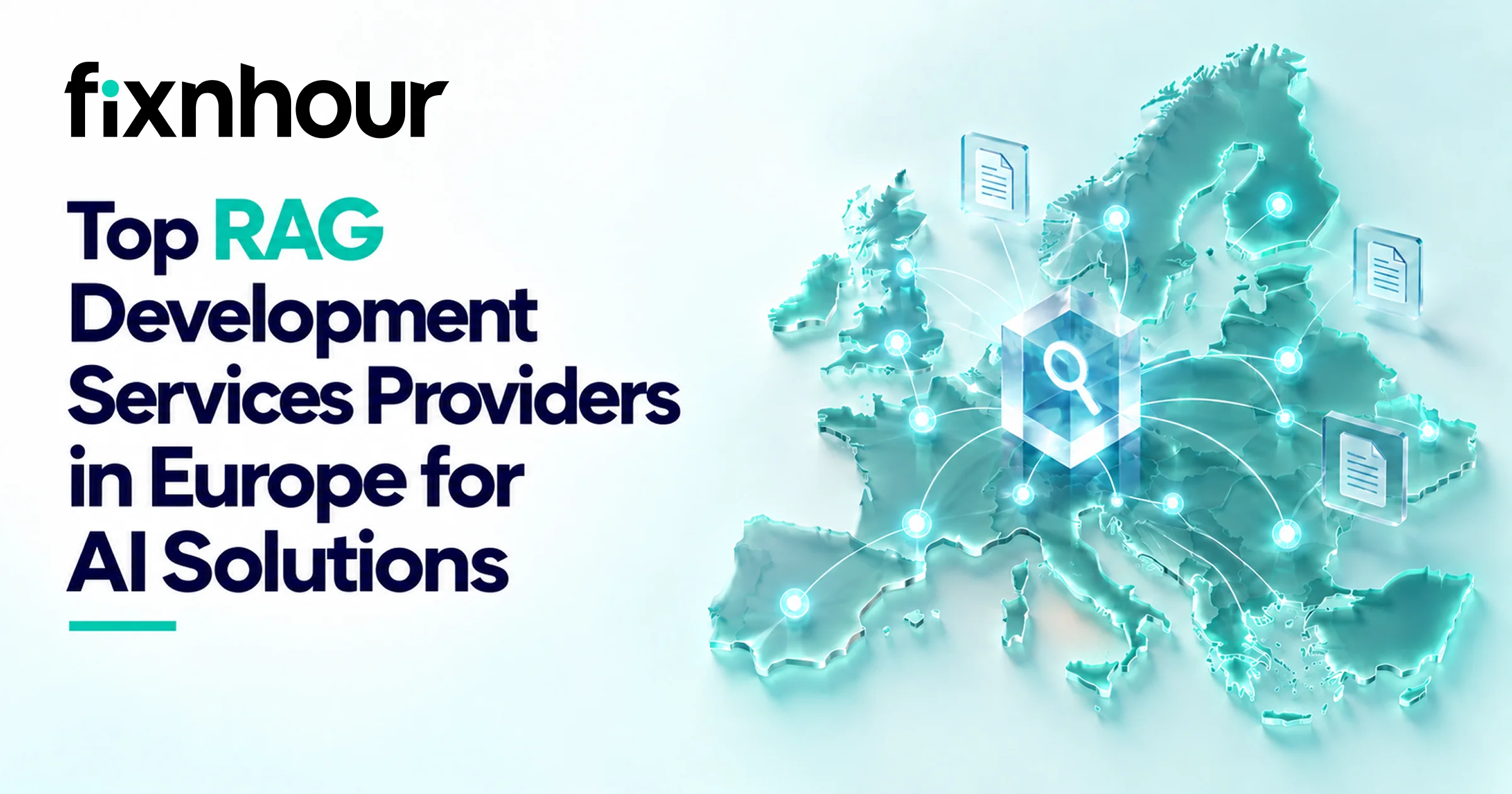
Retrieval-Augmented Generation (RAG) is becoming an important architecture for businesses that want AI applications to answer questions using trusted, private, and frequently changing information. Instead of depending only on an LLM's training knowledge, RAG retrieves relevant content from enterprise sources and provides that context to the model before generating an answer.
European businesses are increasingly exploring RAG for enterprise search, AI assistants, customer support, document intelligence, knowledge management, and internal automation. Choosing the right development partner requires more than checking whether a company offers generative AI. Businesses should evaluate retrieval architecture, data engineering, LLM integration, security, compliance, scalability, and ongoing optimization.
Quick Answer
European businesses can consider providers such as N-iX, Cleveroad, ScienceSoft, Andersen, Vention, Netguru, Intellias, Sigma Software, Silo AI, and ML6 for RAG and broader AI development requirements. Businesses can also use Fixnhour to discover and compare technology service providers based on expertise, services, industry experience, and project requirements. The right provider depends on data complexity, industry, security requirements, preferred cloud environment, integrations, budget, and the level of ongoing RAG optimization required.
Key Takeaways
- RAG connects LLMs with external or proprietary business data to generate more context-aware responses.
- European RAG providers support applications including enterprise search, AI assistants, document intelligence, and knowledge management.
- Retrieval quality, data preparation, evaluation, and security are as important as the underlying LLM.
- GDPR, data residency, access control, and AI governance should be considered during architecture design.
- RAG development costs depend on data complexity, integrations, models, infrastructure, security, and project scope.
- Hybrid search, vector databases, reranking, knowledge graphs, and agentic workflows are becoming important RAG technologies.
- Businesses should compare providers according to technical capabilities and project requirements rather than company size alone.
Statistics & Market Insights
RAG is moving from experimental chatbot development toward production-oriented enterprise AI. Current European provider research highlights retrieval engineering, evaluation, compliance, and secure data access as major differentiators. N-iX, for example, describes hybrid retrieval, access control, audit logging, evaluation, and continuous optimization as core components of enterprise RAG. European Artificial Intelligence Companies are also increasingly positioning RAG alongside AI agents, multimodal systems, and enterprise search, helping businesses build more secure, scalable, and context-aware AI solutions.
Key RAG Market Signals
- Growing enterprise demand for private-data AI
- Increased adoption of vector and hybrid search
- Greater focus on AI governance
- Expansion of agentic RAG
- Rising demand for enterprise AI search
- Increased attention to data residency and privacy
Top RAG Development Services Providers in Europe
The following companies are included based on their publicly demonstrated capabilities in RAG, generative AI, machine learning, data engineering, and enterprise AI. These RAG Development Services Providers in USA are presented as a non-ranked selection, rather than suggesting that one provider is universally better than another. When evaluating RAG partners, businesses should consider factors such as production experience, retrieval engineering, evaluation methods, data security, scalability, and enterprise integration.
| # | Company | Description | Key Services |
|---|---|---|---|
| 1 | N-iX | European provider offering RAG development for secure, scalable enterprise AI systems, including retrieval architecture, vector search, integrations, evaluation, and access control. | RAG Consulting & Architecture; RAG Pipeline Development; Vector & Hybrid Search; Enterprise AI Integration; RAG Evaluation & Optimization |
| 2 | Cleveroad | European software development company offering AI development, RAG, LLM integration, AI agents, vector databases, enterprise knowledge retrieval, and MLOps. | Custom RAG Development; LLM Integration; AI Agent Development; Vector Database Implementation; MLOps Solutions |
| 3 | ScienceSoft | Software and IT consulting provider with expertise in AI, machine learning, data analytics, and enterprise software development for customized AI solutions. | AI Consulting; Generative AI Development; Machine Learning; Data Engineering; Enterprise Application Integration |
| 4 | Andersen | European software development and consulting company providing AI, machine learning, cloud, data, and enterprise software services for RAG applications. | Generative AI Development; RAG Application Development; AI & Machine Learning; Cloud Engineering; Data Engineering |
| 5 | Vention | Custom software engineering and AI development company supporting RAG solutions integrated with APIs, cloud infrastructure, databases, and existing software systems. | RAG Application Development; AI & ML Development; LLM Integration; Cloud Engineering; Data Engineering |
| 6 | Netguru | European digital product development company offering AI, software engineering, cloud, and data capabilities for RAG-powered applications and knowledge platforms. | RAG Development; Generative AI Applications; AI Consulting; Product Development; Cloud & Data Solutions |
| 7 | Ahex Technologies | Software development company offering AI, enterprise solutions, custom software, cloud, SaaS, and business intelligence capabilities relevant to AI-powered applications. | AI Development Services; Generative AI; AI Consulting; Enterprise Software Solutions; Cloud & SaaS Development |
| 8 | Sigma Software | European software engineering company providing AI, machine learning, cloud, data, and custom software development services for enterprise RAG implementations. | AI Development; Generative AI; RAG Solutions; Data Engineering; Cloud Development |
| 9 | Antino Labs | AI consulting and digital transformation company offering AI agents, custom LLM integration, generative AI, and automation for RAG-powered applications. | AI Agent Development; Agentic AI Solutions; Custom LLM Integration; Generative AI Development; AI Consulting |
| 10 | Intellectsoft | Custom software and AI engineering company offering generative AI, AI/ML, cloud, data engineering, and technologies relevant to modern RAG implementations. | Generative AI Development; AI/ML Development; Custom LLM Integration; RAG AI Engineering; Data Engineering |
1. N-iX
N-iX provides dedicated RAG development services for enterprises seeking secure, scalable AI systems. Its capabilities cover retrieval architecture, vector and hybrid search, enterprise integrations, evaluation, access control, and continuous optimization. The company works across cloud and hybrid environments, making its services relevant for organizations managing complex enterprise data and governance requirements. Businesses evaluating N-iX should assess its experience with their preferred LLMs, data sources, security requirements, deployment architecture, and production-scale RAG workloads.
Key Services:
- RAG Consulting & Architecture
- RAG Pipeline Development
- Vector & Hybrid Search
- Enterprise AI Integration
- RAG Evaluation & Optimization
2. Cleveroad
Cleveroad is a European software development company offering AI development and custom enterprise software solutions. Its capabilities include RAG development, LLM integration, AI agents, vector databases, enterprise knowledge retrieval, and MLOps. This combination can benefit organizations looking to embed retrieval-augmented generation into existing digital products, platforms, or business applications. Companies considering Cleveroad should evaluate its experience with their data architecture, preferred AI technologies, security requirements, integration needs, and long-term maintenance expectations.
Key Services:
- Custom RAG Development
- LLM Integration
- AI Agent Development
- Vector Database Implementation
- MLOps Solutions
3. ScienceSoft
ScienceSoft is an established software and IT consulting provider with expertise spanning artificial intelligence, machine learning, data analytics, and enterprise software development. These capabilities can support RAG implementations that connect AI models with business applications, databases, and organizational workflows. Its broader technology experience may be relevant for enterprises requiring customized AI solutions. Before selecting a provider, businesses should validate current RAG project experience, retrieval architecture expertise, security practices, technology stack, industry knowledge, and post-deployment support capabilities.
Key Services:
- AI Consulting
- Generative AI Development
- Machine Learning
- Data Engineering
- Enterprise Application Integration
4. Andersen
Andersen is a European software development and consulting company offering AI, machine learning, cloud engineering, data, and enterprise software services. Its engineering capabilities can support RAG applications requiring connections between business systems, structured data, and unstructured knowledge sources. Organizations exploring Andersen for RAG projects should examine its experience with retrieval frameworks, vector databases, LLM integrations, security controls, deployment environments, evaluation processes, and ongoing technical support to determine alignment with their specific enterprise requirements.
Key Services:
- Generative AI Development
- RAG Application Development
- AI & Machine Learning
- Cloud Engineering
- Data Engineering
5. Vention
Vention provides custom software engineering and AI development services for businesses building digital products and enterprise applications. Its capabilities can support RAG solutions where retrieval technologies need to work alongside APIs, cloud infrastructure, databases, and existing software systems. The company can be considered for organizations seeking to integrate generative AI into operational or customer-facing applications. Buyers should evaluate its expertise in embeddings, vector databases, retrieval evaluation, security, LLM integration, and production AI deployment.
Key Services:
- RAG Application Development
- AI & ML Development
- LLM Integration
- Cloud Engineering
- Data Engineering
6. Netguru
Netguru is a European digital product development company offering capabilities across AI, software engineering, cloud, and data solutions. Its product-focused approach can be relevant for businesses integrating RAG into customer-facing applications, internal knowledge platforms, or SaaS products. Organizations considering Netguru should review its specific RAG implementation experience, data architecture methods, LLM integrations, retrieval and response evaluation practices, and post-launch support model. These factors can help determine whether its capabilities match the complexity and objectives of a RAG project.
Key Services:
- RAG Development
- Generative AI Applications
- AI Consulting
- Product Development
- Cloud & Data Solutions
7. Ahex Technologies
Ahex Technologies is a software development company listed on Fixnhour with capabilities across AI, enterprise solutions, custom software, cloud, SaaS, and business intelligence. Its profile highlights Generative AI and AI consulting, making it relevant for organizations exploring AI-powered applications and data-driven enterprise solutions. Businesses considering Ahex Technologies for RAG projects can evaluate its experience with AI implementation, enterprise integrations, custom application development, data workflows, cloud environments, and ongoing support requirements.
Key Services:
- AI Development Services
- Generative AI
- AI Consulting
- Enterprise Software Solutions
- Cloud & SaaS Development
8. Sigma Software
Sigma Software is a European software engineering company providing AI, machine learning, cloud, data, and custom software development services. Its engineering capabilities can support organizations integrating RAG into enterprise platforms, digital products, and business applications. Companies evaluating Sigma Software should consider its experience with retrieval engineering, vector databases, LLM integrations, data pipelines, security controls, and production deployments. Assessing its maintenance and optimization capabilities can also help businesses plan for long-term RAG performance.
Key Services:
- AI Development
- Generative AI
- RAG Solutions
- Data Engineering
- Cloud Development
9. Antino Labs
Antino Labs is an AI consulting and digital transformation company listed on Fixnhour. Its capabilities include AI agents, agentic reasoning engines, custom LLM integration, AI product development, generative AI, and business automation. These services can be relevant to organizations exploring RAG-powered assistants, intelligent enterprise workflows, and AI applications. Businesses evaluating Antino Labs should examine its specific retrieval architecture experience, vector database capabilities, security practices, LLM expertise, evaluation methods, and production deployment experience.
Key Services:
- AI Agent Development
- Agentic AI Solutions
- Custom LLM Integration
- Generative AI Development
- AI Consulting
10. Intellectsoft
Intellectsoft is a custom software and AI engineering company offering AI/ML development, generative AI, AI consulting, cloud infrastructure, data engineering, and enterprise software services. Its listed technologies, including LangChain, OpenAI, Hugging Face, and vector databases, are relevant to modern RAG implementations. The company also highlights enterprise-focused engineering and GDPR-compliant delivery. Businesses evaluating Intellectsoft should assess its retrieval architecture, security controls, integration capabilities, deployment approach, evaluation processes, and experience with production-grade enterprise RAG solutions.
Key Services:
- Generative AI Development
- AI/ML Development
- Custom LLM Integration
- RAG AI Engineering
- Data Engineering
Benefits of RAG Development Services
RAG development services help organizations connect generative AI applications with current, proprietary, and domain-specific information beyond an LLM’s original training data. By retrieving relevant information before generating responses, RAG can improve contextual accuracy, knowledge access, traceability, and response relevance. RAG Development Services Providers in India help businesses implement these solutions for frequently changing documentation, private databases, technical resources, customer information, internal policies, and operational knowledge across multiple systems.
Better Access to Proprietary Knowledge
RAG enables AI systems to retrieve information from private company databases, internal documents, knowledge bases, and specialized resources. This allows AI applications to provide responses based on organization-specific information instead of depending entirely on an LLM’s general knowledge.
- Connect private knowledge sources
- Retrieve company-specific information
- Support internal documentation
- Improve enterprise knowledge access
More Context-Aware AI Responses
RAG retrieves relevant information based on the user’s query before generating a response. This additional context helps AI applications provide more relevant and domain-specific answers while reducing generic responses that may not address the user’s actual information needs.
- Retrieve relevant contextual information
- Improve response relevance
- Support domain-specific queries
- Reduce generic AI responses
Access to Frequently Updated Information
RAG applications can retrieve information from continuously updated sources without requiring the underlying language model to be retrained whenever business information changes. This makes RAG useful for current documentation, policies, product information, technical resources, and operational knowledge.
- Retrieve recently updated information
- Reduce outdated responses
- Connect dynamic data sources
- Maintain current knowledge
Improved Response Traceability
RAG can connect generated responses with the information retrieved from approved knowledge sources. This can make AI outputs easier to review and verify, particularly in enterprise environments where transparency, source awareness, and reliable information retrieval are important.
- Connect answers with source information
- Improve response transparency
- Support information verification
- Enable easier knowledge auditing
Conclusion
RAG development is becoming an important approach for organizations looking to connect generative AI with proprietary, current, and domain-specific information. RAG solutions can support enterprise search, AI assistants, document intelligence, customer service, knowledge management, and intelligent automation while helping businesses make their existing information more accessible and useful.
When evaluating RAG development service providers in Europe, businesses should consider more than general AI capabilities. Factors such as retrieval architecture, data preparation, vector search, LLM integration, security, compliance, evaluation, scalability, and ongoing optimization can influence production performance. The 10 providers covered in this guide offer different technical approaches and capabilities. Before selecting a partner, define your use case, assess your data requirements, establish security needs, review relevant case studies, compare technical expertise, and evaluate long-term support capabilities. Talk to Our Experts
Frequently Asked Questions
Q1. What are RAG development services in Europe?
Ans. RAG development services involve building AI applications that retrieve relevant information from external, proprietary, or enterprise data sources before generating responses through an LLM. Services may include data ingestion, document processing, embeddings, vector databases, retrieval pipelines, reranking, LLM integration, security, evaluation, deployment, and ongoing optimization.
Q2. How much does RAG development cost in Europe?
Ans. RAG development costs in Europe vary depending on application complexity, data volume, integrations, security requirements, infrastructure, model usage, and development scope. A basic internal knowledge assistant typically requires less engineering than an enterprise RAG platform connected to multiple databases, applications, and regulated data environments.
Q3. How do I choose a RAG development company in Europe?
Ans. Businesses should compare RAG development companies based on architecture expertise, relevant case studies, data engineering capabilities, LLM experience, vector database knowledge, security practices, industry expertise, integration capabilities, pricing, and post-launch support. Providers should also explain how they evaluate retrieval quality, response accuracy, and answer groundedness.
Q4. What technologies are used to build RAG applications?
Ans. RAG applications commonly use large language models, embedding models, vector databases, semantic search, keyword search, reranking systems, document-processing pipelines, APIs, cloud infrastructure, and orchestration frameworks. Depending on project requirements, developers may also use hybrid retrieval, knowledge graphs, AI agents, and multimodal retrieval technologies.
Q5. Can European RAG developers build GDPR-compliant AI solutions?
Ans. RAG applications can be designed with privacy and governance measures such as role-based access controls, encryption, data minimization, audit logging, regional deployment, and controlled retrieval. However, GDPR compliance depends on the complete system implementation, data processing activities, legal requirements, contracts, security measures, and organizational governance.
Q6. What is the difference between RAG and LLM fine-tuning?
Ans. RAG provides external information to an LLM during inference, while fine-tuning changes model behavior through additional training. RAG is useful when applications need frequently updated or controlled information. Fine-tuning can be more appropriate for adapting behavior, response style, formatting, or specialized task performance.
Q7. How long does it take to develop a RAG application?
Ans. RAG development timelines depend on data readiness, application complexity, integrations, security requirements, evaluation processes, and deployment scope. A basic proof of concept may take several weeks, while a production enterprise platform can require considerably longer development, testing, integration, and optimization before it is ready for deployment.
Q8. Which industries benefit most from RAG development?
Ans. RAG can benefit industries that manage large volumes of structured and unstructured information, including finance, healthcare, manufacturing, legal services, retail, logistics, technology, education, and professional services. Common applications include enterprise search, document analysis, customer support, compliance assistance, knowledge management, and intelligent internal information retrieval.