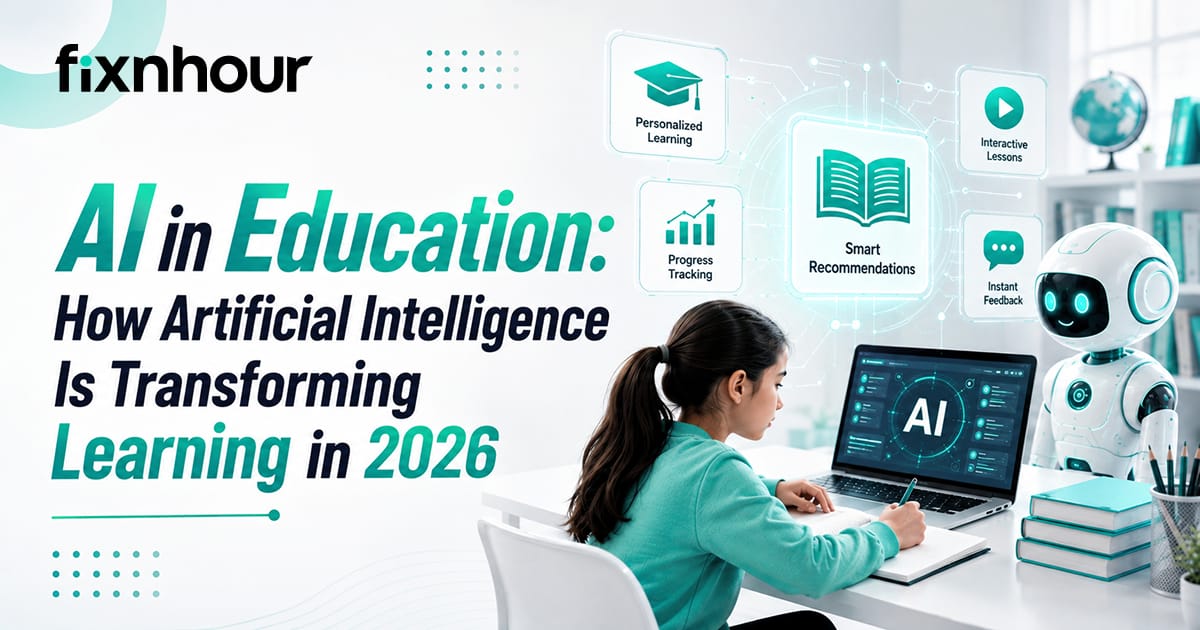
Artificial Intelligence (AI) is no longer a futuristic concept in education, it is becoming an essential part of modern learning. From personalized lesson plans and AI tutors to automated grading and predictive analytics, AI is helping educators deliver more engaging and effective learning experiences. Whether you're a teacher, student, school administrator, or business investing in employee training, understanding how AI is transforming education can help you stay ahead in an increasingly digital world.In this guide, you'll discover how AI works in education, its key benefits, real-world applications, market trends, challenges, implementation costs, and what the future of AI-powered learning looks like in 2026 and beyond.
Quick Answer
Artificial Intelligence is transforming education by creating personalized learning experiences, automating repetitive teaching tasks, improving student engagement, and providing data-driven insights. In 2026, AI enables schools, universities, and organizations to deliver smarter, faster, and more accessible education while supporting teachers rather than replacing them. Fixnhour helps educational institutions leverage AI-powered solutions to enhance learning outcomes, streamline operations, and accelerate digital transformation
Key Takeaways
- AI personalizes education based on each student's learning pace.
- Intelligent tutoring systems provide instant academic support.
- Teachers save time through automated grading and lesson planning.
- Learning analytics help identify struggling students early.
- AI improves accessibility for learners with different abilities.
- Schools can make better decisions using educational data.
- Responsible AI adoption requires strong privacy and ethical standards.
- AI will continue reshaping education through adaptive and immersive learning technologies.
What Is AI in Education?
Artificial Intelligence in education refers to the use of intelligent technologies that simulate human thinking to improve teaching, learning, and educational management. Rather than replacing educators, AI acts as a powerful assistant that helps personalize learning, automate routine tasks, and provide valuable insights that improve educational outcomes.
AI-powered educational platforms analyze student behavior, learning patterns, strengths, and weaknesses to recommend customized learning materials. This makes education more engaging and efficient for learners of all ages. Many generative AI companies are developing advanced AI solutions that enable personalized learning, intelligent content recommendations, and real-time performance analysis, helping educational institutions deliver smarter and more effective learning experiences.
How Artificial Intelligence Is Used in Learning
AI supports nearly every stage of the educational journey, including
- Personalized learning paths
- Smart tutoring systems
- Automated assessments
- Real-time student feedback
- Classroom analytics
- Language translation
- Content generation
- Virtual teaching assistants
Core Technologies Behind AI Education
Several advanced technologies work together to create intelligent educational systems.
Machine Learning (ML)
Machine learning algorithms identify learning patterns and recommend personalized study materials based on student performance.
Natural Language Processing (NLP)
NLP enables AI chatbots and virtual assistants to understand student questions and provide meaningful responses using natural language.
Generative AI
Generative AI helps teachers create lesson plans, quizzes, worksheets, presentations, and summaries within minutes.
Computer Vision
Computer vision supports virtual classrooms by recognizing handwriting, monitoring attendance, and enabling interactive learning experiences.
Predictive Analytics
Educational institutions use predictive analytics to identify students who may require additional academic support before performance declines.
Speech Recognition
Speech recognition improves language learning and accessibility for students through voice-based interactions and pronunciation analysis.
Intelligent Tutoring Systems (ITS)
These AI-powered systems provide personalized tutoring by adapting explanations and practice exercises according to each student's progress.
Why AI Is Transforming Education in 2026
Education is moving away from standardized teaching methods toward personalized, data-driven learning experiences. AI enables institutions to improve educational quality while reducing administrative workload, making learning more accessible, flexible, and effective for students worldwide.
Growing investments in educational technology, increased online learning adoption, and advancements in generative AI have accelerated digital transformation across schools, universities, and corporate training programs. Similar innovations are driving AI e-commerce platforms, where intelligent automation, personalization, and data-driven decision-making are reshaping customer experiences. These advancements highlight how AI is transforming multiple industries by improving efficiency, engagement, and overall performance.
The Shift Toward Personalized Learning
Traditional classrooms often follow the same curriculum for every learner, despite differences in learning speed and understanding.
AI changes this by:
- Adapting lessons to individual performance
- Recommending additional practice where needed
- Identifying knowledge gaps automatically
- Providing instant feedback
- Supporting self-paced learning
Why Educational Institutions Are Investing in AI
Schools and universities recognize AI as a long-term investment because it improves efficiency while enhancing educational outcomes.
Key reasons include:
- Rising demand for digital learning
- Shortage of qualified teaching staff
- Increasing administrative workload
- Need for personalized education
- Better student retention
- Data-driven decision making
- Growing hybrid and remote learning environments
Major Applications of AI in Education
Artificial intelligence is transforming nearly every aspect of education, from classroom instruction to administrative operations. Its ability to automate repetitive tasks, personalize learning, analyze student performance, and provide actionable insights makes AI one of the most valuable technologies in modern education. Similar to AI tools for business, AI-powered education solutions help improve efficiency, streamline workflows, and support smarter decision-making. As AI continues to evolve, educational institutions can deliver more engaging, accessible, and data-driven learning experiences while reducing operational workloads and improving overall outcomes.
Personalized Learning Platforms
Adaptive learning platforms analyze student progress and automatically adjust lessons according to individual strengths and weaknesses.
Benefits include:
- Customized learning paths
- Personalized recommendations
- Flexible learning schedules
- Better concept retention
- Improved student motivation
Intelligent Tutoring Systems
AI tutors provide students with immediate assistance whenever they encounter difficulties, offering instant explanations and personalized guidance. They are available 24/7, allowing learners to study at their own pace without waiting for classroom support. By identifying knowledge gaps and recommending relevant learning resources, AI tutors help improve understanding, confidence, and overall academic performance.
These systems can:
- Explain difficult concepts
- Answer questions instantly
- Recommend additional resources
- Track learning progress
- Offer personalized exercises
AI-Powered Assessments
Manual grading consumes a significant amount of teachers' time, especially in large classrooms with frequent assignments and exams. AI simplifies the evaluation process by automatically assessing quizzes, assignments, and tests while providing detailed and consistent feedback.
Key advantages include:
- Faster grading
- Reduced human error
- Instant feedback
- Consistent evaluation
- Performance analytics
Virtual Teaching Assistants
AI assistants help educators manage classroom activities more efficiently.
They can:
- Answer frequently asked student questions
- Schedule reminders
- Organize learning materials
- Manage course content
- Support online classrooms
AI Content Generation
Generative AI tools are becoming valuable companions for educators by helping them create lesson plans, quizzes, presentations, and learning materials in less time. These tools also assist with content personalization, question generation, and classroom communication. By automating routine tasks, generative AI enables teachers to focus more on student engagement, creativity, and delivering high-quality education.
Teachers can quickly generate the following:
- Lesson plans
- Practice questions
- Homework assignments
- Presentations
- Study guides
- Summaries
- Classroom activities
Learning Analytics
AI collects and analyzes large volumes of educational data to identify learning patterns, student performance trends, and areas that require improvement. These data-driven insights help educators make informed decisions, personalize teaching strategies, and provide timely support to students. By uncovering valuable trends that might otherwise go unnoticed, AI enhances academic outcomes and improves overall educational effectiveness.
Learning analytics help institutions:
- Predict student performance
- Detect learning difficulties early
- Improve curriculum design
- Increase student retention
- Measure educational effectiveness
Benefits of AI in Education
Artificial Intelligence delivers measurable benefits for students, educators, institutions, and businesses by improving learning experiences, increasing operational efficiency, and enabling data-driven decision-making. Instead of replacing human interaction, AI enhances teaching quality while making education more accessible, engaging, and personalized. Many AI Automation Companies are developing intelligent solutions that automate repetitive tasks, optimize workflows, and support personalized learning, helping educational institutions achieve greater efficiency and improved academic outcomes.
For Students
AI empowers students to learn according to their individual pace and abilities. Personalized recommendations, instant feedback, and interactive learning experiences help improve confidence and academic performance.
Key Benefits for Students
- Personalized learning experiences
- Self-paced education
- Instant feedback on assignments
- Better engagement through interactive content
- Improved academic performance
- 24/7 access to AI tutors
- Increased accessibility for learners with disabilities
For Teachers
AI helps educators spend less time on repetitive administrative work and more time focusing on teaching, mentoring, and supporting students.
Key Benefits for Teachers
- Automated grading and assessments
- AI-assisted lesson planning
- Classroom performance analytics
- Reduced paperwork
- Personalized teaching recommendations
- Improved student monitoring.
For Schools and Universities
Educational institutions use AI to improve operational efficiency, optimize resources, and provide better learning experiences across classrooms and online education platforms.
Institutional Benefits
- Improved student retention
- Better academic insights
- Faster administrative processes
- Smarter resource allocation
- Enhanced online learning
- Data-driven decision-making
For Businesses and Corporate Training
Artificial Intelligence is transforming workplace learning by delivering personalized training programs and continuous skill development.
AI Benefits in Corporate Learning
- Personalized employee training
- Faster onboarding
- Skill gap analysis
- AI-powered learning recommendations
- Continuous professional development
- Improved training efficiency
AI Tools Transforming Education
Modern AI tools are making learning more efficient by helping educators create high-quality content, assess student performance, automate administrative tasks, improve communication, and personalize educational experiences. As AI business trends continue to shape the education sector, schools, universities, and training organizations are adopting smarter AI-powered platforms to enhance teaching and learning. These tools continue to evolve with advanced features such as predictive analytics, intelligent tutoring, and real-time insights, enabling institutions to deliver more engaging, accessible, and data-driven education.
Popular Categories of AI Education Tools
AI Learning Management Systems (LMS)
Modern Learning Management System (LMS) platforms use AI to create personalized learning experiences by recommending customized learning paths based on each student's progress, skills, and performance. AI continuously monitors learner activity, tracks academic progress, and identifies areas where additional support is needed.
Features include:
- Personalized course recommendations
- Progress tracking
- Automated notifications
- Learning analytics
- Performance dashboards
AI Tutoring Platforms
Virtual tutors provide personalized guidance whenever students need help, offering instant explanations and step-by-step assistance on various subjects. They adapt to each learner's pace, identify knowledge gaps, and recommend relevant study materials to improve understanding. Available 24/7, AI-powered virtual tutors make learning more accessible, interactive, and effective while boosting student confidence and academic performance.
Common capabilities include:
- Instant question answering
- Personalized explanations
- Practice exercises
- Exam preparation
- Adaptive learning support
AI Writing Assistants
AI writing tools assist students and educators by improving grammar, sentence structure, clarity, and overall writing quality. They help generate ideas, refine content, check for spelling and punctuation errors, and enhance readability. These tools also support research, citation assistance, and content organization, enabling users to create well-structured, accurate, and professional academic documents more efficiently.
These tools help with:
- Essay writing
- Content editing
- Academic summaries
- Citation suggestions
- Language improvement
AI Research Assistants
Researchers and university students increasingly use AI to simplify information gathering.
Benefits include:
- Literature summaries
- Research organization
- Data analysis support
- Academic writing assistance
- Faster information discovery
Language Learning AI
AI-powered language learning platforms enhance communication skills through voice recognition, real-time pronunciation feedback, and personalized learning lessons. They adapt to each learner's proficiency level, recommend targeted exercises, and provide interactive speaking, listening, reading, and writing activities. This personalized approach helps students build confidence, improve fluency, and achieve better language learning outcomes.
They help learners with:
- Pronunciation
- Vocabulary building
- Speaking practice
- Grammar correction
- Real-time conversation
Challenges of AI in Education
While artificial intelligence offers significant opportunities, successful implementation requires careful planning and a well-defined strategy. Educational institutions must address ethical concerns, data privacy, technical challenges, and staff training to ensure responsible AI adoption. Partnering with digital transformation companies in India can help schools, colleges, and universities implement secure, scalable, and AI-driven solutions that improve learning experiences, streamline operations, and support long-term digital transformation.
Data Privacy and Security
Educational platforms collect large amounts of student information, including academic records, learning progress, and personal data. Protecting this information is essential to maintain privacy and build trust. Institutions should implement strong security measures, comply with data protection regulations, and ensure responsible handling of sensitive student data.
Institutions must ensure:
- Secure data storage
- Privacy compliance
- User consent
- Cybersecurity protection
- Responsible data sharing
AI Bias
AI systems are only as effective as the quality of the data used to train them. Inaccurate, outdated, or biased data can lead to unreliable results and unfair decisions. Educational institutions should use diverse, accurate, and regularly updated datasets to ensure AI delivers fair, transparent, and effective learning outcomes.
Poor-quality or biased data may result in:
- Unfair recommendations
- Inaccurate assessments
- Unequal learning opportunities
- Limited inclusivity
Academic Integrity
Generative AI has raised concerns about plagiarism and students relying too heavily on AI-generated assignments. Educational institutions must establish clear guidelines for the ethical use of AI in learning. Encouraging originality, critical thinking, and responsible AI usage helps maintain academic integrity while benefiting from AI-powered tools.
Educational institutions should encourage:
- Ethical AI usage
- Original thinking
- Proper citation
- Human evaluation
- Responsible research practices
Teacher Training
Many educators still require proper training and guidance to use AI technologies effectively in the classroom. Providing professional development programs, hands-on workshops, and continuous support helps teachers understand AI tools, integrate them into lesson plans, and improve student engagement.
Professional development programs should include:
- AI literacy
- Classroom integration
- Ethical AI practices
- Digital teaching strategies
- Technology adoption support
Cost of Implementing AI in Education
The cost of AI implementation depends on factors such as organization size, customization, integrations, and ongoing support. Small institutions can start with affordable AI tools, while universities and enterprise-level education systems often require more advanced solutions.
Estimated AI Education Costs
| AI Solution | Estimated Cost |
|---|---|
| AI Chatbot for Schools | $2,000–$15,000 |
| AI Assessment Platform | $5,000–$40,000+ |
| AI Learning Management Integration | $8,000–$50,000+ |
| AI Tutoring Platform | $10,000–$80,000+ |
| Custom AI Education Software | $30,000–$250,000+ |
| Enterprise AI Learning Platform | $100,000–$1M+ |
Factors That Affect AI Costs
Several factors influence the overall investment:
- Number of users
- Custom AI features
- Cloud infrastructure
- Third-party integrations
- Security requirements
- Maintenance and updates
- Staff training
- Technical support
Step-by-Step Process for Implementing AI in Education
A successful AI implementation starts with clear planning and well-defined educational goals. Institutions should assess their needs before selecting AI solutions. Adopting AI gradually helps teachers and students adapt more effectively, while regular monitoring and performance evaluation ensure continuous improvement. Partnering with artificial intelligence companies enables educational institutions to implement secure, scalable, and innovative AI solutions that enhance learning outcomes, streamline operations, and minimize disruption.
| Step | Description |
|---|---|
| Step 1: Define Educational Goals | Set clear AI objectives such as improving engagement, personalizing learning, and reducing administrative work. |
| Step 2: Assess Existing Infrastructure | Evaluate your technology, devices, security, and infrastructure readiness for AI implementation. |
| Step 3: Choose the Right AI Platform | Select a secure, scalable AI solution that aligns with your educational needs and budget. |
| Step 4: Prepare and Organize Data | Ensure student and institutional data is accurate, secure, organized, and AI-ready. |
| Step 5: Train Teachers and Staff | Equip educators with the skills and knowledge needed to use AI tools effectively. |
| Step 6: Launch a Pilot Program | Test AI with a small group, gather feedback, and refine the implementation strategy. |
| Step 7: Monitor, Evaluate, and Improve | Continuously measure AI performance, optimize workflows, and improve learning outcomes. |
Step 1: Define Educational Goals
- Improve student engagement and participation.
- Personalize learning experiences for different skill levels.
- Reduce administrative and repetitive teaching tasks.
- Enhance student performance through data-driven insights.
Step 2: Assess Existing Infrastructure
- Assess internet connectivity and cloud infrastructure.
- Check device availability for students and educators.
- Evaluate data quality, storage, and security measures.
Step 3: Choose the Right AI Platform
- Choose a solution that supports personalization and automation.
- Ensure compatibility with your existing LMS and software.
- Prioritize data security, privacy, and regulatory compliance.
- Look for scalable platforms that can grow with your institution.
Step 4: Prepare and Organize Data
- Collect accurate and relevant student and institutional data.
- Remove duplicate, outdated, or incomplete information.
- Organize data into a structured and accessible format.
- Ensure compliance with data privacy and security regulations.
Step 5: Train Teachers and Staff
- Conduct hands-on workshops and training sessions.
- Teach educators how to use AI tools effectively.
- Explain AI ethics, data privacy, and responsible usage.
- Provide ongoing technical support and learning resources.
Step 6: Launch a Pilot Program
- Define clear objectives and success metrics for the pilot.
- Monitor student engagement and learning outcomes.
- Collect feedback from teachers, students, and administrators.
- Identify technical issues and optimize AI performance.
Step 7: Monitor, Evaluate, and Improve
- Track student engagement and academic performance.
- Measure AI effectiveness using key performance indicators (KPIs).
- Collect feedback from students, teachers, and administrators.
Conclusion
Artificial Intelligence is redefining education by making learning more personalized, efficient, and accessible than ever before. From adaptive learning platforms and intelligent tutoring systems to automated assessments and predictive analytics, AI empowers students to learn more effectively while helping educators focus on delivering meaningful instruction.
Although challenges such as data privacy, ethical AI usage, and teacher training remain important, the long-term advantages far outweigh the obstacles when AI is implemented responsibly. Educational institutions that invest in AI today will be better equipped to improve student outcomes, streamline operations, and prepare learners for an increasingly digital future. Contact us today
Frequently Asked Questions
Q1. What is AI in education?
Ans. AI in education refers to the use of artificial intelligence technologies to enhance teaching, learning, and educational administration. It helps personalize learning experiences, automate repetitive tasks such as grading and attendance, provide real-time feedback, and analyze student performance. AI also supports educators by offering data-driven insights that improve decision-making and create more engaging, accessible, and effective learning environments.
Q2. How is AI transforming education in 2026?
Ans. In 2026, AI is transforming education through adaptive learning, intelligent tutoring systems, automated grading, predictive analytics, and AI-powered virtual assistants. These technologies provide personalized learning paths, identify student learning gaps, and help educators deliver targeted support. AI also improves administrative efficiency, making education more flexible, accessible, and data-driven for schools, universities, and online learning platforms.
Q3. What are the biggest benefits of AI for teachers?
Ans. AI significantly reduces teachers' administrative workload by automating grading, attendance tracking, lesson planning, and performance analysis. It provides valuable insights into student progress, helping educators identify learning gaps and personalize instruction. This allows teachers to spend more time mentoring students, encouraging critical thinking, and creating engaging classroom experiences.
Q4. Which AI tools are commonly used in education?
Ans. Common AI tools used in education include adaptive learning platforms, AI chatbots, intelligent tutoring systems, Learning Management Systems (LMS), AI writing assistants, language learning applications, virtual tutors, and learning analytics platforms. These solutions help improve student engagement, simplify classroom management, personalize learning, and enhance overall educational outcomes.
Q5. How much does AI implementation cost in education?
Ans. The cost of AI implementation depends on the type of solution, level of customization, integrations, and organizational size. Basic AI chatbots may cost around $2,000–$15,000, while AI assessment platforms and tutoring systems typically range from $5,000–$80,000. Enterprise-level AI learning platforms and custom education software can exceed $1 million, depending on infrastructure, security, and ongoing maintenance requirements.
Q6. What challenges do educational institutions face when adopting AI?
Ans. Educational institutions often face challenges such as data privacy concerns, cybersecurity risks, AI bias, implementation costs, limited technical infrastructure, and the need for teacher training. Ensuring ethical AI usage, maintaining high-quality data, and complying with privacy regulations are also essential for successful AI adoption. Careful planning and continuous monitoring help overcome these challenges effectively.
Q7. Can AI replace teachers?
Ans. No. AI is designed to support teachers rather than replace them. While AI can automate repetitive tasks, provide personalized learning recommendations, and analyze student performance, it cannot replace human qualities such as empathy, creativity, communication, emotional support, and classroom management. Teachers remain essential for motivating students, developing critical thinking skills, and creating meaningful learning experiences.
Q8. How can schools successfully implement AI?
Ans. Schools can successfully implement AI by first defining clear educational goals and assessing their existing technology infrastructure. They should choose the right AI platform, prepare high-quality data, train teachers and staff, and launch a pilot program before full deployment. Regular monitoring, performance evaluation, and continuous improvements ensure AI delivers better learning outcomes while supporting both educators and students