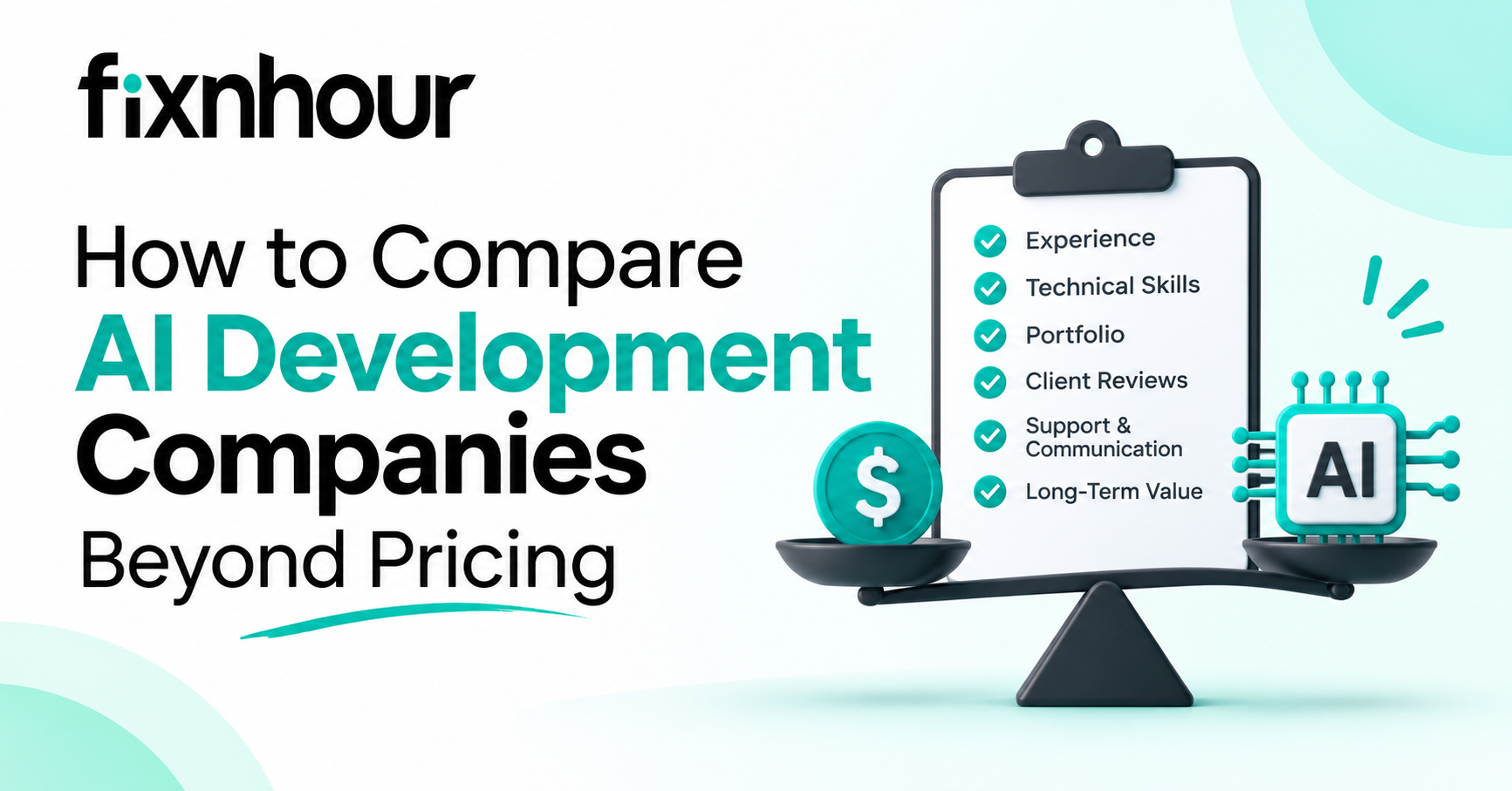
Choosing the right AI development company is an important decision for businesses planning to implement artificial intelligence, machine learning, generative AI, or automation solutions. While pricing is often one of the first factors companies consider, selecting a development partner based only on the lowest quotation can lead to technical limitations, unexpected expenses, project delays, and poor long-term results. Businesses should evaluate several factors, including technical expertise, industry experience, development methodology, communication, security standards, and the ability to deliver scalable AI solutions.
Comparing AI development companies beyond pricing helps businesses identify partners that understand their objectives and can deliver measurable business value. From reviewing previous AI projects and evaluating development teams to assessing post-launch support and ROI, a structured comparison process makes vendor selection more effective. Platforms such as Fixnhour can also help businesses discover and evaluate service providers through company profiles, business information, and client reviews before making a hiring decision.
Quick Answer
Businesses should compare AI development companies by evaluating technical expertise, industry experience, previous projects, development methodologies, data security, scalability, communication, and post-launch support. Reviewing client feedback and assessing long-term business value on platforms like Fixnhour also helps businesses discover reliable AI development partners and make informed hiring decisions instead of selecting a company based only on its lowest quotation.
Key Takeaways
- Compare AI development companies based on technical expertise rather than development costs alone.
- Review previous projects, case studies, and real-world AI implementation experience.
- Evaluate expertise in machine learning, deep learning, NLP, computer vision, and generative AI.
- Check data security, privacy policies, compliance, and intellectual property ownership.
- Understand project management practices, communication, and delivery timelines.
- Evaluate scalability, integration capabilities, and long-term maintenance services.
- Compare client reviews, testimonials, and verified business profiles on platforms such as Fixnhour.
Why Should Businesses Compare AI Development Companies Beyond Pricing?
Businesses should compare AI development companies beyond pricing to identify reliable technology partners that can deliver high-quality, scalable, and result-oriented AI solutions. A structured AI development company evaluation helps businesses understand the actual capabilities of different providers before making a hiring decision. Choosing a development company based only on the lowest quotation may lead to technical limitations, unexpected expenses, security issues, and poor project outcomes. Instead, businesses should evaluate technical expertise, industry experience, previous projects, development methodologies, data security, communication, and post-launch support. A detailed comparison helps organizations understand the actual value each provider offers, minimize development risks, and make informed investment decisions.
- Technical Expertise: Evaluate AI technologies, frameworks, programming languages, and development capabilities.
- Industry Experience: Review relevant projects and domain-specific knowledge.
- Project Quality: Examine portfolios, case studies, and successful AI implementations.
- Data Security: Assess privacy policies, encryption, and compliance practices.
- Scalability: Ensure solutions can accommodate future business growth.
- Post-Launch Support: Check maintenance, updates, monitoring, and technical assistance.
Analyze Previous AI Projects, Case Studies, and Industry Experience
Evaluating previous AI projects, case studies, and industry experience helps businesses understand whether an AI development company has the practical expertise to handle their requirements. A company's portfolio provides insights into its technical capabilities, problem-solving approach, project quality, and experience with different AI technologies, including AI apps that complete tasks through intelligent automation and customized workflows. Reviewing successful implementations also helps businesses understand how the company handles real-world challenges, develops customized solutions, and delivers measurable outcomes. Before selecting a development partner, examine its completed projects, industry specialization, client feedback, and technical achievements.
|
Evaluation Factor |
What to Check |
Key Points |
|---|---|---|
|
AI Development Portfolio |
Examine previous AI-powered applications and completed projects. |
Project complexity, technical expertise, application quality |
|
Real-World Implementation Results |
Review case studies to understand how the company solves business challenges. |
Project objectives, measurable results, AI performance |
|
Industry-Specific Experience |
Check experience in your industry or similar business environments. |
Healthcare, finance, retail, manufacturing, education |
|
Client References and Demonstrations |
Request client feedback, live demos, and technical walkthroughs. |
Client references, project demonstrations, previous experience |
1. Review the Company's AI Development Portfolio
Examine the company's portfolio to understand its experience in developing different AI-powered applications. Look for projects that demonstrate technical knowledge, creativity, and the ability to solve business problems through artificial intelligence.
- Check previous AI applications.
- Review project complexity.
- Examine technology expertise.
2. Evaluate Real-World AI Implementation Results
Case studies help businesses understand how an AI development company approaches challenges and delivers practical solutions. Focus on measurable outcomes rather than general project descriptions to evaluate its actual performance.
- Review project objectives.
- Check measurable business results.
- Evaluate AI solution performance.
3. Check Industry-Specific Experience
Choose a company with experience in your industry or similar business environments. Industry knowledge helps development teams understand specific workflows, customer expectations, operational challenges, and regulatory requirements.
- Healthcare and medical technology.
- Finance and banking.
- Retail and eCommerce.
- Manufacturing and logistics.
- Education and enterprise software.
4. Ask for Client References and Project Demonstrations
Request client references, project demonstrations, or technical walkthroughs to verify the company's experience. Direct discussions and demonstrations can provide a clearer understanding of development quality, communication, and problem-solving capabilities.
- Request client references.
- Ask for live demonstrations.
- Verify previous project experience.
Evaluate Technical Expertise and AI Development Capabilities
Evaluating technical expertise and AI development capabilities is one of the most important steps in AI app development company evaluation when comparing AI development companies. A technically experienced company should have a strong understanding of artificial intelligence technologies, programming languages, machine learning frameworks, model development, and deployment processes. Businesses should examine whether the development team can build customized AI solutions that address specific operational challenges and support long-term business objectives. It is also important to evaluate the company's practical experience with generative AI, natural language processing, computer vision, predictive analytics, and AI-powered automation.
Important Technical Capabilities to Evaluate
- Artificial Intelligence and Machine Learning: Check whether the company has experience developing intelligent applications, predictive models, recommendation systems, and automated business solutions using AI and machine learning technologies.
- Deep Learning Expertise: Evaluate the development team's ability to work with neural networks and deep learning techniques for complex tasks such as image recognition, speech processing, pattern detection, and advanced data analysis.
- Generative AI and Large Language Models (LLMs): Review experience in building AI chatbots, content generation applications, AI assistants, and customized LLM-powered solutions using suitable models and APIs.
- Natural Language Processing (NLP): Check whether the company can develop applications that understand, analyze, and process human language for conversational AI, sentiment analysis, text classification, and language-based automation.
Step-by-Step Process to Choose the Right AI Development Company
Follow a structured approach to choose the right Artificial Intelligence Companies by defining business requirements, researching potential providers, evaluating portfolios, comparing technical expertise, checking client reviews, and assessing long-term support to make a confident hiring decision.
Step 1: Define Your Business Requirements
Clearly identify the business challenges you want to solve through artificial intelligence. Define your project objectives, expected outcomes, budget expectations, and required AI capabilities before approaching development companies.
- Identify business challenges.
- Set clear project objectives.
- Define required AI features.
Step 2: Research and Shortlist AI Development Companies
Research different AI development companies that offer services relevant to your project. Focus on their technical expertise, industry specialization, development experience, and ability to understand your business requirements.
- Explore relevant AI companies.
- Check technical specializations.
- Shortlist suitable providers.
Step 3: Evaluate Portfolios and Case Studies
Review the company's previous AI projects to understand its development capabilities and practical experience. Examine case studies, project outcomes, and real-world implementations to determine whether the company can handle your requirements.
- Review previous AI projects.
- Examine client case studies.
- Request project demonstrations.
Step 4: Conduct Technical Discussions
Arrange technical discussions with shortlisted companies to understand their proposed development approach. Discuss AI architecture, model selection, programming frameworks, data requirements, system integrations, and deployment strategies.
- Discuss AI architecture.
- Evaluate technology recommendations.
- Understand integration requirements.
Step 5: Compare Proposals Beyond Pricing
Compare proposals based on technical solutions, project deliverables, development timelines, and service quality rather than focusing only on the quoted price. Consider maintenance expenses, scalability, and long-term support before making a decision.
- Compare project deliverables.
- Evaluate development timelines.
- Review long-term costs.
Step 6: Verify Reviews and Business Credentials
Check client testimonials, business profiles, ratings, and company credentials to understand each provider's reputation. Explore platforms such as Fixnhour to discover AI development companies and review available business information.
- Check verified client reviews.
- Examine company profiles.
- Verify business credibility.
Step 7: Start With a Proof of Concept (PoC)
Before investing in full-scale development, ask the shortlisted company to create a proof of concept. A PoC helps evaluate technical feasibility, model performance, functionality, and whether the proposed solution addresses your business problem.
- Test technical feasibility.
- Evaluate model performance.
- Validate expected outcomes.
Step 8: Finalize the Development Partner
After evaluating technical capabilities, project proposals, communication, and support services, select the AI development company that best matches your requirements. Ensure that all deliverables, timelines, responsibilities, and contractual terms are clearly documented.
- Select the right development partner.
- Finalize project agreements.
- Confirm delivery milestones.
Conclusion
Comparing AI development companies beyond pricing helps businesses identify technology partners capable of delivering reliable, secure, and scalable solutions. Technical expertise, industry experience, development methodologies, data protection, integration capabilities, and post-launch support should all influence the final decision. Businesses should also review portfolios, verify client feedback, and compare proposals using a consistent evaluation framework.
Rather than selecting the cheapest provider, prioritize a company that understands your business objectives and can deliver measurable long-term value. Platforms like Fixnhour can support the discovery and evaluation process by helping businesses explore B2B service providers and their company information. Connect with our experts
Frequently Asked Questions
Q1. How do I compare AI development companies beyond pricing?
Ans. To compare AI development companies beyond pricing, evaluate their technical expertise, industry experience, previous projects, development methodologies, data security practices, scalability, and post-launch support. Start by identifying your business requirements and the AI capabilities needed to achieve your objectives. Then review each company's portfolio, case studies, programming expertise, and experience with technologies such as machine learning, generative AI, natural language processing, and computer vision. You should also examine client testimonials, communication practices, project management processes, and intellectual property policies. Comparing these factors through a structured evaluation scorecard helps businesses select a development partner based on overall value, reliability, and long-term capabilities rather than the lowest quotation.
Q2. What factors should I consider when choosing an AI development company?
Ans. Several important factors should influence your decision when choosing an AI development company. First, evaluate its expertise in relevant AI technologies, programming languages, frameworks, and model development approaches. Second, review previous projects to understand whether the company has experience solving problems similar to yours. You should also examine its development process, project management capabilities, communication standards, and ability to meet delivery timelines. Data security, regulatory compliance, scalability, and integration capabilities are equally important, particularly for enterprise applications. Additionally, check client reviews, service agreements, maintenance policies, and technical support availability. A reliable AI development partner should demonstrate both technical capabilities and a clear understanding of your business goals.
Q3. Why should businesses not choose an AI development company based only on price?
Ans. Choosing an AI development company based only on price can create problems related to software quality, technical performance, project delivery, and long-term maintenance. A low-cost proposal may exclude important services such as data preparation, model optimization, security testing, documentation, and post-launch support. Businesses may also encounter additional expenses when the original solution cannot handle increasing workloads or integrate with existing systems. Furthermore, inexperienced developers may select unsuitable AI models or create solutions that fail to meet business expectations. Instead of focusing exclusively on initial development costs, businesses should evaluate technical expertise, project deliverables, total cost of ownership, and expected return on investment to make a more informed decision.
Q4. How can I evaluate the technical expertise of an AI development company?
Ans. You can evaluate an AI development company's technical expertise by reviewing its development portfolio, case studies, technical team experience, and previous AI implementations. Check whether the company has practical experience with machine learning, deep learning, generative AI, natural language processing, computer vision, and predictive analytics. Ask about the programming languages, frameworks, cloud platforms, and AI models used in previous projects. It is also useful to request a technical demonstration or proof of concept to understand how the team approaches real-world problems. During technical discussions, ask developers to explain their architecture, model selection, training process, testing methodology, deployment strategy, and performance monitoring practices. These steps help distinguish genuine technical capabilities from marketing claims.
Q5. What questions should I ask an AI development company before hiring?
Ans. Before hiring an AI development company, ask questions that help you understand its technical capabilities, project experience, and service commitments. Find out whether it has completed projects similar to yours and request relevant case studies or demonstrations. Ask which AI technologies and frameworks it recommends for your requirements and why. Discuss development timelines, project milestones, team composition, communication procedures, testing methods, and deployment strategies. You should also clarify data ownership, source code ownership, confidentiality agreements, security practices, and intellectual property rights. Finally, ask about post-launch maintenance, model retraining, technical support, and additional costs. These questions help establish clear expectations and reduce the risk of selecting an unsuitable development partner.
Q6. How important are client reviews when comparing AI development companies?
Ans. Client reviews are important because they provide additional information about a company's reliability, communication, project management, and service quality. A portfolio may demonstrate technical capabilities, but client feedback can reveal how the company handles changing requirements, development challenges, deadlines, and post-launch issues. Businesses should examine detailed reviews instead of relying only on overall star ratings. Look for recurring positive and negative patterns, including responsiveness, technical problem-solving, transparency, and customer support. It is also useful to verify whether reviews come from genuine clients and whether the company has relevant project references. B2B platforms such as Fixnhour can help businesses discover company profiles and available review information while evaluating potential service providers.
Q7. How can businesses calculate the ROI of an AI development project?
Ans. Businesses can calculate the ROI of an AI development project by comparing the financial benefits generated by the solution with its total implementation and operating costs. Start by identifying measurable objectives, such as reducing manual work, improving employee productivity, decreasing operational expenses, increasing sales conversions, or improving customer response times. Calculate the financial value of these improvements over a defined period. Then include all relevant expenses, such as development, data preparation, cloud infrastructure, third-party APIs, deployment, maintenance, and model optimization. A commonly used formula is: ROI = [(Total Financial Benefits − Total Investment Cost) ÷ Total Investment Cost] × 100. Tracking these metrics helps businesses determine whether an AI solution delivers sustainable business value.
Q8. Which is more important when selecting an AI development company: technical expertise or industry experience?
Ans. Both technical expertise and industry experience are important when selecting an AI development company, and their relative importance depends on the project's requirements. Technical expertise ensures that the development team can design, build, test, and deploy appropriate AI solutions using suitable technologies and frameworks. Industry experience helps the team understand business workflows, customer expectations, regulatory requirements, and domain-specific challenges. For example, an AI solution for healthcare may require different data protection practices and validation processes than an AI application for retail or eCommerce. Ideally, businesses should choose a company that combines strong technical capabilities with relevant industry knowledge. If one area is limited, evaluate whether the company can demonstrate a credible plan to address that gap.