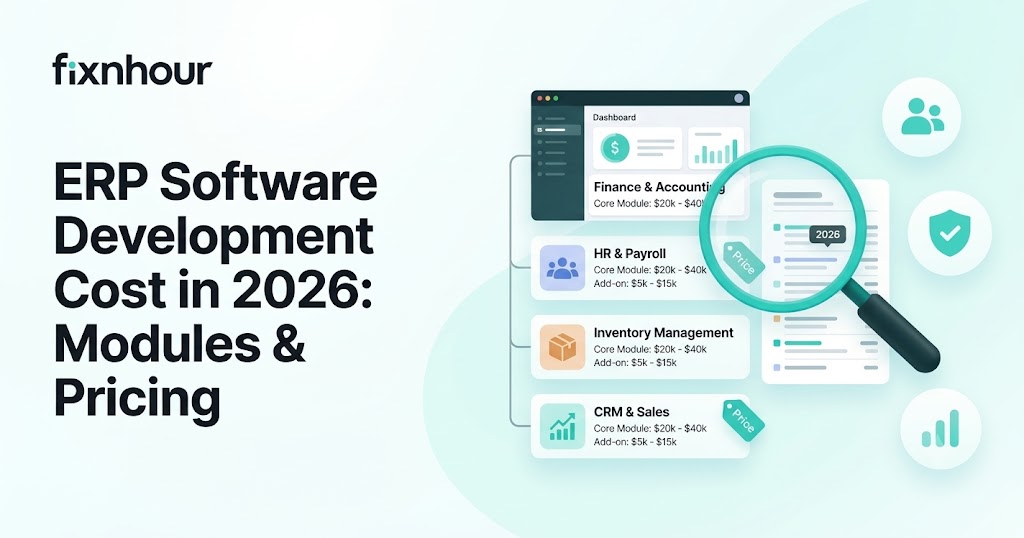
Businesses today rely on ERP software to bring finance, human resources, inventory, sales, procurement, customer data, and operations into one connected system. But before investing in an ERP solution, one of the biggest questions businesses ask is: How much does ERP software development cost in 2026? The answer depends on several factors, including the number of modules, customization level, integrations, technology stack, development team location, security requirements, and whether the solution is cloud-based or deployed on-premise.
For businesses considering custom ERP software development, understanding these cost factors helps create a realistic budget and avoid unexpected expenses. This guide explains ERP software development cost in 2026, major ERP modules, pricing factors, development timelines, pricing models, and practical ways to control development expenses.
Quick Answer
The cost of developing ERP software can vary significantly depending on project complexity. A basic ERP system with essential modules may require a relatively smaller investment, while a sophisticated enterprise ERP platform with advanced analytics, AI, mobile applications, automation, and multiple integrations can require a much larger budget. The major factors affecting ERP software development cost include:
- Number of ERP modules
- Level of customization
- UI/UX complexity
- Third-party integrations
- Cloud or on-premise deployment
- Mobile application requirements
- Data migration
- Security and compliance
- AI and automation features
- Development team location
- Testing and quality assurance
- Maintenance and post-launch support
|
|
|
|
|---|---|---|
|
|
|
|
|
|
|
|
|
|
|
|
|
|
|
|
ERP Software Development Cost in 2026
There is no universal price for ERP development because every business has different workflows and operational requirements. A small company may only need accounting, inventory, HR, and sales functionality. A large enterprise could require manufacturing, supply chain management, procurement, CRM, business intelligence, warehouse management, payroll, mobile applications, and AI-powered automation. Discover the IT Services Pricing Guide 2026 with cost estimates, pricing models, key factors, and expert tips to choose the right IT partner for your business.
ERP Development Cost by Business Size
Small Business ERP
A small business generally needs a focused ERP system with core operational features. Common modules include:
- Accounting and finance
- Inventory management
- Employee management
- Sales management
- Basic reporting
- Customer management
Mid-Sized Business ERP
A mid-sized organization may require more sophisticated workflows and integrations. Typical requirements include:
- Advanced financial management
- HR and payroll
- CRM
- Inventory and warehouse management
- Procurement
- Project management
- Business reporting
- Third-party integrations
Enterprise ERP
Enterprise ERP platforms typically involve complex workflows, multiple departments, large databases, extensive integrations, advanced security, and high scalability. They may include:
- Supply chain management
- Manufacturing
- Advanced financial management
- Enterprise HR
- CRM
- Procurement
- Business intelligence
- AI-powered analytics
- Workflow automation
- Multi-location management
- Multi-language and multi-currency support
ERP Software Cost by Development Approach
Businesses can choose between several ERP development approaches.
Custom ERP software development provides maximum control over functionality, workflows, integrations, and scalability.
Ready-made ERP software can be faster to deploy but may provide limited customization.
SaaS ERP solutions operate through cloud infrastructure and generally use subscription-based pricing.
Open-source ERP customization can reduce licensing expenses but still requires development, configuration, security, integration, and maintenance costs.
ERP Software Development Cost by Modules
The number and complexity of modules are among the biggest contributors to ERP development cost. Instead of developing every feature from the beginning, businesses should identify the modules that directly support their most important processes.
Finance and Accounting Module
The finance module forms the foundation of many ERP systems. Common functionality includes:
- General ledger
- Accounts payable
- Accounts receivable
- Expense management
- Invoicing
- Tax management
- Budgeting
- Financial reports
- Cash-flow tracking
Human Resource Management Module
An HR module centralizes employee-related operations. Features can include:
- Employee profiles
- Recruitment
- Onboarding
- Payroll
- Attendance
- Leave management
- Performance management
- Employee self-service
- Document management
Inventory Management Module
Inventory management helps businesses monitor stock across warehouses and locations. Important features include:
- Real-time inventory tracking
- Stock movement
- Warehouse management
- Purchase orders
- Stock alerts
- Barcode scanning
- Batch tracking
- Serial number management
- Inventory reporting
Customer Relationship Management Module
A CRM module allows organizations to manage customer interactions and sales processes within the ERP platform. Typical functionality includes:
- Lead management
- Customer profiles
- Sales pipeline
- Contact management
- Follow-ups
- Customer support
- Sales forecasting
- Communication history
Supply Chain Management Module
Supply chain functionality is particularly important for manufacturing, retail, logistics, and distribution businesses. Key features include:
- Procurement
- Supplier management
- Purchase orders
- Logistics
- Demand planning
- Order management
- Distribution
- Supply chain analytics
Manufacturing Module
Manufacturing ERP development can be considerably more complex because it must support production workflows. Features may include:
- Production planning
- Bill of materials
- Work orders
- Production scheduling
- Quality control
- Machine management
- Raw material tracking
- Manufacturing reports
Sales and Marketing Module
Sales functionality helps businesses manage the complete sales lifecycle. It can include:
- Product catalogs
- Quotations
- Sales orders
- Invoicing
- Customer management
- Sales targets
- Campaign management
- Sales analytics
Project Management Module
Service-based businesses often require project management capabilities within their ERP. Features can include:
- Project planning
- Task assignment
- Resource allocation
- Timesheets
- Budget tracking
- Milestone management
- Project reporting
Business Intelligence and Reporting Module
Advanced ERP systems need more than basic reports. A business intelligence module can provide:
- Real-time dashboards
- KPI monitoring
- Custom reports
- Data visualization
- Sales analytics
- Financial analytics
- Operational analytics
- Predictive insights
Key Factors Affecting ERP Software Development Cost
Several factors influence the final ERP software pricing. Discover the best ERP software companies reviewed for 2026
Number and Complexity of ERP Modules
More modules generally mean more development hours, testing, database architecture, integrations, and maintenance. A simple accounting and inventory ERP will cost less than a platform combining finance, HR, CRM, manufacturing, procurement, supply chain, analytics, and AI.
UI/UX Design and Customization
The user interface affects both usability and development effort. Custom ERP interfaces may include:
- Department-specific dashboards
- Role-based navigation
- Custom reports
- Interactive charts
- Responsive layouts
- Personalized workflows
- Mobile-friendly interfaces
Technology Stack
The selected technology stack can affect development speed, scalability, security, and long-term maintenance. Common technologies used for ERP development include:
- React
- Angular
- Vue.js
- Node.js
- Python
- Java
- .NET
- PostgreSQL
- MySQL
- Microsoft SQL Server
- Cloud infrastructure
Third-Party Integrations
Integrations can significantly affect custom ERP development cost. Common integrations include:
- Payment gateways
- CRM platforms
- Accounting systems
- Payroll software
- Banking systems
- E-commerce platforms
- Shipping platforms
- Communication APIs
- Business intelligence tools
- Enterprise APIs
ERP Software Development Cost Breakdown
A typical ERP development project involves several stages.
|
|
|
|---|---|
|
|
|
|
|
|
|
|
|
|
|
|
|
|
|
|
|
|
|
|
|
|
|
|
|
|
|
|
|
|
ERP Development Cost Based on Technology and Team Location
Development location can have a substantial impact on the overall ERP development pricing.
ERP Development Cost in India
India is a popular destination for outsourcing software development because businesses can access large technology talent pools and flexible development models. The final cost depends on the team's experience, technology requirements, project complexity, and engagement model.
ERP Development Cost in the USA
Development teams in the United States generally have higher hourly rates, which can increase overall ERP development costs. However, organizations may choose US-based teams when local collaboration, industry expertise, or specific enterprise technology experience is a priority.
ERP Development Cost in the UK
UK development companies can be suitable for organizations seeking proximity to European markets and expertise in enterprise software development.
ERP Development Cost in Europe
European ERP development costs vary significantly between countries. Team expertise, location, technology stack, and project complexity remain important pricing factors.
ERP Software Development Team Required
A professional ERP development team may include:
- Business analyst — Defines business requirements and workflows.
- UI/UX designer — Creates interfaces and user experiences.
- Frontend developer — Builds the ERP user interface.
- Backend developer — Develops APIs and business logic.
- Database developer — Designs and optimizes databases.
- QA engineer — Tests functionality, performance, and security.
- DevOps engineer — Handles infrastructure, deployment, and monitoring.
- Project manager — Coordinates development, communication, and delivery.
For complex enterprise ERP systems, organizations may also require data engineers, solution architects, cybersecurity specialists, and AI engineers.
How Long Does It Take to Develop ERP Software?
ERP development timelines depend heavily on the number of modules and customization requirements.
A basic ERP may take several months, while a complex enterprise platform can require a year or more.
ERP Development Timeline by Project Complexity
Basic ERP: Approximately 3–5 months
Mid-level ERP: Approximately 5–9 months
Advanced ERP: Approximately 9–15 months
Enterprise ERP: Approximately 12–24+ months
The timeline can increase because of:
- Additional modules
- Complex integrations
- Data migration
- Multiple user roles
- Custom workflows
- Security requirements
- Mobile applications
- AI implementation
- Extensive testing
Custom ERP Software vs. Ready-Made ERP: Which Is More Cost-Effective?
The right option depends on the business rather than simply choosing the lowest upfront price.
Advantages of Custom ERP Development
Custom ERP software can provide:
- Business-specific workflows
- Greater flexibility
- Custom integrations
- Scalable architecture
- Personalized dashboards
- Greater control over functionality
- Ability to add AI and automation
- Better alignment with unique processes
Advantages of Ready-Made ERP Software
Off-the-shelf ERP solutions can provide:
- Faster implementation
- Lower initial development effort
- Pre-built functionality
- Established integrations
- Vendor support
- Regular software updates
Key Takeaways
The ERP software development cost in 2026 depends on much more than the number of screens or features. Business requirements, modules, integrations, technology, security, development location, and long-term scalability all influence the final budget. Estimate software development costs by country with our global calculator. Compare hourly rates, project pricing, and outsourcing costs for smarter budgeting. Key points to remember:
- Custom ERP software development generally costs more initially than ready-made ERP solutions.
- The number and complexity of ERP modules significantly affect development costs.
- Third-party integrations can increase both development time and budget.
- AI, automation, analytics, and mobile applications can add advanced capabilities but increase development complexity.
- An MVP approach can help businesses control initial investment.
- Cloud ERP can provide flexible scalability and accessibility.
- Data migration should be planned early in the ERP development process.
- Security and compliance should be considered from the architecture stage.
- Choosing an experienced ERP development company can reduce technical and implementation risks.
- Businesses should evaluate total cost of ownership, not just the initial ERP development price.
Conclusion
The ERP software development cost in 2026 depends on the size and complexity of the business, required ERP modules, level of customization, technology stack, integrations, security requirements, and development team location. A basic ERP can be developed with a relatively smaller investment, while advanced enterprise ERP solutions with AI, automation, mobile applications, analytics, and complex integrations require a significantly larger budget. Businesses should focus on their actual operational requirements instead of choosing an ERP solution based only on price. Starting with essential modules and gradually adding advanced features can help control the initial ERP development cost while creating a scalable platform for future growth.
Choosing an experienced ERP development company is equally important. The right development partner can help with planning, architecture, development, integration, testing, deployment, and long-term maintenance, ensuring that the ERP system delivers measurable business value and supports sustainable growth. Contact fixnhour for more queries.
Frequently Asked Questions
Q1. How much does it cost to develop ERP software in 2026?
Ans. ERP software development can range from tens of thousands of dollars for a basic custom solution to several hundred thousand dollars or more for a complex enterprise ERP. The final cost depends on modules, customization, integrations, technology, security, development location, and team size.
Q2. What is the average cost of custom ERP software development?
Ans. The average cost varies according to business requirements. A basic ERP can require approximately 20,000–50,000, while mid-level and advanced ERP platforms can range from $50,000 to $300,000 or more. Enterprise solutions with extensive integrations and customization can exceed this range.
Q3. Which ERP modules are the most expensive to develop?
Ans. Manufacturing, supply chain management, advanced financial management, business intelligence, AI, and complex workflow modules can require significant development effort. Their cost depends on the depth of functionality, integrations, automation, and customization required.
Q4. How long does it take to develop an ERP system?
Ans. A basic ERP may take around 3–5 months, whereas a mid-level ERP can take 5–9 months. Advanced and enterprise ERP platforms may require 9–24 months or longer, particularly when they include extensive integrations, data migration, AI, mobile applications, and complex workflows.
Q5. Is custom ERP software more expensive than ready-made ERP software?
Ans. Custom ERP development generally has a higher initial cost because the software is built specifically around a company's requirements. However, it can provide greater flexibility, scalability, and control. Ready-made ERP software can have a lower initial implementation cost but may involve subscription, customization, integration, and licensing expenses.
Q6. What factors affect ERP software development cost?
Ans. Major pricing factors include the number of modules, customization, UI/UX design, technology stack, integrations, deployment model, data migration, security, AI features, development team location, testing, and ongoing maintenance.
Q7. How much does ERP software development cost in India?
Ans. ERP development costs in India vary based on project complexity, team expertise, modules, integrations, and engagement model. India can offer flexible development options, but businesses should compare providers based on technical expertise, portfolio, reviews, security practices, and total project scope rather than choosing solely on hourly rates.
Q8. How can businesses reduce ERP development costs?
Ans. Businesses can reduce costs by defining requirements early, prioritizing essential modules, developing an MVP, selecting scalable technologies, planning integrations in advance, using cloud infrastructure, and working with an experienced ERP development partner.
Q9. What is the cost of maintaining ERP software after development?
Ans. ERP maintenance costs depend on system complexity, number of users, infrastructure, integrations, security requirements, and support arrangements. Ongoing expenses can include bug fixes, hosting, security updates, performance optimization, technical support, third-party API updates, and new feature development.
Q10. Should a small business invest in custom ERP software?
Ans. A small business should consider custom ERP when its workflows are sufficiently unique that ready-made software cannot efficiently support them. If standard ERP functionality meets most requirements, an off-the-shelf or SaaS ERP solution may be more cost-effective. A phased or MVP-based custom ERP approach can also help control the initial investment